
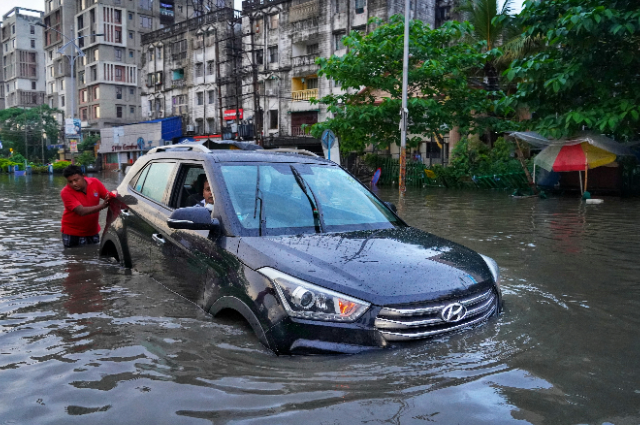
In Chennai, water has told two very different stories.
In May 2019, Akhilandeshwari Venkatramani, a resident of Triplicane, told The Indian Express that a public tanker came to her neighbourhood once every two days and supplied just four buckets per family. Four buckets: a quantity that turns an ordinary day into a series of decisions. How much for cooking? How much for washing? What can wait until tomorrow?
Four years later, in December 2023, Bhuvana, a 65-year-old resident of Narayanapuram, was dealing with the opposite problem. After the rains associated with Cyclone Michaung, floodwater had entered her home. She described sitting on the stairs because she could not go inside. Her belongings were damaged; food kept in the kitchen had been affected. The problem was no longer finding enough water. It was finding somewhere dry to live.
The women lived in different neighbourhoods, and their experiences were separated by years. Yet together their accounts reveal a question that refuses to leave Chennai alone: how can a city face such frightening shortages of water and, at another time, be overwhelmed by it?
The easy response is to blame the weather. The more difficult response is to ask what happens to rain after it touches the ground—and who is left to deal with the answer.
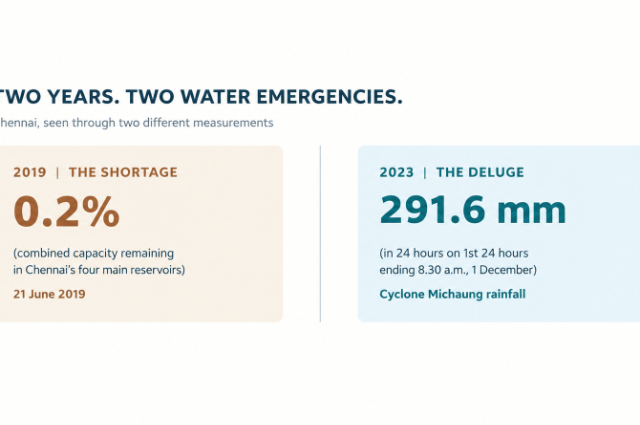
Original graphic based on NASA Earth Observatory (2019) and IMD (2023) data. Different units; not a direct scale comparison.
The year when four buckets mattered
By June 2019, images of Chennai's shrinking reservoirs were being viewed far beyond Tamil Nadu. A NASA Earth Observatory report noted that the city's four main reservoirs had fallen to about 0.2 per cent of capacity on 21 June. Puzhal Lake, ordinarily an enormous store of rain-fed water, looked startlingly diminished in satellite imagery.
But a satellite can only show part of a drought. It cannot show the time a family loses while waiting for a tanker. It cannot show the embarrassment of arriving late to work because water came late, or the argument over whether to use the last clean vessel for drinking or cooking.
The 2019 reporting carried details that deserve to be remembered. In Triplicane, Akhilandeshwari described depending on tanker deliveries. In other neighbourhoods, residents spoke about borewells that no longer yielded enough water and private tankers that took days to arrive. A shortage at the scale of a city was experienced at the scale of a kitchen.
It is tempting to call such a moment a natural disaster and move on. Rainfall did matter enormously. Chennai depends heavily on the northeast monsoon, and the weak 2018 season left the city exposed. Yet a shortage this severe also invites other questions. How much rain had been stored when it did fall? How much groundwater had been taken out? How much could seep back into the earth beneath a changing city?
A city cannot order the monsoon to arrive on time. It can, however, decide whether water is treated as something to protect between one rainy season and the next.
The year when the rain would not leave
In December 2023, the familiar anxiety about an empty tap was replaced by another: water that had nowhere to go. Cyclone Michaung brought exceptionally heavy rain to Chennai and surrounding areas. The India Meteorological Department recorded 291.6 millimetres at Perungudi in the 24 hours ending on the morning of 4 December. This was an extraordinary amount of rain, and it would have tested even a well-maintained city.
Roads disappeared beneath brown water. Electricity and mobile connectivity failed in affected neighbourhoods. Some residents were unable to leave their homes, while others were trying desperately to return to stranded relatives. The Indian Express reported that more than 100 houses around S Kolathur Road in Narayanapuram had been affected. It was there that Bhuvana and her daughter, Alli, spoke about the damage and the struggle to obtain essentials.
One detail from Bhuvana's account stays with me: the stairs. We usually think of stairs as a way of moving from one floor to another. For her, they had become a place to sit when the rest of home was unreachable. The distance between safety and danger had shrunk to a few steps.
Flood statistics describe water in millimetres, hectares and relief operations. People experience it through smaller losses: medicine that must stay dry, a phone that cannot be charged, a bed that cannot be slept in, the uncertainty of whether an elderly parent is safe. The financial costs can continue after the water recedes. A damaged refrigerator is not merely an appliance if replacing it means giving up months of savings.
And while images of flooded streets may briefly unite a city's attention, the ability to recover is not evenly shared. A family with savings can repair a home faster than a family choosing between repairs and rent. A salaried worker and a daily-wage worker do not lose the same thing when roads remain impassable. The rain falls widely; its consequences do not.
The missing space between too little and too much
At first, drought and flooding seem like opposite problems. One means not enough water; the other means far too much. But they are also connected by the same systems: lakes, rivers, wetlands, drains, soil, groundwater and the buildings placed around them.
Think of a city as more than a collection of roads and houses. Beneath the visible streets lies another geography. Rain once moved through open land into ponds and lakes, across marshy areas, and towards canals, rivers and the sea. Some of it soaked into the ground. Some was held temporarily in water bodies. Some flowed away. These processes were never perfect, and extreme rain could cause floods long before modern development. But the landscape had room for water to move.
As cities expand, that room can narrow. Soil is covered with hard surfaces. Natural channels can be interrupted, narrowed or blocked. Lakes and wetlands can be polluted or encroached upon. Even where drains exist, they may be unable to cope with intense rainfall or may be poorly connected to the wider water system. Water that cannot soak in or escape begins to collect where people live.
The Pallikaranai Marsh is a reminder that a wetland is not empty land waiting for a better use. Tamil Nadu's State Wetlands Authority describes it as one of Chennai's last remaining natural wetlands. Its drainage area covers about 250 square kilometres of south Chennai and includes a network of 65 wetlands. That is not just an ecological fact. It is a description of infrastructure made by nature, functioning long before concrete pipes and stormwater plans.
A marsh does not make a city flood-proof. No wetland could simply swallow every extreme storm. But protecting connected water bodies and their outlets gives rainfall places to spread, slow down and drain. Their value is easy to overlook because they do not resemble the infrastructure we are accustomed to applauding. A flyover announces itself. A functioning wetland often asks for no attention at all.
In 2023, researchers writing in The Indian Journal of Social Work identified encroachment on water bodies, unchecked urbanisation, heavy extraction and governance challenges among the factors behind Chennai's recurring water difficulties. Their findings are a useful correction to the idea that every disaster is an isolated surprise. The failures accumulate quietly before they become visible in a headline.
Who gets to have a normal day?
There is another connection between 2019 and 2023 that maps do not capture: both crises took control of people's time.
When there is too little water, the day revolves around its arrival. Someone must listen for the tanker, stand in line, carry the vessels, calculate what remains. That person is often expected to complete all their usual responsibilities as well. A city's lost hours rarely appear in the water bill.
When there is too much water, the day revolves around getting through it. Can a child reach school? Can a patient reach a clinic? Can a shop open? Can an employee get to work without risking a flooded road? For some families, the answers remain uncertain long after the rain has stopped.
We speak of resilience as though it is an unlimited personal quality, something people ought to demonstrate every time disaster arrives. Chennai has certainly shown extraordinary solidarity during difficult times. Neighbours, volunteers, rescue workers and local groups have helped people when systems were under strain. That deserves respect.
But gratitude for resilience should not become an excuse to demand it endlessly. People should not have to become experts at survival in order to live in a major city. The real measure of progress is not how bravely families recover from preventable losses. It is how often they are spared those losses in the first place.
A solution is more than a new drain.
None of this means Chennai can solve its water problem with one attractive proposal. A new drain can help one locality and still fail if its outlet is obstructed. A rainwater harvesting pipe may look satisfactory in an inspection while doing little to recharge groundwater. A reservoir can store water, but it cannot substitute for protecting every feeder channel that sustains it.
A 2023 study of rainwater-harvesting structures in Chennai found substantial differences in how effectively installations worked. In the surveyed systems, only about one-third were rated in very good condition, with others needing improvement. The finding points to an uncomfortable truth: requiring a system to exist is not the same as ensuring that it functions.
Real improvement begins with connected thinking. Wetlands and lakes need protection not as isolated patches of green on a map but as parts of drainage and water-storage networks. Stormwater drains need regular maintenance, clear outlets and designs informed by increasingly intense rainfall. Groundwater extraction needs monitoring alongside measures that allow recharge. Rainwater harvesting needs follow-up, not just installation certificates. Wastewater reuse and desalination can support supply, but each has costs and limitations and must be managed carefully.
Just as important, people who live in flood-prone and water-scarce neighbourhoods need a voice in planning. They know which street floods first, which drain has remained blocked, which public tap regularly fails and which route becomes dangerous after dark. Their experience is information. Ignoring it because it does not arrive in a technical report is a costly mistake.
And when something goes wrong, the public deserves answers that last longer than a news cycle: What was identified? What was repaired? Who checked that it worked? What remains unfinished before the next monsoon?
What the city is really asking
It would be reassuring to end this story with the promise that Chennai has learned every lesson. Cities do not change so neatly. They grow under pressure. They face genuine trade-offs over land, housing, jobs and infrastructure. Extreme weather adds uncertainty, and good planning cannot remove every risk.
Still, the events of 2019 and 2023 make one lesson hard to ignore: water cannot be managed only when it becomes an emergency. Scarcity and flooding have to be considered together, because the ability to store, absorb, move, clean and share water is part of the same public responsibility.
I keep returning to those two accounts: four buckets in Triplicane, and a staircase in Narayanapuram. Neither detail captures the whole city. That is precisely why they matter. They bring the argument down from reservoirs and rainfall charts to the size of an ordinary life.
A bucket should be an everyday object, not a measure of how much dignity a family can afford. A staircase should lead someone home, not become the only dry place left inside it.
Chennai does not have to choose between preparing for drought and preparing for floods. The harder task is to build a city that understands both—and remembers that water, whether absent or overflowing, is never merely a number.
The question is not whether it will rain again. It will. The question is what kind of city will be waiting when it does.
Research references
- Shivani Ramakrishnan, “In parched Chennai, residents left at mercy of water tankers,” The Indian Express, 27 May 2019. Source link
- NASA Earth Observatory, “Water Shortages in India,” 28 June 2019. Source link
- Janardhan Koushik, “No food, electricity and internet connectivity: Chennai battles aftereffects of Cyclone Michaung,” The Indian Express, 5–6 December 2023. Source link
- India Meteorological Department, Regional Meteorological Centre Chennai, Northeast Monsoon 2023 report, rainfall maps, p. 32. Source link
- Tamil Nadu State Wetlands Authority, “Pallikaranai Marsh” (site information). Source link
- Sivapragasam P. and Kavitha Balaraman, “Water Woes in Chennai City: A Preliminary Study,” The Indian Journal of Social Work, vol. 84, no. 4, 2023. Source link
- “Assessing the effectiveness of rainwater harvesting structures in an urban environment,” Desalination and Water Treatment, vol. 316, December 2023. Source link
- Image source credit: Original chart produced for this article from the NASA Earth Observatory and IMD records cited above. No third-party photograph is included.