
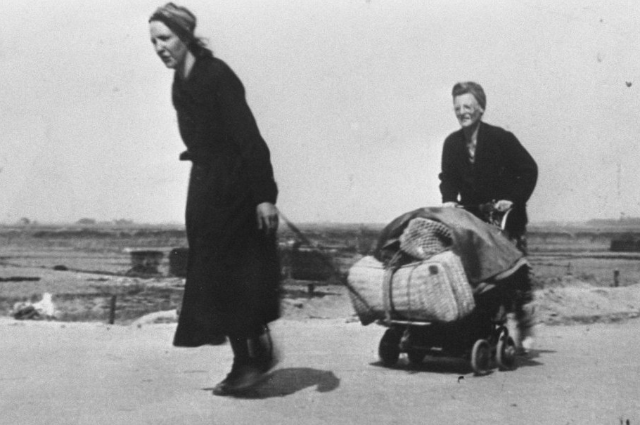
In the autumn of 1944, people in the western Netherlands thought liberation was close. Allied forces had already freed the south, and residents of cities such as Amsterdam, Rotterdam and The Hague hoped the war would soon be over. Instead, they faced the harshest winter of the German occupation.
The months that followed brought terrible suffering. Years later, however, this tragedy also gave scientists a rare chance to study how a mother's lack of food during pregnancy might affect her child much later in life. By following people who had been in the womb during the famine, researchers found that the effects of hunger could last far beyond childhood.
A Winter Without Food
In September 1944, the Dutch government-in-exile urged railway workers to strike in support of the Allied advance. The workers did so, and German occupying authorities responded by blocking food supplies from reaching the heavily populated western provinces. Canals froze, fuel became scarce, and city food stocks rapidly ran down. The famine is generally dated from October or November 1944 until the Netherlands was liberated in early May 1945.
Official food rations dropped to dangerously low levels, sometimes providing only a few hundred calories a day. People waited in long soup lines, burned furniture to keep warm and travelled for hours on foot or by bicycle to exchange belongings for potatoes and sugar beets. These journeys became known as hongertochten, or “hunger trips.” Even tulip bulbs, usually associated with Dutch prosperity, were cooked and eaten. Around 20,000 people are estimated to have died from causes related to the famine.
Then, in May 1945, the situation changed quickly. Food supplies returned, and rations increased after months of severe shortage. This clear period of hunger, followed by a relatively sudden return to better food access, later helped researchers examine the effects of famine.
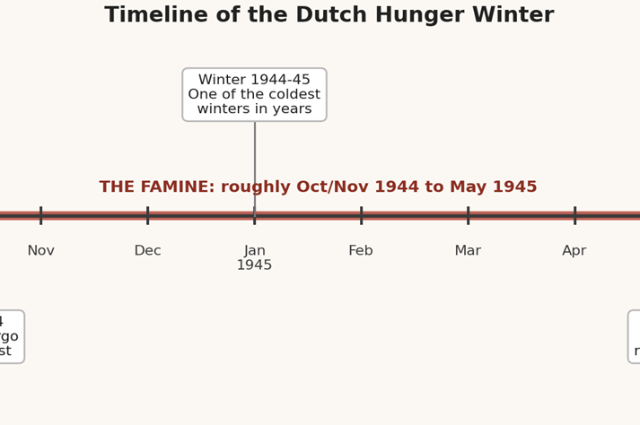
Timeline of the Dutch Hunger Winter. Illustration created by the author using published historical accounts.
A Natural Experiment, Written in Hospital Records
Studying the effects of poor nutrition during pregnancy is difficult. Researchers cannot deliberately deprive pregnant women of food, and in many real-life situations, hunger occurs alongside poverty, illness and stress. The Dutch Hunger Winter offered an unusual opportunity: people who had generally been better nourished before the famine experienced severe food shortages for a defined period, followed by a return to more plentiful food.
Detailed medical records made this period especially useful for research. Despite the war, Dutch hospitals continued recording information about newborn babies, including their weight, length and general condition. These records helped researchers work out which stage of pregnancy had overlapped with the famine. Years later, researchers in Amsterdam used the records to establish the Dutch Famine Birth Cohort Study, following people born around the famine period into adulthood and middle age.
The central question was straightforward: could hunger experienced before birth affect someone's health many decades later?
What the Children Carried
Some of the earliest findings appeared in the 1970s. Researchers studying young Dutch men who were called up for military service found that those whose mothers had experienced famine early in pregnancy were more likely to be obese at age nineteen. Interestingly, men exposed during the final months of pregnancy were less likely to be obese. In other words, the timing of the shortage seemed to matter.
As the participants grew older, researchers identified other possible long-term effects. People exposed to famine before birth showed poorer glucose tolerance in middle age, which can be an early warning sign of type 2 diabetes. Studies also reported links with heart disease and less favourable cholesterol levels, particularly among people exposed early in pregnancy. Other research suggested possible effects on kidney and airway health. A study by Ezra Susser and Shang Lin also found an association between exposure early in pregnancy and a higher risk of schizophrenia.
These findings support the idea that pregnancy includes important developmental windows. A baby's organs and body systems develop in stages, and the body begins setting up how it will use and store energy. A shortage of food during one stage may affect development differently from a shortage at another stage.
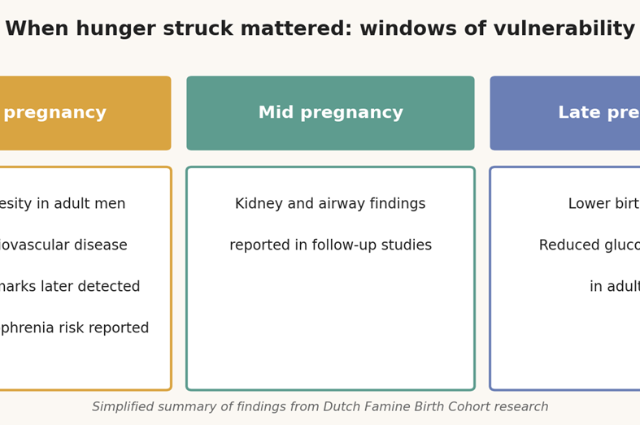
A simplified overview of findings from the Dutch Famine Birth Cohort research. Illustration created by the author.
The Thrifty Body
The Dutch findings also connected with an idea proposed by British epidemiologist David Barker in the late 1980s. Known as the fetal origins hypothesis, it suggests that conditions in the womb can influence the risk of disease in adulthood. A related idea, called the thrifty phenotype hypothesis, proposes that a developing baby may adapt to a shortage of food by using energy very carefully.
Such an adjustment might help if food remains scarce after birth. But if food becomes plentiful, the same adaptation may contribute to weight gain and problems with metabolism. That was a possibility in the Netherlands, where food supplies improved sharply after May 1945. The Dutch study did not prove the theory by itself, but it provided important evidence that conditions before birth could be linked to health much later. It also raised another question: how could an experience from before birth still be reflected in the body decades afterwards?
A Memory Written on the Genes
One possible explanation involves epigenetics. In simple terms, epigenetics refers to chemical markers that help regulate whether certain genes are more or less active. These markers do not change the DNA sequence itself. They influence how the instructions in our DNA are used.
In 2008, a research team led by Bastiaan Heijmans compared people who had been conceived during the famine with their same-sex siblings who had not been exposed in the same way. The team studied IGF2, a gene involved in growth. About sixty years after the famine, the exposed group showed slightly lower levels of DNA methylation at a regulatory region of that gene. The difference was small, and the researchers described it cautiously. Even so, the study offered evidence that an environmental experience very early in life could be associated with a biological difference that remained measurable decades later.
Later studies asked whether these effects might also be seen in the next generation by examining the children of people who had been exposed to famine before birth. The evidence is much less certain here, and researchers have not reached a clear agreement about whether, or how much, these effects are passed on.
Beyond the Netherlands
The Dutch experience is not the only example. Studies of the Chinese famine of 1959–1961 reported that people born during the worst period had a higher risk of schizophrenia, echoing one of the findings from the Netherlands. Research involving other famine-affected populations has also suggested links between hunger early in life and later metabolic or cardiovascular problems. However, famines differ in their length and severity, and people experience very different conditions after they end, so the findings cannot always be compared directly.
These questions are relevant to India, too. Undernutrition among pregnant women and children remains a public health concern, while changes in diet and lifestyle have contributed to rising rates of diabetes. The Dutch research raises an important possibility: a person who experiences poor nutrition before birth and then grows up in an environment where food is readily available may face health challenges later on.
What the Research Does Not Say
The findings should not be taken to mean that everyone exposed to famine will become ill. Many people who experienced the Dutch Hunger Winter went on to live long and healthy lives. Adult health is shaped by many factors, including diet, physical activity, smoking and income. These studies are observational, which means they identify associations but cannot prove that famine directly caused every outcome. The people who survived and took part in later research may also have differed in ways that affected the results.
Epigenetic findings need particular care when being interpreted. Finding a chemical marker in blood does not automatically explain why a person develops a disease. More research is needed to understand exactly what such changes mean for health.
Still, the research makes one point clear: health may begin to take shape earlier than we often think. A mother's nutrition and wellbeing during pregnancy may influence not only a baby's early development but also aspects of health many years later.
A Lesson Written in Hunger
For those who lived through the Hunger Winter, it was a time of fear, cold and loss. Many babies whose mothers endured those months grew up, built families and led ordinary lives. Yet researchers later found clues that the conditions surrounding their earliest development may have left lasting traces. Studying their lives helped scientists understand that the environment before birth can matter long after childhood.
The lesson is difficult, but it also offers hope. If a lack of food during pregnancy can have consequences that last for years, then better support early in life may make a difference too. Providing pregnant women with nutritious food, reliable healthcare and safe living conditions is not just help for today. It may also be an investment in the long-term health of future generations.
References:
- Barker, D. J. P. (1990). The fetal and infant origins of adult disease. BMJ, 301, 1111.
- Heijmans, B. T., et al. (2008). Persistent epigenetic differences associated with prenatal exposure to famine in humans. Proceedings of the National Academy of Sciences, 105(44), 17046–17049.
- Ravelli, G.-P., Stein, Z. A., & Susser, M. W. (1976). Obesity in young men after famine exposure in utero and early infancy. New England Journal of Medicine, 295, 349–353.
- Roseboom, T., de Rooij, S., & Painter, R. (2006). The Dutch famine and its long-term consequences for adult health. Early Human Development, 82(8), 485–491.
- St Clair, D., et al. (2005). Rates of adult schizophrenia following prenatal exposure to the Chinese famine of 1959–1961. JAMA, 294(5), 557–562.
- Susser, E. S., & Lin, S. P. (1992). Schizophrenia after prenatal exposure to the Dutch Hunger Winter of 1944–1945. Archives of General Psychiatry, 49(12), 983–988.