
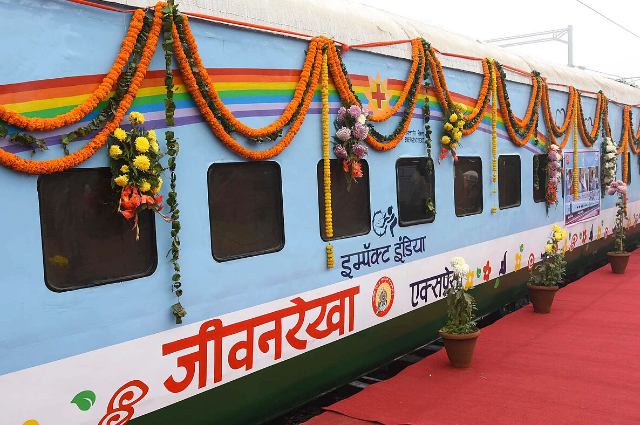
On a December morning in 2016, a 52-year-old tea vendor named Hiralal Lodhi arrived at a railway station in Satna, Madhya Pradesh. He was not there to catch a train. He had come seeking treatment for an advanced oral cancer that had changed his face and threatened his life.
For months, he had visited doctors, but the cost of surgery remained beyond his means. He owned some land, but it did not provide him with a regular livelihood. As his condition worsened, he had almost lost hope.
Then a neighbour told him about a hospital that had arrived by train.
Hiralal consulted specialists aboard the Lifeline Express on 22 December 2016. Just two days later, doctors operated on him inside a railway coach, removing the tumour. The surgery became the first cancer operation performed aboard the Lifeline Express.
His experience was remarkable not because a train had performed an impossible medical miracle, but because a specialised medical service had reached someone who might otherwise have struggled to access it.
In a country where distance, poverty and limited healthcare facilities can delay treatment, the Lifeline Express represents an unusual but powerful idea: when patients cannot easily reach a hospital, a hospital can travel towards them.
The dream behind a moving hospital
The story of the Lifeline Express began long before Hiralal's operation.
On 16 July 1991, the Impact India Foundation launched the Lifeline Express in partnership with Indian Railways. It was recognised as the world's first modern hospital train.
The idea addressed a persistent problem in rural India. Many communities lacked access to specialised medical facilities. People with treatable conditions sometimes lived for years with preventable disabilities because the nearest appropriate hospital was too far away or treatment was unaffordable.
For a person living in a remote village, reaching a specialist could involve travelling long distances, arranging accommodation and losing several days of income. Even when treatment existed, the practical barriers could make it inaccessible.
The Lifeline Express offered a different approach. Instead of expecting every patient to travel to a distant city, the hospital would use India's extensive railway network to reach underserved locations.
The original train began with three coaches. Over time, it developed into a larger medical facility. In 2007, a new five-coach train was introduced, equipped with two modern operating theatres. In December 2016, two additional coaches were added to expand cancer detection and family health services.
The railway network became more than a means of transportation. It became the route through which healthcare could reach people who needed it.
What happens inside a hospital train?
From the outside, the Lifeline Express looks like a specially designed railway train. Inside, however, its coaches serve different medical purposes.
The facility includes operating theatres, diagnostic services and spaces for consultations and treatment. Its services have expanded over the years to address several conditions that can cause avoidable disability or serious health complications.
These include cataract and other eye-related problems, hearing difficulties, orthopaedic conditions, congenital deformities such as cleft lip, and certain plastic and reconstructive surgery needs.
The train has also expanded beyond restorative procedures. Its services include dental treatment, epilepsy-related care, screening for oral, breast and cervical cancer, and support for conditions such as diabetes and hypertension.
This range of services is important because disability and illness do not always arise from conditions that require complicated treatment. Sometimes a relatively straightforward intervention, provided at the right time, can make a significant difference to someone's life.
A person who receives appropriate treatment for cataracts may regain useful vision. A child with a correctable congenital condition may gain opportunities that would otherwise be limited. Someone with a hearing impairment may benefit from assessment, treatment or a hearing aid.
The train does not simply provide a place for surgery. It brings together different forms of medical assistance in one location.
A hospital cannot work alone
One of the most interesting aspects of the Lifeline Express is that its work depends on cooperation beyond the railway coaches.
The train is operated by Impact India Foundation in partnership with Indian Railways. But the medical services also depend on doctors, surgeons, specialists, technicians and other healthcare professionals who contribute their expertise.
A 2018 answer in the Lok Sabha stated that doctors and medical staff were not provided by the government to work permanently on the train. Instead, medical professionals provide services voluntarily on a rotational basis.
This arrangement makes the project a collaborative effort. The railway system provides the means to reach different locations, the foundation coordinates the programme, and medical professionals contribute their specialised skills.
Local communities also play an important role. Before a project begins, outreach activities help identify people who may need treatment. Patients are informed about the services, examined and assessed so that those requiring further care can be directed appropriately.
This preparation matters. A hospital train cannot simply arrive at a station and expect people to know what treatment is available. Awareness, screening and coordination are essential if the services are to reach the people who need them most.
The Lifeline Express is therefore not only a medical facility on wheels. It is also an example of what can be achieved when institutions, professionals and communities work together.
Hiralal Lodhi: when distance and cost are not the only barriers
Hiralal Lodhi's story gives a human face to the purpose of the project.
According to a December 2016 report by "The Indian Express", he was a tea vendor whose advanced oral cancer had caused a large tumour in his mouth. His jaws and cheeks had become visibly swollen. He had spent months visiting doctors but could not arrange the money required for surgery.
The opportunity to consult specialists aboard the Lifeline Express changed his situation.
After being examined, he underwent surgery inside the train's medical facility. The operation was significant not only because of the complexity of the condition, but also because it demonstrated that the hospital train could provide more than basic check-ups or preliminary screening.
Hiralal's case was particularly important in the history of the project: it was the first cancer surgery performed aboard the Lifeline Express.
His experience also reveals a wider problem in healthcare. A treatment may exist, a doctor may be available, and a hospital may have the necessary equipment, yet a patient can remain untreated because the cost of reaching that treatment is too high.
Healthcare access is not determined by medical knowledge alone. It is also shaped by income, geography, transport and the ability to navigate the healthcare system.
For Hiralal, the hospital's arrival at a railway station brought specialised treatment closer to home.
Measuring the journey
The Lifeline Express has continued to operate through projects across different parts of India.
According to the Impact India Foundation's website, its cumulative figures currently include more than 1.5 million patients served, 234 camps and 214 unique districts covered. The organisation also reports substantial numbers of eye procedures, hearing-related surgeries, congenital anomaly corrections and other medical interventions.
These are figures reported by the organisation itself, but they help illustrate the scale of the initiative.
The project's history also shows how its services have evolved. In 2014, Impact India Foundation marked the milestone of one million people medically served across India. Two years later, the additional coaches expanded its capacity to include cancer and family health services.
Its influence has extended beyond India as well. The model has inspired similar hospital trains and mobile medical initiatives in other countries, including projects in China and Central Africa, as well as floating hospital services in Bangladesh and Cambodia.
The idea was simple, but its application demonstrated that existing infrastructure could be used in an innovative way to address healthcare gaps.
The limits of a hospital on wheels
Despite its achievements, the Lifeline Express should not be mistaken for a complete solution to India's rural healthcare challenges.
A mobile hospital can provide specialised services during its stay at a particular location, but it cannot remain there permanently. Once the train moves to another destination, patients may still need medicines, rehabilitation, additional investigations or long-term medical supervision.
Some conditions require repeated visits and continuous treatment. Cancer care, for example, may involve further investigations, specialist consultations and treatment over an extended period. A single operation or screening camp cannot replace the entire process.
There is also the question of follow-up care. Patients who live far from major hospitals may find it difficult to return for appointments or manage complications. The availability of local healthcare facilities therefore remains essential.
The Lifeline Express itself has recognised the importance of this issue. Impact India Foundation's history records the establishment of health homes in Deoria, Uttar Pradesh, and Memari, West Bengal, in 1995 to serve as follow-up centres for patients operated on by the train.
This is an important reminder that healthcare does not end when a procedure is completed.
Mobile medical projects are most effective when they are connected to permanent healthcare facilities, referral systems and local health workers. They can reduce immediate barriers, but they cannot replace the need for well-equipped rural hospitals, accessible primary healthcare and affordable long-term treatment.
The success of such initiatives should therefore be measured not only by the number of patients treated during a camp, but also by whether patients can continue receiving the care they need afterwards.
A different way of thinking about access
The Lifeline Express offers a lesson that reaches beyond medicine.
Many public services are designed around the assumption that people can travel to the place where assistance is available. But this assumption does not reflect everyone's circumstances.
A person living in a remote village may not have reliable transport. A family with limited income may be unable to afford repeated journeys. An elderly patient or someone with a disability may find travelling particularly difficult.
Bringing services closer to communities challenges this traditional arrangement.
The hospital train does not eliminate every obstacle, but it changes the starting point. It uses an existing public transport network to bring medical expertise to places where specialised care may be limited.
Its story also shows that innovation does not always require inventing an entirely new technology. Sometimes it means recognising the potential of infrastructure that already exists and using it to solve a problem differently.
A railway coach, usually associated with carrying passengers from one destination to another, can also become a space where people receive treatment that may change the course of their lives.
When the hospital comes to the patient
Hiralal Lodhi went to a railway station in search of medical treatment, not a journey. For him, the Lifeline Express represented an opportunity to receive surgery that had previously seemed financially out of reach.
His story is one among many associated with a project that has travelled across India for more than three decades.
The train's importance lies not in the idea that it can replace every hospital, but in the fact that it challenges the distance between medical services and the people who need them.
Its achievements deserve recognition, but so do the limitations that remind us why permanent healthcare infrastructure remains essential.
A country cannot depend on a moving hospital alone to meet the needs of its rural population. It needs accessible local clinics, trained professionals, affordable medicines, reliable referral systems and continuing care.
Yet the Lifeline Express demonstrates what becomes possible when institutions are willing to rethink how essential services are delivered.
Sometimes, progress does not begin with asking people to travel farther, wait longer or overcome one more obstacle.
Sometimes, progress begins when the service itself moves.
And sometimes, a train arriving at a quiet railway station carries something far more important than passengers: it carries the possibility of treatment, recovery and renewed hope.
References:
- Impact India Foundation. “Lifeline Express.” Official programme information and organisation-reported cumulative figures. https://www.impactindia.org/lifeline_express
- Impact India Foundation. “Milestones.” Historical timeline of the Lifeline Express, including its 1991 launch, expansion of coaches and medical services. https://www.impactindia.org/milestones
- The Indian Express. Tabassum Barnagarwala, “First cancer surgery on Lifeline Express,” 27 December 2016. https://indianexpress.com
- Impact. “Taking the hospital to the people.” Account of the Lifeline Express and Hiralal Lodhi's treatment. https://impact.org.uk/taking-the-hospital-to-the-people/
- Press Information Bureau, Government of India, Ministry of Railways. Indian Railways in partnership with Impact India Foundation to augment two additional coaches for cancer and family health services to the Lifeline Express,” 5 December 2016. https://www.pib.gov.in
- Lok Sabha, Government of India. Unstarred Question No. 6536, “Lifeline Express Train,” Ministry of Health and Family Welfare, 6 April 2018. https://sansad.in