
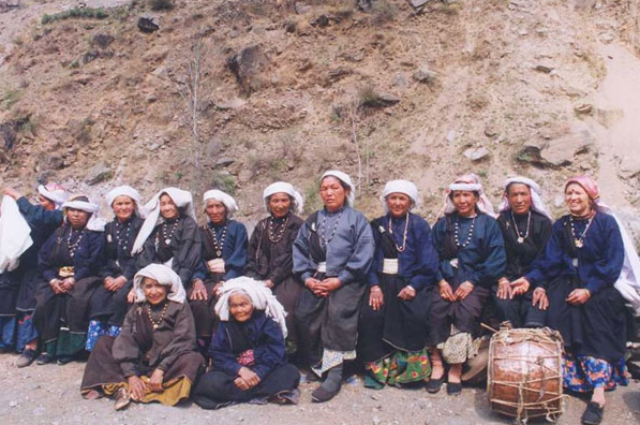
A College Built to Tame a River
Every evening the Upper Ganga Canal slides past Roorkee almost without a sound. I have often stood on its banks, watching water that was Himalayan snow a few weeks earlier move obediently through a channel cut nearly two centuries ago. The institute where I study exists because of that channel. In 1847, the colonial government opened a college here to train the engineers who would build the Ganges Canal; it later became Thomason College, then the University of Roorkee, and finally IIT Roorkee. We were, quite literally, founded to make Himalayan water do what it is told.
I had never felt uneasy about this. Engineering, to a student, is a kind of quiet confidence: give me the load, the slope and the discharge, and I will give you a structure that holds. That confidence cracked the first time I watched a phone video recorded in Chamoli district on 7 February 2021. In it, a grey-brown mass of water, ice and boulders comes roaring down a narrow gorge. Somewhere off camera, men on the hillside are screaming at people below to climb. Within seconds, a dam is simply gone.
I went looking for the name of the village beside the first dam to be destroyed, and realised the story had not begun in 2021 at all. It had begun forty-seven years earlier, with twenty-seven women and a forest.
The Morning the Men Were Away
In the early 1970s, the forests above the Alaknanda valley were being auctioned to timber contractors. The hill villages depended on those forests for fodder, firewood and something harder to price: roots holding soil to steep slopes. Their resistance acquired a name, Chipko, from the Hindi word for “to cling”. Its most famous moment came at Reni, a small tribal village above the Rishiganga River, where around 2,500 trees had been marked for felling.
The contractors chose their day with care. In the last week of March 1974, the men of Reni, and the activists organising them, were drawn away to the district headquarters at Chamoli with the promise of long-pending compensation. While they waited there, labourers arrived below the village. A young girl saw them first and ran to tell Gaura Devi, a widow in her late forties who led the village women’s council, the Mahila Mangal Dal.
Gaura Devi gathered twenty-seven women and walked up to meet the men. She tried reasoning first. The officials accompanying the loggers, reportedly drunk, answered with abuse and brandished a gun. As the valley tells it, Gaura Devi stepped forward and told them to shoot her before they touched a single tree, because that forest was her maika, the mother’s home a married woman returns to for comfort. The women wrapped their arms around the trunks and refused to let go. They kept watch through the night. Within a few days the contractors gave up and left, and every tree was still standing.
What moves me most is not the hugging. It is what Gaura Devi did afterwards. When the activist Chandi Prasad Bhatt came to document what had happened, she asked him not to report the officials who had threatened her; they were only following orders, she said, and a complaint might cost them their jobs. A man had just pointed a gun at her, and her first thought was for his livelihood.
The world noticed Reni. In 1980 the Union government imposed a fifteen-year ban on felling green trees in the Himalayan forests of what was then Uttar Pradesh, and in 1987 the Chipko movement received the Right Livelihood Award. Generations of Indian schoolchildren, mine included, met the story in their textbooks as a tidy lesson with a happy ending.
Happy endings, however, belong to textbooks. Villages have to keep living after the chapter closes.
The Applause Fades
Gaura Devi never became a celebrity. She could not read, and according to one account, the people who wrote forest policy never thought to ask her opinion. She died in Reni in 1991, largely forgotten outside her valley.
Meanwhile,e the village emptied, slowly. When Down To Earth revisited Reni in 2013, its reporter found a village of women, children and old men. Bali Devi, one of the women who kept the memory of Chipko alive, said bitterly that they had chased the contractors away but never really won, since the government itself behaved like a contractor, and that the trees now grew mostly on paper. The same report mentioned, almost in passing, a detail that chills me today: a hydroelectric dam was coming up right beside the village, and almost nobody was protesting.
That project was the Rishiganga hydropower plant, a small 13 MW scheme on the river below the village, which most official records now spell “Raini”. By 2019, villagers were complaining of rock being blasted, stone being crushed in the riverbed and muck being dumped straight into the Rishiganga, and they took their complaint to the Uttarakhand High Court. A joint inspection found no proof of explosives, though it did find debris piled around the barrage and the powerhouse.
They were not the only ones worried. After the Kedarnath floods of 2013, which killed thousands of people, the Supreme Court had asked an expert body led by Dr Ravi Chopra to examine whether hydropower projects had worsened the disaster. Its April 2014 report found that they had played a significant role and recommended dropping 23 of the 24 projects under review. Chopra later recalled that his committee had judged the high valleys of Uttarakhand, above roughly 2,000 metres, unsuitable for such projects; NTPC’s 520 MW Tapovan-Vishnugad project, a few kilometres downstream of Raini, sat in exactly that paraglacial zone.
By the winter of 2020, then, every warning was on record: the villagers’ petition, the expert report, the memory of Kedarnath. The only party that had not yet spoken was the mountain.
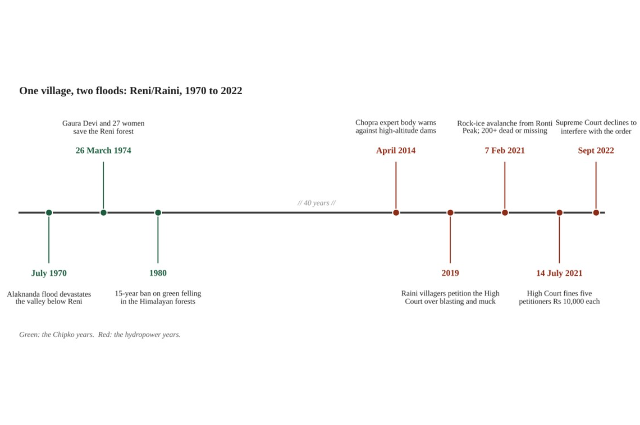
Figure 1. One village, two eras: key events at Reni/Raini from the Alaknanda flood of 1970 to the Supreme Court order of 2022. Using data from Priya (2019), Guha (1989), SANDRP (2014), Shugar et al. (2021), High Court of Uttarakhand (2021) and PSU Watch (2022).
Sunday, 7 February 2021
A little after ten on a clear Sunday morning, an enormous wedge of rock and glacier ice broke away from the north face of Ronti Peak, high above the Rishiganga valley. A study by more than fifty scientists, published in Science, estimated its volume at about 27 million cubic metres. That is enough material to cover a full-size football pitch to a height of more than three kilometres. It quickly turned into an extraordinarily mobile debris flow that carried boulders more than twenty metres across and scoured the valley walls up to 220 metres above the river.
The Rishiganga plant below Raini vanished. The flood tore away the bridge linking the border villages to the state, then raced on into the Dhauliganga and struck the Tapovan-Vishnugad site, where men were at work inside the project’s tunnels.
Here the story offers a moment of grace. In one tunnel, twelve workers heard someone shout at them to get out, and then water and silt came rushing in. With nowhere to run, they hauled themselves up to the curved roof of the tunnel and clung there in the dark for hours, not knowing whether anyone outside was alive. That evening, Indo-Tibetan Border Police personnel rappelled down a steep slope with ropes, pulleys and carabiners, and pulled the men out one by one through the narrow mouth of the tunnel. One worker, plastered with mud from head to toe, leapt into the air the moment he reached daylight, and the phrase that travelled across the country afterwards was simple: “Nayi zindagi mili”, we have been given a new life.
I watched that clip more times than I would like to admit. I needed it. For one evening, at least, the mountain had lost.
The second tunnel was a different story. About thirty-five people were believed to be trapped inside a longer tunnel with a sharp ninety-degree turn, packed with debris. Slowly, the hopeful headlines turned into body counts. At least 204 people were eventually counted dead or missing, most of them workers at the two power projects.
Then came the detail that made me stop reading and sit very still. Of all the villages battered that day, Raini suffered most. Reni. The same village. The forest that twenty-seven women had refused to surrender in 1974 stood above a river that had just swallowed a power plant, a bridge and dozens of lives.
One more fact belongs here, between the grief and the anger. When the flood came, the people of Raini ran uphill, into the forest, and stayed there for three days. The trees Gaura Devi had saved sheltered the generations that came after her. I doubt any novelist would have dared to write that. Reality did.
Anatomy of a Disaster
It is tempting to call Chamoli a natural disaster and close the file. No dam made Ronti Peak collapse, and honest analysis must say so. The Science study, however, makes a sharper point: the catastrophe happened where a natural chain of hazards met infrastructure that had been built in its path. A mountain falling into an empty valley is a geological event. A mountain falling onto two hydropower projects and the people working inside them is a disaster. The difference is human, and it breaks down into four failures.
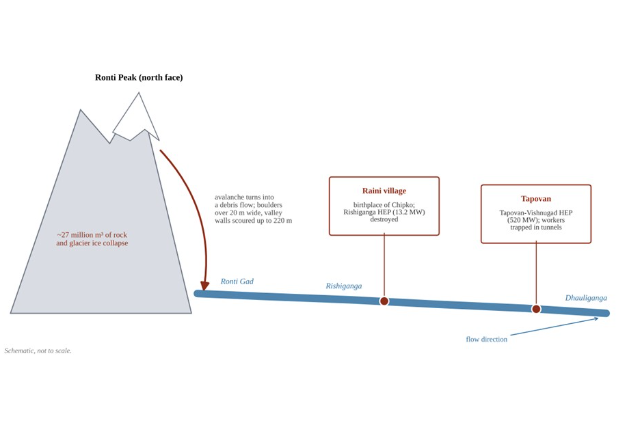
Figure 2. The hazard cascade of 7 February 2021, from Ronti Peak through Raini to Tapovan (schematic, not to scale).
The first was a failure of siting. The Chopra committee had flagged the paraglacial belt, the unstable ground just below retreating glaciers, as unsuitable, and Tapovan-Vishnugad stood inside it. The warning existed; it was simply outweighed.
The second was a failure of warning. Between the collapse on Ronti Peak and the flood’s arrival downstream, there were minutes, not seconds. No sensor, siren or telephone chain converted those minutes into an evacuation. The workers in the tunnel had nothing but a shout from the hillside.
The third was a failure of listening. Raini’s people had complained, petitioned and been inspected. Their complaints concerned blasting rather than glaciers, yet the system treated them as a nuisance to be managed rather than as observers who lived on that slope every day. Gaura Devi, never consulted on forest policy because she could not read, had met the same deafness decades earlier.
The fourth was a failure of revision. Environmental clearances in India are typically granted once, often years before construction begins, and are rarely reopened when the ground itself changes. Projects in the valley went on carrying approvals issued for a world that no longer existed.
None of this is unique to Chamoli. On the night of 3 to 4 October 2023, South Lhonak Lake in Sikkim burst, releasing roughly 50 million cubic metres of water; nearly 130 people were killed or went missing, and the flood destroyed the Teesta III dam at Chungthang. Different valley, same pattern: a known high-altitude hazard, a large structure downstream, and far too little warning.
What Should Change
Grief is not a policy. Here is what I believe should change.
First, a “seconds that save lives” rule for underground work. Every tunnel in a high-hazard valley should carry the protections that mining already treats as standard: refuge chambers stocked with air, water and light; alarms wired to sensors on upstream tributaries; and drills in which every worker knows the route to high ground. The twelve men of Tapovan survived on instinct and luck. The next twelve should not have to.
Second, paid village sentinels. Chipko was guardianship by the people who live on the slope. That model can be modernised by training and paying residents, women of the Mahila Mangal Dal among them, as hazard watchers with satellite phones, river-level gauges and geophones on upstream streams. A watcher who notices an unusual roar or a sudden drop in river flow should be able to trigger sirens downstream within a minute.
Third, a village hazard register with a mandatory reply. Every gram sabha in a project-affected area should maintain a public register of observed changes: new cracks in homes, unusual sediment, falling ice, the effects of blasting. The project developer and the district administration should be bound to answer each entry in writing within sixty days, with the exchange published online. An unanswered entry would block the project’s next approval or disbursement. Local experience thus becomes evidence that cannot be waved away as rumour.
Fourth, a post-disaster review trigger. Any major flood, avalanche or glacial lake outburst in a river basin should automatically reopen every hydropower clearance in that basin for an independent hazard review, with work paused only in the high-risk reach until the review is published. This is precisely what Raini’s petitioners asked for in 2021. It should not depend on villagers having to ask.
Fifth, and closest to my own doorstep, a Himalayan Science Clinic. Law schools run legal aid clinics; institutes like IIT Roorkee could run science clinics, where villagers bring what they have seen and students, guided by faculty, turn it into structured technical evidence: satellite imagery, slope measurements, hydrological models. When Raini’s own case reached the Supreme Court in 2022, the judges called the original petition “completely unstructured”. Structure is exactly what we are trained to provide. A clinic like this would cost little more than the time of a few committed students and a faculty adviser, and it would teach those students something no textbook does: the people on the slope are data.
The Puppets
I had meant to end there. Then I read one more document: a short order of the Uttarakhand High Court, dated 14 July 2021.
In June 2021, a second flood washed away the lower part of Raini, and the village asked to be moved somewhere safe. The gram sabha met and decided, unanimously, to go to court. Five people signed the petition: three residents of Raini and two social workers from Joshimath. They asked for the clearances of both power projects to be revoked, for the companies to be held accountable for the deaths, and for the village to be rehabilitated in a safe place. The villagers pooled their own savings to file the case in Nainital, nearly 300 kilometres from home.
The petition did not survive its first day. The division bench dismissed it, declared itself unconvinced of the petitioners’ bona fides, called the plea highly motivated, and described the five as puppets in the hands of an unknown puppeteer. It ordered each of them to pay Rs 10,000 in costs, to be credited to the High Court Advocates’ Welfare Fund.
Five puppets. I read their names. Sangram Singh, a former panchayat member who had challenged the project in court before. Bhawan Singh, the village head. Atul Sati and Kamal Raturi from Joshimath. Sohan Singh.
Sohan Singh is Gaura Devi’s grandson.
Forty-seven years after his grandmother stood between a gun and a forest, he stood before a court to ask that his village be moved out of the mountain’s path. He was told that someone else was pulling his strings, and he was fined for asking.
There was more. That summer, to rebuild the road the floods had broken, the hillside near the village was cut away. A guest house, a primary school and a statue of Gaura Devi were removed to make room; for a time the statue sat in the tehsil office at Joshimath, before it was reinstalled higher up in the village. The woman who had once saved the hill was moved aside for the road.
In September 2022, the Supreme Court declined to overturn the High Court’s order. It did, however, refuse to endorse the remarks tarring those who had raised environmental concerns before. The sting was softened in a single sentence. The order itself stood.
Who Holds the Strings
The word “puppet” kept echoing until I remembered where I had met it before. In George Orwell’s essay “Shooting an Elephant”, a young police officer in Burma stands before a crowd of two thousand and realises that, for all his apparent power, he is only “an absurd puppet” pushed about by the expectations of those behind him. He kills an elephant that no longer poses any danger, simply because he cannot bear to look like a fool.
I think Orwell understood something the court did not. The puppets in this story are not the five men from Raini. Puppets are those who keep moving because the strings of habit, money and momentum keep pulling them: approvals that are never revisited, expert reports that gather dust in ministries, projects that continue because stopping would look like failure. The person most at risk of becoming a puppet is someone like me: a student at a college founded to tame a river, trained to say yes to the load, the slope and the discharge, and never taught to ask the woman on the hillside what she has seen.
Gaura Devi could not read. She knew, though, that a forest holds a mountain together, and that the people who live on a slope are its first and finest instruments. In February 202,1 her forest held her village one last time. The least the rest of us can do is learn to listen before the mountain speaks again.
References
- Bhatt, T. (2021, July 28). Battle to preserve nature resumes in Uttarakhand’s Raini village 48 years after Chipko. Down To Earth. https://www.downtoearth.org.in
- Deccan Herald. (2021). “We live with a sense of fear,” say villagers from Uttarakhand’s Raini. https://www.deccanherald.com/
- Down To Earth Staff. (2013, March 26). Remembering Chipko. Down To Earth. https://www.downtoearth.org.in
- Encyclopaedia Britannica. (n.d.). Chipko movement. https://www.britannica.com/
- Guha, R. (1989). The Unquiet Woods: Ecological Change and Peasant Resistance in the Himalaya. Oxford University Press.
- High Court of Uttarakhand at Nainital. (2021, July 14). Sangram Singh and others v. Union of India and others, Writ Petition (PIL) No. 113 of 2021 [Order].
- Hindustan Times. (2021, February 17). Activists question govt’s move to push on with 7 hydel plants. Hindustan Times (print edition, via PressReader).
- IIT Roorkee (Indian Institute of Technology Roorkee). (n.d.). History of the Institute. https://www.iitr.ac.in
- Khan, H. (2021, February). “Had lost hope of survival”: Uttarakhand workers rescued by ITBP. The Quint.
- Orwell, G. (1936). Shooting an Elephant. New Writing, 2.
- Priya S, L. (2019, March 26). Why Uttarakhand remembers this unsung woman as a “modern-day Jhansi ki Rani”. The Better India. https://thebetterindia.com
- PSU Watch. (2022, September 27). SC refuses to interfere with HC order on Rishi Ganga and NTPC’s Tapovan-Vishnugad hydro projects. PSU Watch. https://psuwatch.com
- Ranjan, M. (2021, February 11). “Chipko” birthplace Raini battles nature’s fury. The Tribune. https://www.tribuneindia.com
- Sajwan, R. (2024, April 17). Chipko: A distant memory. Down To Earth. https://www.downtoearth.org.in
- SANDRP (South Asia Network on Dams, Rivers and People). (2014, April 29). Report of Expert Committee on Uttarakhand flood disaster and role of HEPs. https://sandrp.in
- SANDRP (South Asia Network on Dams, Rivers and People). (2023, October 4). Glacial lake flood destroys Teesta 3 dam in Sikkim, brings widespread destruction. https://sandrp.in/
- Shugar, D. H., Jacquemart, M., Shean, D., et al. (2021). A massive rock and ice avalanche caused the 2021 disaster at Chamoli, Indian Himalaya. Science, 373(6552), 300-306. https://doi.org/
- The Quint. (2021, February 9). Uttarakhand glacier breach: 35 still stuck in tunnel, says CM Rawat. https://www.thequint.com/
- The Tribune. (2021, February 7). “Nayi zindagi mili”: ITBP rescues workers stuck in flash-flood hit tunnel. https://www.tribuneindia.com/
- University of Potsdam. (2025, January 31). Glacial lakes and climate change: Lessons learned from the catastrophic Sikkim flood [Press release on Sattar, A. et al. (2025), Science]. https://www.uni-potsdam.de/
- Upadhyay, K. (2021, July 28). By dismissing petition on Chamoli floods, Uttarakhand HC ignored environmental concerns. The Wire. https://thewire.in/