
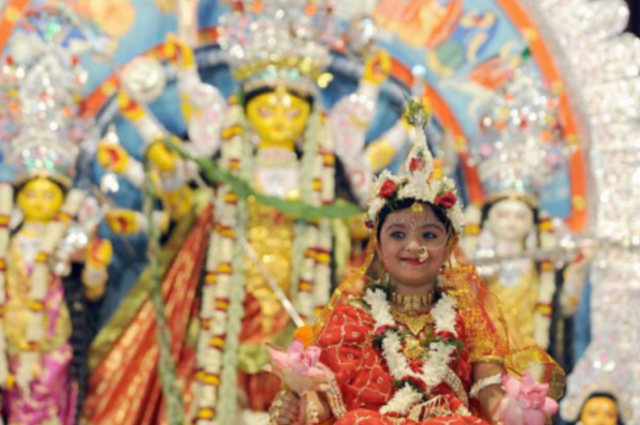
The Girl Who Is Allowed to Become a Goddess
Every autumn, Bengal transforms itself into a landscape of devotion. The streets glow beneath elaborate pandals, the sound of dhak drums travels through neighbourhoods, and the air carries the familiar fragrance of shiuli flowers. Durga Puja arrives with the promise of celebration and the return of the Goddess to her maternal home. For millions of Bengalis, it is an expression of cultural identity as much as religious faith. It celebrates the triumph of good over evil and the power of the feminine to overcome forces that threaten the world.
On Mahashtami, one of the most significant days of the festival, another form of worship takes place. A young girl is seated on a raised platform. Her feet are washed, and her forehead is adorned with sandalwood paste. Flowers are offered before her while devotees bow in reverence. She is no longer regarded simply as a child. For the duration of the ritual, she is worshipped as the living embodiment of the Goddess herself. This is Kumari Puja.
The sight is powerful because it transforms an ordinary child into the centre of collective devotion. A girl who might otherwise have little authority in the decisions that shape her life is suddenly treated as a manifestation of divine power. Her presence is enough to inspire reverence. She does not need to prove her intelligence or demonstrate her strength. She is sacred because the ritual recognises her as the Goddess. Yet there is a question that rarely receives the attention it deserves. Before a girl can be worshipped as a goddess, she must first be considered eligible to occupy that position. Who determines this eligibility? Who decides which child can represent the supreme feminine power and which child cannot?
In the Bengali ritual setting that this essay examines, the answer is deeply connected to caste. The selection of a Brahmin girl as the Kumari reflects a religious convention that gives hereditary social status a role in determining who may embody the divine. A Dalit girl may possess the same childhood innocence. A Kayastha girl may belong to a socially established Bengali community. An Adivasi girl may grow up surrounded by traditions that recognise the sacred in the natural world. Yet none of these qualities necessarily grants them the same recognition within the caste-restricted practice under discussion.
This is where Kumari Puja becomes more than a religious ritual. It becomes a lens through which the relationship between caste and sacredness can be examined. The Goddess is celebrated as a power that transcends ordinary human limitations. Yet the child chosen to embody her may be selected according to a social hierarchy inherited at birth. The divine ideal promises something universal while the ritual practice can reproduce distinctions that are anything but universal.
This essay argues that the caste-based restriction of Kumari Puja exposes a contradiction within the social practice of Bengali Hinduism. When a Brahmin girl is elevated as the living Goddess while girls from other castes are excluded from the same recognition, the ritual raises difficult questions about the relationship between spiritual equality and hereditary privilege. The issue is not whether the child deserves reverence. It is why the right to receive that reverence is not extended equally.
The unchosen goddess is the girl who remains outside this circle of recognition. Her exclusion does not make her less worthy of divinity. Instead, it reveals the social boundaries through which human beings decide whose divinity they are prepared to acknowledge.
The Theology of Shakti and the Limits of Its Social Promise
To understand the contradiction, it is necessary to examine the religious significance of Kumari Puja. Within Shakta traditions, the Goddess is understood as Shakti, the fundamental power through which the universe comes into existence and continues to function. She is not merely a passive figure who accompanies a male deity. She is an independent source of cosmic energy and authority. The Devi Mahatmya, contained within the Markandeya Purana, presents the Goddess as a force capable of defeating powerful demons and restoring order to a universe threatened by arrogance and destruction. The story of Durga's victory over Mahishasura has become one of the most enduring representations of this power. Durga does not require a male figure to fight her battle. She emerges as the force through which the cosmic order is restored.
Kumari Puja brings this understanding of Shakti into the human world. The Goddess is not represented exclusively through stone idols or elaborate images. She is recognised in a living girl who becomes the focus of worship. The ritual therefore creates a striking relationship between the sacred and the ordinary.
The child sitting before the devotees is simultaneously a human being and a manifestation of divine power within the ritual's religious framework. However, the theological significance of this practice becomes more complicated when the selection of the child is governed by caste.
The Devi Bhagavata Purana contains prescriptions concerning the selection of girls for Kumari worship that distinguish between caste groups and prescribe different eligibility according to the worshipper's social category. This historical context matters because it challenges the assumption that caste and religious devotion have always operated independently of one another. Religious traditions are diverse, and their texts contain different prescriptions. Nevertheless, some ritual frameworks have explicitly accommodated hereditary hierarchy even while presenting the worship of the feminine as sacred.
If caste determines which girl can occupy the ritual platform, then the question of divine embodiment becomes inseparable from the question of inherited status. The child is not selected only because she is young or because she symbolises feminine power. Her social identity can also determine whether she is considered suitable for worship. This creates a profound moral difficulty. If Shakti represents a power that sustains all existence, then why should its representation in human form depend upon caste? If the Goddess can defeat demons and restore cosmic order, then why should the ritual through which she is honoured reproduce a hierarchy that assigns different forms of recognition to children according to birth?
The point is not to claim that every Hindu tradition imposes the same restriction. Kumari Puja varies across regions and communities. Some traditions permit girls from different castes to be worshipped, and particular observances have deliberately challenged caste and religious boundaries. The argument here concerns the caste-restricted practice found in the Bengali settings under examination and the assumptions that allow it to be defended as religious tradition.
A Ritual That Reveals the Hierarchy It Inherits
The caste dimension of Kumari Puja is not merely a theoretical concern. It has also appeared in public accounts of how the ritual is practised in Bengal.
In October 2019, a family in Arjunpur in North 24 Parganas district made an unusual decision during Durga Puja. The family of Tamal Dutta chose to worship a four-year-old Muslim girl named Fatima as the Kumari on Mahashtami. The family had been organising its household Durga Puja since 2013. According to reporting by The New Indian Express and the Press Trust of India, the family deliberately departed from the convention that it understood to reserve the role for Brahmin girls. Dutta explained that the family had previously worshipped only Brahmin girls and had decided to challenge that practice by recognising the Goddess in a Muslim child. Fatima's story is significant not because it proves that every Bengali household follows the same caste restriction but because it demonstrates that the restriction was sufficiently established in this family's understanding of the ritual for the decision to be presented as a departure from tradition.
This means a four-year-old child was not being considered for an ordinary ceremonial role. She was being recognised as the living embodiment of a deity. Yet, her eligibility became a subject of discussion because of her religious identity and the inherited rules surrounding the ritual. The family ultimately chose inclusion. But the need to make that choice reveals the existence of a boundary that could be challenged in the first place.
The incident also invites a more uncomfortable question about caste. If a family could deliberately move beyond the conventional restriction and worship a Muslim girl, then why should a girl born into a Dalit family be considered inherently less suitable for the same honour? If the Goddess is understood as the mother of all, then the social identity of the child should not determine whether she can represent her. Fatima's case is an example of an individual family challenging a convention. It is not evidence that caste-based restrictions have disappeared from Kumari Puja across Bengal. Indeed, the significance of such departures lies precisely in their ability to expose the assumptions that ordinary practice can leave unquestioned.
The wider history of Kumari worship also shows that the tradition has never been entirely uniform. Academic research on Kumari Puja describes differing ritual practices across India and Nepal. Some traditions recognise girls from different caste backgrounds while others have incorporated caste-based distinctions.
This diversity does not weaken the argument about caste, but makes it more precise. The existence of inclusive practices demonstrates that the exclusion of girls from particular caste groups is not an unavoidable requirement of every form of Kumari worship. Where caste restrictions operate, they must be understood in their specific religious and social contexts rather than presented as an unquestionable feature of the entire tradition.
For a Dalit girl, the question is particularly unsettling. She belongs to the same broad religious world in which the Goddess is worshipped. She may grow up hearing the stories of Maa Durga's victory and watching the celebrations that make the Goddess central to Bengali cultural life. Yet, her caste may prevent her from receiving the same ritual recognition afforded to a Brahmin child in the practice being examined.
Her exclusion is not a consequence of lacking the qualities associated with childhood innocence. It is a consequence of the social meaning attached to her birth. The ceremony therefore reveals something beyond individual prejudice. It raises questions about how inherited status becomes embedded in practices that are often accepted as ordinary and sacred. A hierarchy does not cease to be a hierarchy merely because it is reproduced within a religious ceremony. Nor does a practice become immune to ethical scrutiny because it has been followed for generations.
The Unchosen Goddess: Why the Exclusion of Dalit Girls Matters
The exclusion of Dalit girls from the role of Kumari must be understood within the wider history of caste in India. Caste is not simply a description of community identity. It has historically influenced access to religious spaces, education, land, occupations, and public resources. Its consequences have extended into the intimate details of everyday life by determining who is treated as respectable and whose presence is regarded as undesirable.
The Constitution of India rejects this hierarchy as a basis for unequal citizenship. Article 14 guarantees equality before the law and equal protection of the laws. Article 15 prohibits discrimination on specified grounds including caste and sex. Article 17 abolishes untouchability and forbids its practice in any form. These provisions are important because they establish a distinction between inherited social status and legitimate entitlement. A person's caste cannot lawfully determine whether she deserves equal protection. Yet constitutional equality does not automatically eliminate social practices through which caste distinctions continue to be reproduced.
Kumari Puja is not equivalent to the denial of access to public services, and a restriction on ritual participation should not automatically be treated as a violation of a particular constitutional provision. Its significance here is social and ethical. The ritual provides an opportunity to examine how ideas of purity and inherited status can shape recognition even in a setting devoted to the feminine divine. The problem becomes especially clear when we consider the meaning of purity within the ritual. The young girl is valued partly because she represents a state of childhood innocence and prepubescent femininity. Yet if caste determines which girl can represent that innocence, then purity is no longer simply a spiritual quality attributed to childhood. It is also being filtered through a social classification.
A Brahmin girl is recognised as suitable for the role because she belongs to a particular caste. A Dalit girl who is equally young and equally innocent may be denied that recognition because she does not belong to it. The distinction does not arise from any difference in their capacity to embody childhood. It arises from the social rules through which their identities are interpreted.
The question is not whether every Brahmin family consciously intends to discriminate against Dalit girls. Individual intentions cannot explain the entire persistence of caste hierarchy. People may follow a custom because it is familiar or because they believe it is religiously prescribed. But a practice can reproduce social exclusion even when those participating in it do not understand themselves as acting with hostility. This is why the distinction between individual prejudice and structural discrimination matters. The former may involve an explicit belief that one caste is superior to another. The latter can operate through established rules and conventions that systematically grant different forms of recognition to different groups.
There is also a particular irony in the position of the Kayastha girl. Kayasthas have historically occupied an influential position within Bengali society and have often been associated with education and administrative service. Yet in the caste-restricted practice described here, even this social position does not necessarily confer eligibility for the role of Kumari. This illustrates that social privilege operates through specific hierarchies rather than through a single division between those who possess privilege and those who do not.
However, the exclusion of a Kayastha girl and the exclusion of a Dalit girl should not be treated as equivalent experiences. Dalit communities have historically faced forms of untouchability and caste-based degradation that cannot be reduced to exclusion from a particular ritual. The point is that the selection rule can reveal a hierarchy in which even a child's eligibility is determined by birth, while the consequences of caste extend far beyond the ceremony itself.
The unchosen goddess is therefore not simply a girl who misses an honour. She represents the contradiction between a universal religious ideal and a social order that distributes recognition unequally.
Beyond the Ritual: Caste and the Lives of Marginalised Girls
The implications of caste discrimination extend far beyond the ceremonial platform. For Dalit and Adivasi girls across India, the interaction of caste and gender can influence their access to education and healthcare as well as their exposure to violence and economic insecurity. These experiences vary considerably across communities and regions. They cannot all be explained by Kumari Puja or by religious practice. Nevertheless, they reveal why the question of whose dignity is recognised cannot be confined to a single ritual.
Official figures illustrate the wider context of caste-based vulnerability. The National Crime Records Bureau's Crime in India 2022 report recorded 57,582 registered cases of crimes against Scheduled Castes compared with 50,900 in 2021. It also recorded 10,064 cases of crimes against Scheduled Tribes compared with 8,802 in the previous year. These figures represented increases of 13.1 per cent and 14.3 per cent respectively. They cover registered crimes against members of these communities as a whole rather than crimes exclusively against girls. They therefore cannot establish the prevalence of violence against Dalit or Adivasi girls specifically. They do, however, demonstrate the continuing scale of reported crimes affecting communities that have historically faced social exclusion.
One of the most disturbing features of caste-based inequality is that discrimination can become normalised. It may appear in the way a child is treated by classmates or in assumptions about the work she is expected to perform. It may influence whether a girl's education receives the same priority as that of her brother. It may determine how seriously her complaints are taken when she experiences harassment or violence.
These forms of exclusion are not identical. Nor should every difficulty experienced by a Dalit girl be attributed automatically to caste. Poverty and geographical isolation can affect children from different communities. The significance of an intersectional analysis is that it recognises how disadvantages can reinforce one another. A girl who faces economic insecurity may have fewer opportunities to challenge discrimination. A girl who experiences caste prejudice may also have to navigate gendered expectations that restrict her mobility and independence. West Bengal itself illustrates the importance of examining inequalities within a state that is often celebrated for its literary traditions and reformist history.
A report on women's status in the state published by the National Commission for Women identified disparities in educational attainment between women and men, as well as differences across Scheduled Caste and Scheduled Tribe communities and between rural and urban areas. Its significance lies in documenting that gender and social-group inequalities have long been recognised as important concerns in West Bengal.
The same distinction between symbolic recognition and material equality applies here. A girl may be celebrated in a religious setting, without having equal access to the resources that enable her to live with dignity. She may be told that the feminine is powerful while being expected to remain silent when she experiences discrimination. She may hear stories about the Goddess defeating oppression while growing up in an environment where challenging inherited social norms carries a personal cost.
It would be wrong to suggest that every girl who experiences these difficulties comes from a Dalit family or that every person who participates in Kumari Puja supports caste discrimination. The argument is not about assigning collective guilt. It is about recognising that the values expressed in public rituals should be examined alongside the social arrangements within which those rituals take place.
The contrast is especially sharp when the ritual itself is considered. The Kumari is treated as worthy of exceptional attention because she has been selected to embody the Goddess. The Dalit girl who is not selected does not receive that same ceremonial recognition. Yet her entitlement to education and safety should never depend on whether a community has chosen to place her on a pedestal.
There is a danger in discussing marginalised girls only through their suffering. Dalit girls are not merely victims of caste hierarchy. They are students and artists, as well as future professionals and community leaders. Their aspirations do not begin with discrimination, and their identities cannot be reduced to the barriers they face. The purpose of examining their exclusion is not to portray them as helpless. It is to ask why inherited social status should determine the recognition and opportunities available to them.
If Kumari Puja is understood as a celebration of the feminine divine, then the lives of girls beyond the ceremony become an important measure of the society that performs it. The question is not whether every girl can receive ritual worship, but whether every girl can live with dignity without needing to receive it.
Beyond the Pedestal
Kumari Puja offers Bengal an opportunity to reflect on a question that extends beyond religion: how does a society reconcile its inherited customs with its changing understanding of equality? The answer cannot lie in dismissing tradition altogether or in defending every aspect of it simply because it has survived across generations. It lies in the willingness to examine what these traditions preserve and whose experiences they leave unrecognised.
Caste has shaped Indian society through institutions and customs that have often made social status a matter of birth rather than individual worth. Its influence on religious practices deserves particular scrutiny because religion carries moral authority and emotional significance for millions of people. When caste determines eligibility for a ritual role, the distinction between religious convention and social hierarchy becomes difficult to ignore.
Questioning that distinction is not necessarily an act of hostility towards faith. It can instead be an attempt to understand whether the values associated with faith are being reflected in its practice. The answer ultimately rests with the choices communities make about the traditions they pass on to future generations. A ritual can remain meaningful while its practitioners reconsider the assumptions through which participation is regulated. Its spiritual significance need not depend on the preservation of every inherited restriction. Indeed, a willingness to question exclusion may allow the ethical promise of the tradition to find a fuller expression.
For the girl who is never considered for the ceremonial seat, however, the issue is not an abstract debate about religious reform. It is a reminder that recognition can be distributed unequally even before a child has had the opportunity to define herself. Her exclusion is determined not by anything she has done but by an identity assigned to her at birth.
Perhaps the measure of a society's cultural maturity lies in its ability to confront such contradictions without retreating into defensiveness. Traditions endure not merely because they are repeated but because successive generations continue to find meaning in them. That meaning becomes richer when inherited practices can be examined honestly and when the dignity of those historically excluded is taken seriously.
The future of Kumari Puja need not be a choice between faith and equality. It can be an opportunity to reconsider why the recognition of the sacred should be governed by the boundaries of caste at all.
References:
- Johansen, Sundari. “Kumārī/Kumārī Pūjā.” Oxford Bibliographies in Hinduism, published 20 July 2026. An overview of the historical development and regional diversity of Kumari worship. Academic overview.
- The New Indian Express. “Bengal family worships four-year-old Muslim girl in Kumari Puja.” 7 October 2019. Reporting on the worship of Fatima by the Dutta family in Arjunpur in North 24 Parganas. Report.
- Press Trust of India / Business Standard. “Bengal family worships Muslim girl as Goddess Durga in Kumari.” 7 October 2019. Further reporting on the same incident and the family's stated decision to depart from convention. Report.
- The Devi Bhagavata Purana, Book III, Chapter 27. A historical religious text containing prescriptions on the selection of girls for Navaratri worship that distinguish between caste groups. Translated chapter.
- National Crime Records Bureau. Crime in India 2022. Official statistics on registered crimes against Scheduled Castes and Scheduled Tribes. Official statistics.
- Constitution of India. Articles 14, 15 and 17 concerning equality before the law, non-discrimination and the abolition of untouchability.