
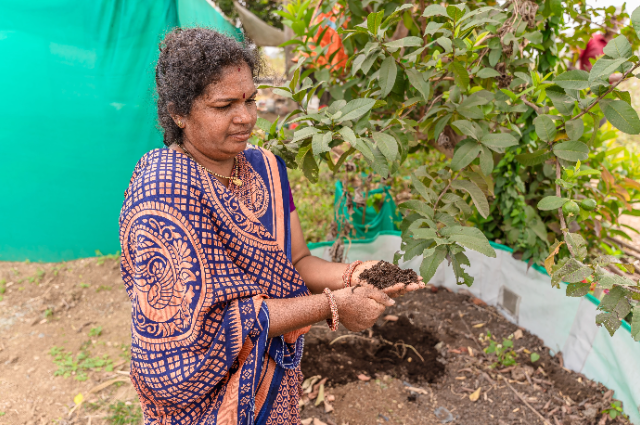
When many think about entrepreneurship, the first thing that springs to mind is a great idea, a big
investment, or a detailed business plan. However, some of the most meaningful businesses begin with the simple question, 'How can I create a living out of my resources?'
In the village of Barjar in the district of Nalbari, Assam, Kanika Talukdar decided that she could create a living out of organic waste. Despite not having much money, she began creating vermicompost (an organic fertiliser created using earthworms). As time went on, this small business evolved into the brand Jay Vermicompost and then ultimately Jayatu Organic Products.
Kanika's journey is not only meaningful due to the small initial investment but also illustrates how you can create business opportunities within rural communities by using training, local resources, institutional support, and hard work. It helps to remind us that whilst a lot of people talk about success in entrepreneurship with big investments and tech-based businesses, innovation can also come from agricultural businesses, sustainability, and determination.
Kanika's journey to becoming an entrepreneur was difficult. She became a widow in 2008, leaving her with the difficult task of supporting and raising her young daughter.
With no real income and little savings, it was difficult to make a living for herself. However, she tried different methods to make money, including weaving and small-scale farming.
Many women in rural areas of India find themselves in a similar situation. If they become the main earner, they may need to balance raising their child, looking after the home, and making money. Due to the lack of access to credit, training, and markets, it can be difficult to create a business.
However, this is not just a story about overcoming personal struggles. It also shows how she discovered an opportunity, learnt a skill, and had support to turn her idea into a business.
The key question for her was how she was going to make money, but also how she could create a living from something she had access to.
An important part of Kanika's journey was in 2014 when she attended training at Krishi Vigyan Kendra (KVK) Nalbari, an agricultural extension organisation linked to Assam Agricultural University.
The training provided her with information on how to create vermicompost. This is done by taking suitable organic materials and using earthworms to turn them into a useful product.
This gave Kanika an opportunity. She could use resources available locally to create her product.
She had an initial investment of approximately ₹500, and with help from KVK Nalbari, she was provided with earthworms to begin her production. The District Agriculture Office also helped her by providing vermicompost beds.
She used affordable resources such as bamboo to create her structures. This example shows how we can learn from our education. We don't always need to attend a class to gain skills. Training can provide us with knowledge we can use in our situations.
However, we also need an opportunity. Kanika had the technical knowledge but also had the initial resources to begin her business. The technical support helped her create her business.
During her first year of production, she made 17 quintals of vermicompost with earnings of approximately ₹16,300. During her second year, her production increased to 66 quintals with earnings of approximately ₹60,000. By 2017, she was selling approximately 150 quintals with earnings of around ₹1.4 lakh.
This shows how her business evolved. Whilst her business began as a smaller business, it is important to remember that this provided her with experience and insight into what her customers wanted. This then helped to build her business for the future.
As she gained more experience, she continued to improve her production facilities. She progressed from using cheap bamboo structures to more permanent vermicompost beds. She also began to work on creating a brandable product. She created the brand Jay Vermicompost.
This is an important step, as even if you can create a useful product, you will need to create a brand. You need to build trust with your customers, promote your products, and find reliable ways to get your products to customers.
Her products began to reach different towns and districts. Recently, it has been reported that her business has grown beyond Assam. She now sells to neighbouring north-eastern states.
The growth of Jayatu Organic Products shows how you can create a business from your local resources. This involves using your knowledge, growing your production, creating a brandable product, and getting your product to market.
One of the most interesting parts of Kanika's story is her product.
Vermicomposting is using earthworms and microorganisms to help break down suitable biodegradable materials. Depending on the materials and method used, this creates a nutrient-rich compost. This helps agricultural productivity and manages organic waste.
Biodegradable materials will be created regularly within households and farming communities. When managed correctly, suitable waste can be turned into a resource. Vermicomposting is one way of doing this.
Kanika's business shows how you can create a living from sustainable practices. She took organic materials available locally and turned them into a product farmers and others would use.
However, it is important to note that vermicompost cannot replace all fertilisers. It depends on the soil, crop, quality of compost, and correct agricultural practices.
This shows how we do not always need to choose between sustainability and income generation. If managed correctly, sustainable resource management can help generate income. This can help communities use their resources effectively.
Often in popular success stories, there is a huge emphasis on personal determination. Kanika was extremely determined to create her business; however, her journey also shows the importance of support.
She gained technical knowledge from Krishi Vigyan Kendra Nalbari and received initial support with her earthworms and production. The District Agriculture Office also helped her establish her production. This helped overcome some of the barriers she may have faced.
This is an important part of Kanika's story. Not everyone will have the same opportunities. Even if two people have similar ideas and are willing to put in the work, they may not have the same opportunities due to their training, funding, infrastructure, and market.
If you don't have much in the way of savings, it can be a big barrier to overcome. However, technical institutions can help overcome this by providing training and connecting you to people with agricultural knowledge.
Government schemes and agricultural developments can also be more effective when you receive support. Entrepreneurs may need help with product quality, packaging, planning, marketing, and finding customers.
This leads to a bigger question for policymakers. How can rural development schemes help people move from gaining a skill to creating a stable living?
Kanika's story shows how training and resources can help. This can then be supported with ongoing guidance and getting products to market.
Kanika's story is also important in relation to women and economic independence.
Many women in rural areas will play a part in agriculture, production, and informal work. However, they may not have the same financial resources or opportunities to create their own business. Creating their own business can provide them with an income using the skills and resources available locally.
However, this does not mean entrepreneurship is an easy solution to overcoming inequalities. Women entrepreneurs may still struggle to gain funding, balancing care, transport, reaching customers, and managing risk.
Not every woman should expect to overcome economic hardship by being an entrepreneur. It is important that they have good employment, education, social security, and public services.
The value of Kanika's story is that it shows how, with the right institutions and individual determination, you can create opportunities.
It also shows that you do not need to be from a major city to be a successful entrepreneur. Rural communities have knowledge, resources, and skills that can help create innovative businesses.
This story can also be a helpful reminder for young people that entrepreneurship can be in many industries. You can create meaningful businesses in agriculture, waste management, food production, handicrafts, and more.
There are many lessons we can learn from Kanika's journey. However, when thinking realistically:
Resources were available. Whilst Kanika had a small initial investment, she was able to use resources available locally. She also received key support from agricultural institutions. This does not mean money isn't important, but it shows how you can start a business with little capital if you have the right business model and support.
Training can provide opportunities. Kanika received training that showed her how to create her product. When the knowledge is linked to a real need, and people have the resources, it can be powerful.
Businesses need to grow. Kanika's production increased over a few years. This shows her business grew in stages.
Environmental concerns can inspire economic solutions. Kanika's work shows how organic materials can be turned into a useful agricultural product. There may be similar opportunities in other communities. However, each idea needs the right technical knowledge and market research.
Individual effort and institutional support. Whilst it is important to celebrate her determination, it is also important to recognise the contribution of agricultural training and public support. This also shows how we can practically help other aspiring entrepreneurs.
Kanika Talukdar's journey began with her facing financial uncertainty and raising a young child. In 2014, she received agricultural training and discovered vermicomposting. With an initial investment of around ₹500 and support from agricultural institutions, she began to create her small business. Over time, her production increased, her products reached a wider market, and her business grew under the names Jay Vermicompost and Jayatu Organic Products.
Whilst this does not guarantee everyone's small businesses will grow like this, Kanika's journey shows the importance of using practical knowledge, resources available locally, institutional support and determination. Entrepreneurship can be risky, and there are many factors to consider when trying to be successful.
Her story shows us that innovation can come from rural knowledge. At a time when success is often linked to big investments and tech-based businesses.
The key part of her journey is that despite her having a small initial investment, she was able to create a business. This shows how organic materials can be used productively and how you can create a living using a practical agricultural skill.
Overall, this shows us that there is potential in many areas of Assam and other rural areas. However, you need to have access to knowledge, resources, opportunities, and markets to turn your idea into something sustainable.
Kanika Talukdar's journey reminds us that waste can be turned into a resource, training can be turned into an opportunity, and a small beginning can lead to a growing business. Most importantly, it shows us why real stories should be told to inspire us but also show us what conditions are needed for people to create meaningful change.
References:
- Krishi Vigyan Kendra, Nalbari, Assam Agricultural University. Kanika Talukdar: Vermicompost Production and Export
Https://kvknalbari.aau.ac.in/kanika.html - Lakhpati Didi, Government of India. Kanika Talukdar - Lakhpati Didi Journey.
Https://lakhpatididi.gov.in/lakhpati-didis/kanika-talukdar/ - The Sentinel, Assam. Vermicompost production: Nalbari's Kanika Talukdar attains self-reliance. (12Th July 2026)
Https://www.sentinelassam.com - Moneycontrol. From Rs 500 to Rs 75 lakh: How a young widow with her 4-month-old daughter built a waste-to-wealth business. (9Th June 2026)
Https://www.moneycontrol.com