

Ask almost anyone what they want from life and the answers arrive quickly: a good salary, a secure career, a home of one’s own, perhaps a little recognition. We spend our twenties and thirties chasing these things, quietly convinced that happiness is waiting at the end of the list. But what if the list is wrong?
In 1938, long before anyone talked about wellness apps or work-life balance, a group of researchers in Boston began a project that would outlast most of its founders. They wanted to understand what makes a human life go well, and they decided the only honest way to find out was to watch real lives unfold, year after year, without knowing how they would turn out. Today it is known as the Harvard Study of Adult Development, and it is widely described as one of the longest studies of adult life ever conducted.
Two Groups, One Question
The study did not begin as a single project. It began as separate studies of very different populations, later brought together. The first group consisted of 268 sophomores at Harvard College, young men the researchers considered among the brightest and most promising of their generation. The second group, 456 teenagers, came from Boston’s poorest neighbourhoods and was chosen precisely because they belonged to some of the city's most troubled and disadvantaged families. In total, 724 young people entered the study.
The men went on to live very different lives. Among them were lawyers, bricklayers and doctors, and one of the Harvard sophomores, John F. Kennedy, would become President of the United States. Others struggled: some developed problems with alcohol, and a few developed schizophrenia. Some climbed from the bottom of the social ladder to the top, while others travelled in the opposite direction. The researchers followed all of them, gathering questionnaires, interviews and medical information at regular intervals, and later widened their lens to include the men’s wives and, eventually, their children.
Over the decades, four directors have led the project. The current one, psychiatrist Robert Waldinger of Harvard Medical School, said when the study reached a wide public audience in the mid-2010s that about sixty of the original participants were still alive and taking part, most of them in their nineties. By then the researchers had also begun studying the more than 2,000 children of the original men.
The Answer Was Not Money
When Waldinger summed up what generations of data had revealed, he did not point to wealth, fame or professional achievement. “Good relationships keep us happier and healthier. Period,” he told an audience in a talk that has since been watched by millions of people. The study’s own findings, he explained, can be gathered into three lessons about relationships.
Connection is good for us, and loneliness is harmful. People who are more connected to family, friends and their community tend to be happier and physically healthier than less connected people. Isolation, on the other hand, turned out to be genuinely toxic over the long run.
Quality matters more than quantity. The number of friends a person has does not decide anything, and neither does whether that person is in a committed relationship. What counts is the quality of close relationships. Living in the midst of constant conflict is bad for health, while warm, trusting bonds are protective.
Good relationships protect the brain as well as the body. People who felt they could truly count on another person in times of need tended to keep sharper memories for longer, a sign that the link between relationships and health is not only physical.
One finding captures the whole idea. The men who were most satisfied with their relationships at the age of 50 turned out to be the healthiest at 80. In other words, how warm and secure a person’s closest bonds were in middle age was a better guide to healthy ageing than many of the physical measurements one might expect to matter more.
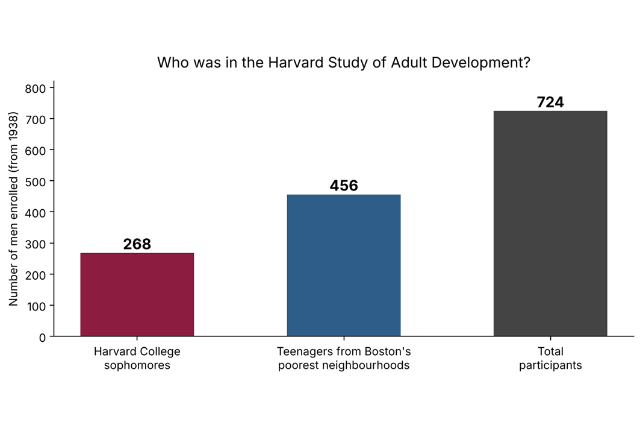
Figure 1. The two groups that made up the original 724 participants. Image source: original chart created by the author from cohort figures reported by the Harvard Study of Adult Development (via Next Avenue and Robert Waldinger).
Other Lessons From Eight Decades
Relationships were not the only thing the study uncovered. Over the years, researchers reported that the single most important thing a person can do to age well physically is to avoid smoking. Alcohol turned out to be the primary cause of divorce among the men in the study, and alcohol abuse often came before depression rather than after it, a reversal of what many people assume. These are less poetic conclusions than the ones about love and friendship, but they come from the same patient observation of real people living real lives.
Reading the Findings Carefully
Good research deserves a careful reading, and this study has limits that are worth stating plainly. The original participants were all white men from one region of the United States, so the findings cannot simply be assumed to apply to women or to people in very different cultures. The researchers are also careful to note that the study does not prove happier relationships cause better health. It is possible that healthier people find it easier to build and keep good relationships, or that a third factor shapes both.
Even so, the pattern is hard to ignore. It appears across two very different groups of men, rich and poor, across decades of change, and it echoes what many other studies on happiness and loneliness have suggested. A result that survives that much variety deserves to be taken seriously, even if it cannot be treated as a final law of human nature.
What This Means for the Rest of Us
The most useful part of the study may be how ordinary its advice sounds. Nothing here requires a new gadget, a new diet or a new job title. It asks us to treat the people in our lives as something worth investing in, in the same way we invest in a degree, a career or a savings account. Waldinger himself suggested leaning into relationships rather than pouring everything into work.
In practical terms, that can be small and unglamorous. It can mean calling a friend instead of sending a quick message. It can mean sharing a meal without phones on the table, or finally making peace with a relative after years of silence. It can mean showing up, consistently, for the people who would show up for us. These are not dramatic gestures, but the study suggests that a life is built out of exactly such moments.
This message feels especially relevant in India today. Many of us grew up surrounded by joint families, crowded festivals and neighbours who walked in without knocking. As careers pull people into distant cities and long working hours, that web of closeness is easy to lose without noticing. The study is a reminder that connection is not a luxury we can postpone until we are successful. It is part of what makes success worth having.
The Good Life, Reconsidered
Eighty-plus years after it began, the Harvard Study of Adult Development has not handed us a formula, and it would be wrong to pretend that it has. What it has given us is something rarer: a long, honest look at how real lives actually turn out. The lawyers, the bricklayers, the doctors and the future president all faced the same quiet question: whether to lean toward other people or away from them.
The data suggests that the men who leaned in, with family, with friends and with community, fared best. If we are wise, we will not wait until we are 80 to confirm it for ourselves. The next time we make a list of what we want from life, it may be worth writing a few names on it, and then spending our time accordingly.
References:
- Waldinger, R. TEDxBeaconStreet talk on the Harvard Study of Adult Development, as reported in the articles below.
- World Economic Forum, “What one of the world’s longest studies tells us about happiness” (2016): weforum.org/stories/2016/01/what-one-of-the-worlds-longest-studies-tells-us-about-happiness
- AARP, “What’s the secret to a happy life? It’s not what you think” (2016): blog.aarp.org/2016/03/25/whats-the-secret-to-a-happy-life-its-not-what-you-think
- Next Avenue, “The One Thing You Need for a Happier, Healthier Life”: nextavenue.org/the-one-thing-you-need-for-a-happier-healthier-life
- Pharmacy Times, “The secret to a healthy, happy life”: pharmacytimes.com/news/the-secret-to-a-healthy-happy-life
- Robert Waldinger, “A Zen Priest at Harvard Finds the Key to Happiness”: robertwaldinger.com/?p=1052