


The Self Is Not Finished
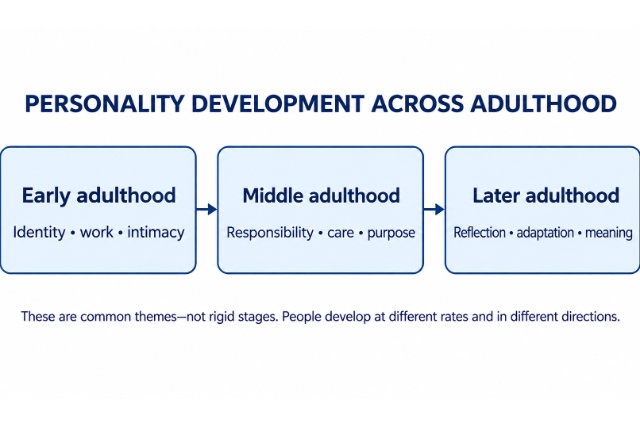
Figure 1. A simplified overview of common adult-life themes. Original illustration created for this article.
Personality is often treated as if it were a permanent description of a person: quiet or outgoing, confident or anxious, organised or spontaneous. Yet adulthood shows that the self is more complex than a fixed label. People carry patterns of feeling, thinking, and behaving across the years, but they also respond to new roles, relationships, challenges, and opportunities. Personality development is the process through which these patterns may become more stable, shift gradually, or change after important experiences.
Research reviews suggest that both continuity and change are normal. McAdams and Olson (2010) describe personality through three connected perspectives: the person as an actor, whose everyday behaviour can be observed; as an agent, who pursues goals; and as an author, who builds a life story and gives experiences meaning. This view helps explain why development involves more than learning manners or improving public speaking. It also includes becoming clearer about values, motives, relationships, and the kind of life one wants to lead.
1. What Does Personality Development Mean?
Personality refers to relatively enduring patterns in how a person thinks, feels, and behaves. Development does not mean replacing one’s whole identity or becoming extroverted, fearless, or successful by a single standard. It can mean learning to manage frustration, becoming more dependable, listening more carefully, or responding to disagreement with greater patience. A person may remain naturally reserved while becoming more confident in meetings; another may remain adventurous while learning to plan responsibly.
It is useful to distinguish personality traits from skills. A trait is a broad tendency, while a skill is something that can be practised directly. Someone who finds social situations tiring may still develop strong communication skills by preparing, listening actively, and speaking clearly. Personality and behaviour are related, but they are not identical—and a person’s usual tendency does not determine every action.
2. The Big Five: A Research-Based Framework
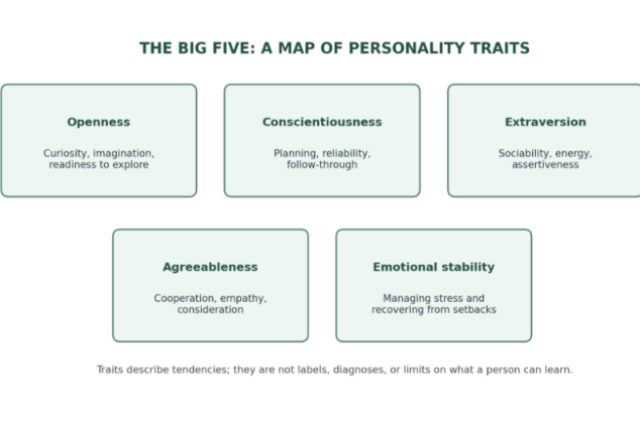
Figure 2. The Big Five framework in brief. Original illustration based on the trait dimensions discussed in personality research.
The Big Five model organises personality into five broad dimensions. Openness concerns curiosity and willingness to consider new ideas. Conscientiousness concerns organisation, responsibility, and follow-through. Extraversion includes sociability and energy in social settings. Agreeableness concerns cooperation and consideration for others. Emotional stability describes the tendency to remain comparatively steady under stress; research often measures the opposite pole, neuroticism.
These dimensions are not grades, and none is automatically good or bad in every situation. High conscientiousness can support reliability, but excessive rigidity may make adaptation difficult. Agreeableness can encourage teamwork, while healthy assertiveness is still needed to set boundaries. Extraversion may help in roles requiring frequent interaction, but quiet reflection can also be valuable. The framework is best used as a vocabulary for understanding patterns—not as a box that limits potential.
3. How Personality Can Change During Adulthood
Early adulthood often brings decisions about education, work, independence, close relationships, and personal values. New environments can reveal strengths and habits that were less visible earlier. A person who has relied on family to organise daily life may learn planning and self-management after moving away for study or work. Someone who avoids difficult conversations may gradually develop confidence through respectful practice.
Middle adulthood may bring greater responsibility for work, family, caregiving, or community life. Such roles can encourage planning, cooperation, and emotional regulation, although pressure can also create stress. Later adulthood can involve retirement, changes in health, bereavement, renewed interests, and reflection on what matters most. These experiences do not produce the same outcome for everyone; support, culture, resources, and personal interpretation influence how people respond.
A coordinated analysis of 16 longitudinal samples involving more than 60,000 people found that personality trajectories vary across studies and individuals. Average trends should therefore be interpreted cautiously rather than as a timetable that every adult follows (Bleidorn et al., 2021). A 2024 review also emphasises that personality development reflects both environmental and genetic contributions, while important questions about causes and individual differences remain open (Bleidorn, 2024).
4. Life Experiences, Relationships, and Social Context
Personality develops through interaction between the individual and the environment. Work can encourage reliability; friendships can teach trust and boundaries; parenting or caregiving can strengthen patience while increasing stress; and education can expose people to ideas that challenge old assumptions. These are possibilities, not guaranteed effects. The same event may lead one person to become more open and another to become more cautious.
Relationships matter because other people provide feedback and create opportunities to practise new responses. Constructive feedback can help a person notice the effect of their behaviour. Supportive relationships can make it easier to attempt difficult tasks, admit mistakes, and repair conflict. However, pressure to please everyone can weaken self-understanding. Healthy development involves considering feedback without allowing every opinion to define one’s identity.
Culture and circumstances also matter. Ideas about independence, family duty, emotional expression, and success differ across communities. A fair account of personality development should not assume that one cultural ideal represents maturity for everyone. Maturity may appear as independent decision-making in one context and as dependable contribution to family or community in another.
5. Useful Theories: Identity, Generativity, and Life Stories
Erik Erikson’s psychosocial theory highlights changing developmental concerns across life. In young adulthood, intimacy versus isolation focuses on forming close, mutual relationships without losing a sense of self. In middle adulthood, generativity versus stagnation concerns contributing to others and to the next generation—through caregiving, mentoring, creative work, or community involvement. In later life, integrity versus despair concerns reflecting on one’s life and finding a way to accept its mixture of achievement, disappointment, and unfinished goals. These are influential theoretical ideas, not strict rules that all people experience at the same age.
Narrative approaches add another dimension: people interpret events by connecting them into a life story. A setback can be understood only as proof of failure, or as evidence that a strategy needs to change. Reflection does not erase hardship, and every difficult event does not automatically make a person stronger. But thoughtful meaning-making can help people learn from experience without pretending that the experience was easy or deserved.
6. Practical Ways to Support Personal Growth
- Practise honest self-reflection. Once a week, write down one situation that went well, one that was difficult, and what each taught you. Focus on behaviour you can change rather than attacking your character.
- Choose specific, observable goals. Instead of ‘become confident,’ try ‘ask one question in a meeting’ or ‘explain my idea clearly to a classmate.’ Specific actions are easier to practise and review.
- Build emotional regulation. Pause before reacting, name the emotion, and identify what the situation requires. When possible, return to a difficult conversation after you have had time to think.
- Invite useful feedback. Ask a trusted person for one concrete example of what you do well and one behaviour that could improve. Look for patterns across feedback rather than accepting every comment as fact.
- Practise empathy and boundaries together. Listen to understand another person’s perspective, while remembering that empathy does not require agreeing with them or accepting disrespect.
- Keep learning and adapting. Try unfamiliar responsibilities, read beyond familiar viewpoints, and treat mistakes as information. Adjust the approach when evidence shows that it is not working.
- Protect the foundations of growth. Sleep, physical activity, supportive relationships, and reasonable routines can help people cope with stress. They do not guarantee personality change, but they can make learning and self-regulation easier.
7. Common Misunderstandings
First, adulthood does not make personality completely fixed. Longitudinal research finds both stability and change, with meaningful differences between individuals (Roberts & Mroczek, 2008; Schwab et al., 2018). Second, development is not a straight upward line: a person can improve in one area while struggling in another. Third, growth is not the same as becoming more popular, constantly productive, or comfortable in every situation. Finally, self-improvement should not become self-rejection. The aim is not to erase temperament or imitate someone else, but to respond more deliberately and live more consistently with one’s values.
Becoming, Not Performing
The evolving self is shaped by both continuity and change. Temperament, biology, culture, relationships, responsibilities, and personal choices interact throughout adulthood. Research does not support a single ideal personality or a universal schedule for maturity. Instead, it points to varied developmental paths: some traits may become more stable, others may shift, and people can differ considerably in the direction and pace of change.
Personality development is therefore less about performing a perfect identity and more about building awareness, responsibility, flexibility, and meaningful relationships. By reflecting honestly, practising specific behaviours, seeking constructive feedback, and adapting to life’s changing demands, adults can keep growing without denying who they already are.
References:
- Bleidorn, W. (2024). Toward a theory of lifespan personality trait development. Annual Review of Developmental Psychology, 6, 455–478. https://doi.org
- Bleidorn, W., et al. (2021). Trajectories of Big Five personality traits: A coordinated analysis of 16 longitudinal samples. European Journal of Personality, 34(3), 301–321. https://doi.org
- McAdams, D. P., & Olson, B. D. (2010). Personality development: Continuity and change over the life course. Annual Review of Psychology, 61, 517–542. https://doi.org
- Roberts, B. W., & Mroczek, D. (2008). Personality trait change in adulthood. Current Directions in Psychological Science, 17(1), 31–35. https://doi.org
- Schwaba, T., et al. (2018). Individual differences in personality change across the adult life span. Journal of Personality. https://doi.org
- Erikson, E. H. (1950). Childhood and Society. W. W. Norton & Company. (Psychosocial development theory.)
- Image Credits and Further Reading: The two figures in this document are original illustrations created for this article. For optional real-world photographs and a developmental-theory visual from Wikimedia Commons, use the linked source pages below. Check each page’s license and retain attribution if you insert or reuse its image: