
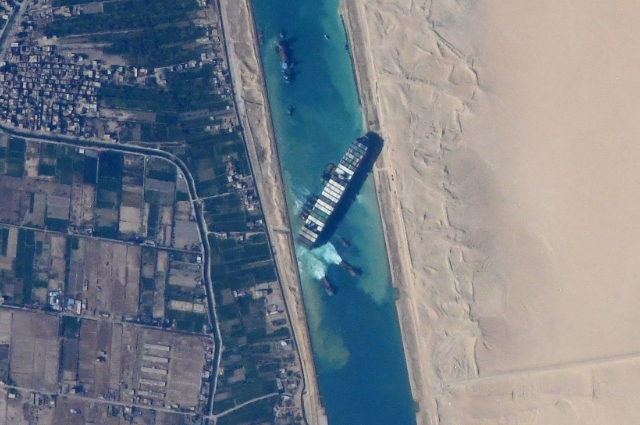
The Ever Given stuck in the Suez Canal, photographed from the ISS on 27 March 2021. Source: Wikimedia Commons

Six days that made distance visible
On 23 March 2021, the container ship Ever Given ran aground in the Suez Canal. The vessel, with capacity for 20,150 containers, blocked one of the world’s busiest maritime shortcuts. It was freed six days later. During that time, ships backed up at both ends; Reuters reported a backlog of more than 400 vessels. Some operators chose not to wait and rerouted around the Cape of Good Hope. UNCTAD noted that such a detour could add as much as 7,000 miles to a voyage.
The episode made a hidden fact visible: a supply chain is not simply a list of suppliers. It is a network of routes, ports, production steps, data systems, standards and payments. A single blocked passage can make a distant factory, retailer or customer feel the delay. The ship was extraordinary in size, but the vulnerability it exposed was ordinary: too much dependence on a route that had no ready substitute.
The warning did not end when the Ever Given moved. In a February 2024 assessment, UNCTAD reported that about 22% of global seaborne container trade had passed through the Suez Canal in 2023. By the first half of February 2024, 586 container vessels had been rerouted amid Red Sea disruptions, and container tonnage crossing the canal had fallen by 82% from earlier levels. These are dated figures, not current measurements; together, they show how quickly a familiar route can become uncertain.
Resilience is not a warehouse full of backups.
A common response to disruption is to choose between two extremes. One is to opt for the cheapest, fastest route and hope it stays open. The other is to duplicate every supplier, factory and stockpile. The first can be brittle; the second can tie up money in capacity that is rarely used. Neither asks the central question: if a critical route fails, how quickly can the business switch to a workable alternative?
That is where strategic optionality comes in. An option is a prepared choice: a qualified second supplier, a product designed to accept an alternative component, a data system that can move to a compliant location, or financing that can support a sudden change. Preparing costs something, but it is not the same as paying to duplicate the entire operation. The goal is not to predict the next crisis. It is to make a small number of critical changes possible before the crisis arrives.
The idea can be pictured as a “switchboard firm.” Management records each option alongside its trigger, owner, days required to switch, exercise cost and the revenue it protects. A warning signal—such as a port closure, a new tariff, a supplier failure or a regulatory change—then points to an already examined route. The final decision still belongs to a responsible person; a dashboard should inform judgment, not replace it.
Four choices that make switching real
First is the source option. A backup supplier should be qualified, technically capable and contractually understood—not just a name in a spreadsheet. A small reserved-capacity agreement or periodic test order can reveal whether the supplier can actually deliver when needed.
Second is the product option. If every component is unique to one vendor, a new source may require redesign and fresh testing. Modular designs, common interfaces and pre-approved alternative bills of material can shorten that process. The point is not to lower standards; it is to make compliance portable across more than one production route.
Third is the data option. Manufacturing and trade depend on digital records, planning software and customer information. Businesses should know which workloads can move, which data must stay within a jurisdiction and who can authorise a compliant transition. Portability is useful only when security and privacy controls travel with the data.
Fourth is the capital option. Switching may require deposits, expedited freight, testing, new tooling or additional working capital. A technically possible alternative can still fail if no one has budgeted for it. Staged investment, a pre-agreed emergency credit line or currency protection can give a business the financial room to act.
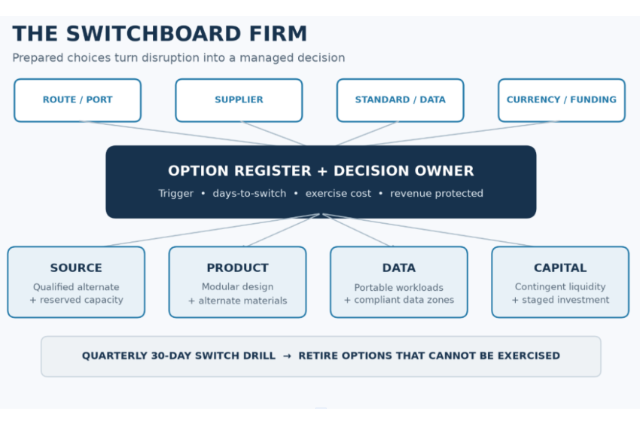
Figure 1. An original illustration of the Switchboard Firm: signals are matched to tested options, accountable owners and a timed exercise. Source: Author’s original illustration.
A 30-day drill is better than a promise.
Options have value only if they work under pressure. A practical test begins with one critical product or revenue stream, not the whole company. The team names a realistic disruption, sets a clear trigger and asks the alternate supplier to fulfil a small order, or asks the production team to assemble a batch using an approved substitute. If the change involves software, the team moves a limited workload. If it involves finance, treasury tests whether the contingency funds can be accessed and settled.
The drill should record actual elapsed days, added costs, quality results, regulatory approvals and communication failures. A failure is useful evidence: it shows that the “option” was only theoretical. After the exercise, the owner fixes the gap or retires the option. Repeating a modest test every quarter is more credible than presenting an impressive resilience plan that has never been tried.
Four measures can keep the effort disciplined: the share of critical revenue covered by tested alternatives; median days-to-switch; the annual cost of maintaining options compared with the value they protect; and the percentage of drills passed. These measures reward readiness without pretending that every part of a business needs a backup.
An opportunity for India—and a responsibility
For India, the lesson is larger than attracting production when another country’s route becomes risky. A lasting advantage would be the ability to help global firms reconfigure responsibly: capable suppliers, reliable ports, accredited testing, interoperable documentation and predictable finance. This is a proposal, not a claim that one programme already exists. A “30-Day Trade Switch Sandbox” could let firms in electronics, pharmaceuticals and clean-energy components rehearse a specific route change with suppliers, laboratories, logistics providers and banks.
Participants could test whether an alternate component meets standards, whether customs documents can be prepared, whether the shipment can move and whether payment can clear. An independent credential could report what was actually tested and the time it took. It should not promise that disruption will never occur. It should state, narrowly and honestly, what the firm has demonstrated.
This distinction matters. “Friend-shoring” depends on political relationships that may change. Verified switchability is an operational capability that can be measured. India can strengthen its role in global trade not by claiming immunity from shocks, but by showing that businesses here can help customers keep essential production moving while meeting safety, labour, environmental and data requirements.
Buy choices, not bunkers.
The Ever Given’s six-day interruption was a real event, but its most useful lesson is not that every company should fear another ship in another canal. It is that efficiency without alternatives can turn a local obstruction into a distant business problem. Research on the Suez and later shipping disruptions reinforces that routes are exposed to more than one kind of shock.
A resilient business does not need to forecast every crisis or build a duplicate world. It needs to know which few dependencies could stop its most important work, prepare credible alternatives, assign decision-makers and practise the switch. The measure of resilience is not the number of suppliers on a slide. It is whether the company can change course—quickly, safely and at a cost it understands—when the familiar route is no longer available.
References:
- UN Trade and Development (UNCTAD). Review of Maritime Transport 2021: Overview. 4 October 2021. https://unctad.org
- Reuters. “The Ever Given’s stranding in the Suez Canal.” 6 July 2021. https://www.reuters.com
- UN Trade and Development (UNCTAD). Navigating Troubled Waters: Impact to Global Trade of Disruption of Shipping Routes in the Red Sea, Black Sea and Panama Canal. 22 February 2024. https://unctad.org
- NASA Johnson Space Centre, ISS Expedition 64, photo ISS064-E-48480, 27 March 2021. Public domain in the United States. Source: https://eol.jsc.nasa.gov
https://commons.wikimedia.org