
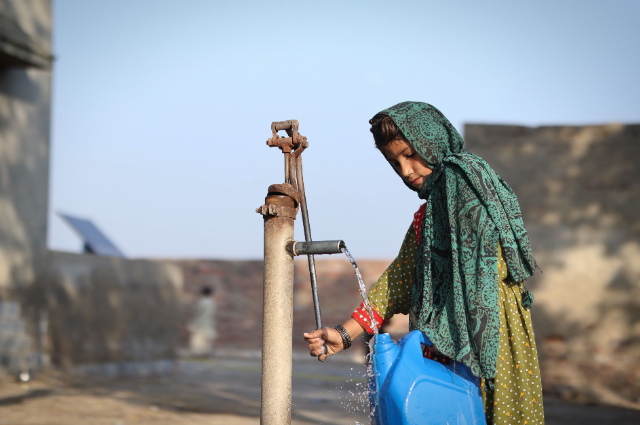
At first glance, fetching water looks like a simple task. Fill a container, carry it home, and get on with the day. But when water is far away, unreliable, or available only at certain hours, that small task can quietly organise an entire life. Breakfast waits. Schoolwork is delayed. Paid work becomes harder to accept. A daughter learns early that some responsibilities arrive before she has had the chance to choose them.
Water scarcity is often discussed through numbers: rainfall, reservoirs, groundwater levels and the number of households with tap connections. These figures matter. Yet behind each number is a person arranging her day around a basic need. In many communities, that person has historically been a woman or a girl. Her labour may not appear in a wage record, but it has a cost: time that could have gone towards education, rest, earning, or simply being with her family.
A story from Maharashtra
A 2024 case study published in the Government of India’s Jal Jeevan Samvad newsletter describes the village of Nagdarwadi in the Loha block of Maharashtra’s Nanded district. According to the report, severe water scarcity had become more than a daily inconvenience. Families from elsewhere were reluctant to marry their daughters into villages where women might have to spend much of their lives walking long distances to fetch water. The shortage had begun to shape private decisions and the future of families. (Jal Jeevan Samvad, September 2024).
The detail is striking because it shows how a missing service can reach far beyond the kitchen. Water scarcity can affect a person’s choices about where to live, how to spend the day, and what kind of future seems possible. The report also describes local efforts to improve household water access through the Jal Jeevan Mission. It is one documented example, not a story that represents every village in India. Still, it reveals a truth that statistics can easily hide: when water is distant, the burden is rarely distributed equally.
Imagine planning a day when the supply is uncertain. You cannot always decide when to cook, wash clothes, study, or leave home, because first you must find out whether water is available. If a tap works only intermittently, a connection on paper may not bring much relief. If the source is far away, the journey takes time and energy. If the water is unsafe, the work continues even after it reaches the house. Access means more than a pipe; it means water that is safe, dependable and available when people need it.
What the numbers tell us
The scale of the challenge in India has been considerable. The Ministry of Jal Shakti reported that when the Jal Jeevan Mission began in August 2019, around 3.23 crore rural households—about 16.71 per cent—had tap-water connections. In an update published on 27 July 2026, the Press Information Bureau reported that, as of 18 July 2026, around 15.89 crore of the country’s 19.36 crore rural households (82.09 per cent) were reported to have tap-water supply at home. These figures show a major expansion in reported coverage, although a connection count alone cannot establish whether every household receives safe water reliably every day. (Press Information Bureau, 27 July 2026).
The Jal Jeevan Mission’s stated service goal is not simply to install pipes. It describes a functional supply of prescribed quality, delivered regularly and over the long term. That distinction matters. A tap that is dry for days is not the same as dependable access. A supply that is available but contaminated cannot meet a family’s needs. Progress should therefore be judged both by coverage and by what people experience at the tap: Is water coming? Is it safe? Is it sufficient? Who is responsible when the system breaks?
Research also helps explain why this is a question of equality. UNICEF India’s study, Domestic Water Security: Gender and Social Inequities, examines water access through the connected lenses of gender and social inequality. When water collection is treated as women’s
natural responsibility, the time it consumes can become invisible. A girl who reaches school tired or misses a class to help at home may be described as having a family problem or an attendance problem. The water burden behind that absence can be overlooked. (UNICEF India).
Time is a form of opportunity.
Time is not an abstract benefit. It is the difference between rushing through homework and having an hour to understand it. It is the chance to attend a training session, take a paid shift, visit a health centre, or sit down without keeping one ear open for the sound of a water tanker. When a reliable supply comes closer to home, the household gains time—but the gain becomes fairer only when families share domestic work, and girls are encouraged to use that time for their own goals.
This is why water projects should involve the people who manage water every day. Women’s participation in village water committees, local planning and water-quality testing can help ensure that a system responds to real needs. The Jal Jeevan Mission has reported training women to use field-test kits to check water samples. Such participation matters not because women should be given yet another unpaid responsibility, but because people affected by a service should have a voice in how it is designed, monitored and repaired.
There is also a responsibility beyond government schemes. Communities can protect local water sources, repair leaks, avoid wasting treated water and discuss how water is shared during shortages. These steps cannot replace public infrastructure, and it would be unfair to tell households to solve a supply problem alone. But maintenance, accountability and community involvement can help make infrastructure last. A working tap is the result of pipes and pumps, but also of planning, testing, funding and someone answering a complaint when the water stops.
A tap is not the end of the story.y
It would be easy to end with a simple claim: give every home a tap and the problem disappears. Real life is more complicated. Water sources can weaken, electricity can fail, pipelines can leak, and quality can change. Climate pressures and growing demand make careful management essential. The progress reported under the Jal Jeevan Mission deserves attention, but the next question is whether the service remains reliable in every season and reaches households that are hardest to serve.
The story of Nagdarwadi reminds us that water scarcity is not only about thirst. It can influence social expectations, family decisions and the amount of freedom a person has over her own day. The national figures show that household connections have expanded dramatically since 2019. Both facts belong in the same conversation: one tells us the scale of change, while the other helps us understand what change is for.
Perhaps the best way to measure water access is to ask what people can do once they no longer have to organise so much of life around finding it. Can a girl leave for school without first completing a long water journey? Can a woman take up work without worrying that the household will run short? Can a family trust that the water from its tap is safe? Can residents report a fault and expect it to be fixed? These are practical questions, not grand slogans, and they deserve honest answers.
A household tap may look ordinary, especially to someone who has always had one. But for a family that has spent years planning around distant or uncertain water, it can return something valuable: time, choice and dignity. The goal is not merely to bring water to a doorstep. It is to make sure that no one’s education, work or future must wait for the next pot to be filled.
References:
- Press Information Bureau, Ministry of Jal Shakti. “Extension of the Jal Jeevan Mission and Transfer of Rural Water Supply Schemes,” 27 July 2026. https://www.pib.gov.in
- Jal Jeevan Mission. “Jal Jeevan Samvad,” September 2024, case study on water scarcity in Loha block, Nanded district, Maharashtra.
- https://jaljeevanmission.gov.in
- UNICEF India. “Study on domestic water security from aspects of gender, social inequities, and water management.” https://www.unicef.org