
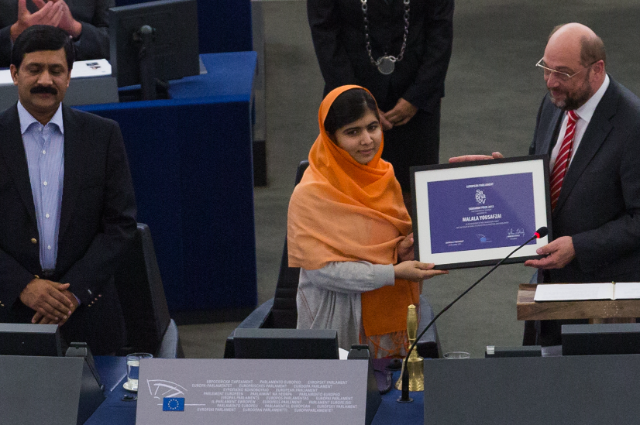
A Voice That Changed the World
Some stories are remembered because of extraordinary achievements. Others remain in our hearts because they remind us of the strength of the human spirit. Malala Yousafzai's story belongs to the second category. Her journey is not simply about winning the Nobel Peace Prize. It is about a young girl who believed that education was a fundamental right and refused to remain silent when that right was denied.
Born on 12 July 1997 in Mingora, Pakistan, Malala grew up in the Swat Valley. From an early age, education played an important role in her life. Her father, Ziauddin Yousafzai, was an educator who ran a school and strongly believed in equal educational opportunities for girls and boys.
For Malala, school was more than a place to read books and write examinations. It represented freedom, confidence, opportunity and the possibility of building a better future.
However, the circumstances around her began to change. The growing influence of the Taliban in the Swat Valley created serious restrictions on everyday life, particularly for girls who wanted to attend school.
What happened next transformed the life of an ordinary schoolgirl into an extraordinary story of courage.
When Education Became a Struggle
In 2009, when Malala was only eleven years old, she began writing anonymously for BBC Urdu under the name Gul Makai. Through her writing, she described the difficulties of living in a place where girls' education was increasingly restricted.
Her words allowed the outside world to understand what many children were experiencing.
Imagine being a student who loves learning but suddenly faces uncertainty about whether you will be allowed to attend school. For many girls in her region, this was not an imaginary situation. It was their everyday reality.
Malala understood that education could change the direction of a person's life. She believed that every girl deserved the opportunity to learn, develop her abilities and make decisions about her future.
Her willingness to speak about this issue attracted public attention. Despite her young age, she continued to express her belief in education.
The Incident That Shocked the World
On 9 October 2012, Malala was attacked while returning home from school. The attack was carried out by a Taliban gunman because of her public advocacy for girls' education.
She was seriously injured and received medical treatment. Her recovery became an international concern, with people across the world expressing support for her.
This incident brought worldwide attention to the issue she had been speaking about for years.
However, the most important part of her story was what followed.
Malala did not abandon her commitment to education. Instead, she continued to speak about the importance of ensuring that every girl could attend school safely.
Her experience demonstrated that a person's age does not determine the value of their ideas or the importance of their voice.
Turning Personal Experience into a Global Mission
In 2013, Malala and her father co-founded the Malala Fund, an organisation dedicated to supporting girls' education.
The organisation works towards a world in which every girl can access quality education and have the opportunity to shape her own future.
On 12 July 2013, on her sixteenth birthday, Malala addressed the United Nations. Her speech highlighted the importance of education and the need to protect the rights of children.
Her message reached people across different countries, cultures and communities.
In December 2014, Malala received the Nobel Peace Prize, becoming the youngest Nobel laureate in history at that time. She shared the prize with Indian children's rights activist Kailash Satyarthi.
This achievement was not simply a personal award. It brought international recognition to the struggle for children's rights and girls' education.
The Power of Education
Malala's story encourages us to think beyond examination results, certificates and academic rankings.
Education is not limited to memorising lessons or obtaining a degree. It develops independent thinking, confidence, communication and the ability to make informed decisions.
For a girl who receives an education, new possibilities become available. She can explore different careers, contribute to her community and participate in decisions that affect her life.
Education also benefits families and society. When people have access to knowledge and opportunities, they are better equipped to address social and economic challenges.
Malala's journey reminds us that education should never be treated as a privilege reserved for a particular group. It should be an opportunity available to every child.
Lessons for Today's Students
Students today have opportunities that previous generations often had to fight to obtain. Schools, colleges, libraries, digital learning platforms and educational resources provide different ways to develop knowledge.
Yet having opportunities is only the beginning. Students must also develop discipline, curiosity and responsibility.
Malala's journey offers several important lessons.
First, age should never be considered a limitation to meaningful ideas. Young people can contribute valuable thoughts to society.
Second, education gives individuals the confidence to understand their rights and responsibilities.
Third, challenges should encourage thoughtful action rather than destroy a person's sense of purpose.
Finally, success should not be measured only by personal recognition. The positive difference a person makes in the lives of others is equally important.
Conclusion: A Story That Continues to Inspire
Malala Yousafzai's journey teaches us that one person's determination can bring attention to an issue affecting millions of people.
She began as a schoolgirl who wanted to continue learning. Through her writing, public speaking and educational advocacy, she became an internationally recognised voice for girls' education.
Her story is not only about courage in difficult circumstances. It is also about responsibility, hope and the importance of using opportunities to create positive change.
There are countless girls around the world who still dream of entering a classroom, opening a textbook and building a future through education. Their dreams deserve attention and support.
The real meaning of Malala's achievement is not simply the Nobel Prize she received. It is the message that every child's future matters.
A classroom can change a life. Education can transform a community. And a determined voice can inspire the world.
A girl who once wanted nothing more than the freedom to learn became a symbol of the belief that every girl deserves that same opportunity.
Her story leaves us with one powerful thought:
The greatest achievement is not simply rising above difficulties, but using our experiences to help others rise too