
This short academic essay examines the living archives of indigenous oceanic epistemologies in Indian ocean coastal communities in general and the western coastal belt in particular. While colonial cartography and scientific oceanography privileged extractive, state-centric visions of the Indian Ocean, the fisherfolk, Seafarers and agrarian communities of the littoral zone such as the Kolis, Gabits, Mogaveeras and other tribes of Konkan developed empirically robust knowledge systems deeply entwined with the ocean, tides, winds, navigation for understanding sea-level variability, currents, biodiversity, and cyclonic risk. These knowledge systems, often dismissed under colonial-modern discourse, represent critical epistemic alternatives in the era of climate crisis. This essay mobilises a postcolonial lens to critique the epistemic violence of colonial ocean science and highlights how Indigenous ecological intelligence—expressed through seasonal calendars and bio-indicators, embodied practices, and customary institutions—can enrich contemporary marine governance and resilience. By presenting unique case studies with factual evidence through on-field research, this essay argues for co-production of marine knowledge, epistemic justice, and recognition of Indigenous sovereignty in ocean science and policy.
The Indian Ocean has historically been framed as a geopolitical arena of trade, empire, and colonial expansion, often reduced to a 'blue frontier' for extraction, commerce, and naval strategy. In pre- colonial era, when Europe was still searching for maritime gateways, coastal communities of the region already possessed elaborate navigational maps and knowledge. The celebrated “discovery” of sea route to India by Vasco da Gama in 1498 is incomplete without acknowledging the role of Gujarati seafarer Ibn Majid (or malemo cana, as colonial sources refer to him) who guided the Portuguese ships across the treacherous waters of the Arabian sea.
Scholars like K.N. Chaudhari and Sanjay Subramanyam have highlighted how the Indian ocean was a “cultural and commercial continuum” long before European arrival. Indigenous ocean epistemologies are not 'premodern folklore' but systematic, empirically tested knowledge practices.
The western coastal belt of India along Arabian sea through state of Maharashtra, goa and Karnataka, often recognized as “Konkan”, is one of the richest repositories of ancient wisdom transmitted across generations. This wisdom is fairly evident from their beliefs, wisdom and practices to the ultimate sophistication even till present postcolonial era
The belief
The cosmology of Konkan based communities’ rests on the conviction that nature is morally responsive. The sea is simultaneously sacred, generous and punitive. The annual fishing season starts from a full moon day of august, locally known as ‘Narali Purnima’, by offering prayers and coconut to the sea. Local songs – ‘Koli Geet’ encode warnings of storms, methods of navigation and reverence for the sea, a cosmology that generates ethics of restraint, unlike modern extractive paradigms.
The rivers, forests, mangroves are not inert resources either; they are deities, ancestors and protectors (locally known as Rakhandar), demanding reverence and restraint. One of the most distinctive ecological institutions of Konkan is the sacred groves, locally called Devrai, protected by stringent taboos, due to which cutting trees, hunting animals or exploiting resources inside them is strictly forbidden. The ecological efficacy of this belief system was dramatically demonstrated during the 2004 Indian Ocean Tsunami. Scientific surveys (UNESCO,2005 and FAO 2007) revealed that coastal villages of Tamil Nadu, Karnataka and Ratnagiri of Maharashtra with intact mangroves and sacred groves acted as bio shields and suffered significantly less devastation compared to degraded ecosystems, proving that indigenous faiths embed sustainable resilience far more deeply than external interventions.
The wisdom.
Traditional communities track constellations and lunar phases for maritime and agricultural Calendars. The sighting of Orion constellation (mriga nakshatra) in pre monsoon sky is taken as sign of impending rains while Pleiades cluster (Krittika) is linked to intensity of monsoon showers (dim suggesting weak and bright suggesting heavy downpour). This astronomical knowledge was embedded into sowing cycles of paddy and millets.
The coastal communities observe the migration, nesting and flight of seabirds as indicators of weather. The arrival of swallows in Konkan skies is believed to herald the southwest monsoon, and egrets flocking inland in large numbers indicate heavy rains, while the sea birds flying unusually low signals “impending storms”. Unusual silence of cicadas and frogs with sudden withdrawal of water from the shore interpreted as a signal of impending storms. Soles (flatfish) and prawns entering river mouths signals onset of monsoon rains. If these runs are delayed, elders predict weaker or late monsoon. Before 1999 cyclone near Devgad, mackerel (bangda) fish that usually swims deeper came near the shoreline in agitation, shoals and sardines rushed towards estuaries. The communities halted sea-fishing, avoiding casualties. The oral histories from southern Konkan (malvan) recall how fisher- villages were spared during past cyclonic surges because elders recognized these bioindicators and ecological early warning systems and led timely evacuation too higher ground.
The Practices.
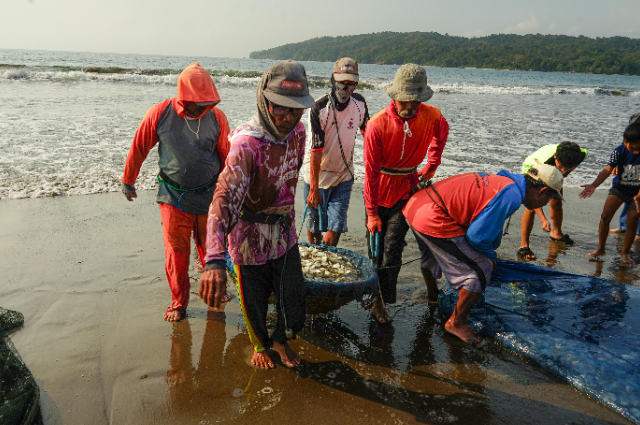
The fish folks such as the Koli’s, Gabits and Mogaveeras and native tribes like Warli and Gond follow lunar and tidal Calendars to regulate fishing cycles. Swahili sailors of east Africa used monsoon-driven dhow trade, reflecting a parallel maritime calendar to that of Konkan communities. The practice of abstaining from fishing during the monsoon breeding season, once derided as “superstition”, now recognized as sustainability ethic in line with FAO recommendations on seasonal bans. On field research suggested us that there still exists a practice of shore based, beach seining or drag-net fishing, in locally made wooden canoe known as ‘Hodi’ or ‘dongi’. This practice is highly collective, where large nets, known as ‘Rampanis’, are cast into the sea from the shore, targeting seasonal fish shoals close to the coast, like sardines, mackerel and anchovies.
The Konkan’s Machwa and Hodi boats are designed for monsoon resilience, blending hydrological knowledge with woodcraft. Sindhudurg and Ratnagiri villages use Chira (laterite blocks) to build sloping tiled roofs for houses, often reinforced with coconut fronds to withstand 3-4 months of torrential monsoon. Walls are often plastered with mixture of cow dung, lime, and clay serving as natural insulation against coastal humidity and heat. These structures are porous and regulate temperature, reflecting a sustainable architecture attuned to monsoon ecology.
Dietary practices are based on seasonal availability. Coastal tribes consume millets, tubers, wild fruits and paddy during rainy season while dry fish and coconut- based preparations dominate lean months. During the monsoon, when a strict fishing ban is observed for a month or two, communities rely on stored grains, pulses and sun-dried food as a form of ecological risk management. Prevalent agroforestry models that integrate Konkan kitchen gardens (wadis) with areca-nut, jackfruit, mango, pepper and coconut provide year-round food security without exhausting the soil.
The indigenous oceanic epistemologies of the Konkan reveal a worldview where knowledge is not extracted from nature but co-created with it. What colonial modernity once dismissed as a “folklore” is today resurfacing as a lighthouse of sustainability. In the world fractured by ecological crises, these epistemologies remind us that the sea is not a commodity but a cosmic partner – to be respected, nurtured and celebrated in equal measures.
To borrow the words of the philosopher Raimon Panikkar,” to know is to participate”. The western coastal communities of India embody precisely this participatory wisdom – where knowledge is embedded in rituals, songs, tides and toil. The legacy is not merely of the past: it is a guiding current towards a greener, more sustainable and spiritually attuned future.
Citation
- Chaudhuri, K. N. Asia Before Europe: Economy and Civilisation of the Indian Ocean from the Rise of Islam to 1750. Cambridge University Press, 1990.
- Subrahmanyam, Sanjay. Across the Green Sea: Histories from the Western Indian Ocean. University of Texas Press, 2023.
- Godbole, Archana, et al. “Safeguarding Biodiversity and Ecosystem Services of Sacred Groves.” Sustainable Development, vol. 21, no. 3, 2013, pp. 157–168. Doi:10.1080/21513732.2013.835350.
- Godbole, Archana, et al. “Cultural Dimensions of Sacred Forests in the Western Ghats Biodiversity Hot Spot, Southern India, and Its Implications for Biodiversity Protection.” International Journal of Environment and Ecology, vol. 12, no. 2, 2021, pp. 1–19. Doi:10.1186/s41257-021-00053-6.
- Rane, Sahil. “Konkan’s Hidden History: From Rock Art to Resilience.” Medium, 15 Sept. 2025, medium.com
- Forbes, Keith, and Jeremy Broadhead. The Role of Coastal Forests in the Mitigation of Tsunami Impacts. RAP Publication 2007/1, Food and Agriculture Organization of the United Nations, 2007, www.fao.org
- "Mangroves: Nature's Shield Against Coastal Hazards in Savegre." UNESCO, 23 June 2023, www.unesco.org