
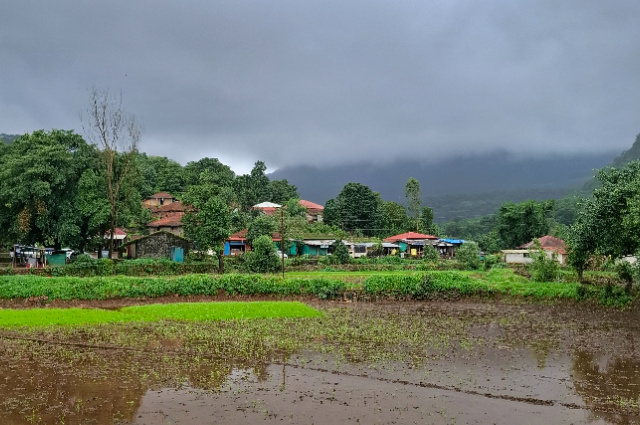
Image credit: Author [Harihar foothills, September 2025]
Deep within the dense folds of the forest, kilometres away from the urban sprawl of my city, Nashik, lay a sanctuary of vivid wildlife and breathtaking vistas. The crown jewel of this terrain is the Harihar Fort, famous for its notoriously unique, near-vertical eighty-degree incline. Conquering it had been a liberating but equally punishing experience for us. Those four gruelling hours ascending and three hours descending had unexpectedly drained every last drop of vitality from our bodies.
Yet, our difficulties were far from over. As dusk began to bleed into the horizon, finding a vehicle to take us back home felt like an impossible task. With no immediate relief in sight, seeking temporary refuge in a nearby tribal hamlet became the only modest option left to us.
"Kaka," I called out, using the Marathi word for uncle, my voice raspy. "Can I please get a little bit of water?"
The middle-aged man was kind enough to offer us water so ice-cold that it tasted like amrit—the divine nectar of the gods—to my parched throat. I watched him draw it from a traditional earthen pot tucked away inside his hut. To call it a mere hut would be an understatement; it was a lavish, beautifully crafted earthen home topped with weathered brown roofing. The soft, natural evening light filtered through the doorway, casting a distinct, serene aura inside the kind of rustic magic I had only ever seen in films.
Near the back, his daughter was cooking over a clay stove (chulha), tending to earthen pots. A thin, lazy streak of grey smoke curled upward, escaping through the roof and adding a peaceful, comforting tinge to the landscape. It felt exactly like a picturesque desktop wallpaper. A profound calmness, a deep serenity, and a divine ambience hung in the air; a feeling completely alien to the city life I knew.
"Kaka, how can we get back to the city at this hour?" I asked, looking out at the fading light. "This area doesn't even have a proper dirt road. We had to leave our bikes back at the bus stop and catch a bus from Trimbakeshwar this morning, but now I don't think we can return anytime soon."
"Don’t worry, beta," he answered reassuringly. "There is a bus that goes back to Trimbakeshwar, but it isn’t until 7:00 PM."
That meant a two-and-a-half-hour wait. Kaka looked at our weary frames and smiled generously.
"You can have dinner with us if you are hungry. I don't know if city boys will like our humble food, but my daughter is preparing pithla bhakri. We can easily make more."
He was incredibly gracious to offer, and we were far too hungry to decline his hospitality.
As we waited, the absolute isolation of the place began to weigh on my companion. "I honestly wonder how you survive out here in such a secluded, underdeveloped place," my friend muttered, venting his growing frustration. "Not a single paved road, no shops, and not even a sliver of cellphone network."
I noticed a subtle, knowing smile play upon Kaka's face. It was as if he had been expecting this exact comment, intimately familiar with the mindset we carried. Yet, the heavy label of being "underdeveloped" clearly did not resonate with him.
"Beta, tell me," Kaka began, his voice calm but grounding. "What is development?"
I wasn't expecting him to initiate a conversation with such an ambiguous, heavy question, one whose philosophical depth was almost too much for our exhausted minds to grasp at that time.
"Well... just better roads, good schools, hospitals, shopping complexes, and at least decent internet connectivity," I answered with a tentative smile. "These facilities are prerequisites. They make life easier. I presume it must be incredibly difficult to even get basic medical treatment out here."
"It isn't quite like that," Kaka replied softly. "A doctor from the city visits our village every alternate day to manage our medical supplies, and we have a dedicated schoolmaster who teaches our children. But as for the highways and the internet! Yes, we do not have them. But tell me, would your version of development be truly complete if we got those things?"
"I feel development isn’t a stage, but a continuous process," I argued, trying to find my footing. "It’s about acquiring the essential facilities that humans need as times change. As our requirements grow, so does the progress. Tell me, isn't it our fundamental right to have the modern conveniences that make us happy?" I asked
"Are you happy?"
Kaka leaned forward, his gaze piercing through the dim light, peeking straight into our souls. Suddenly, the reality of what he was doing dawned on me. I found myself completely speechless.
"Your city possesses every single facility you just listed," Kaka continued, his voice dropping to a powerful whisper. "Yet, you travelled all this way just for a thrill, a trek... or were you perhaps trying to escape the chaos? Why do you constantly seek an escape, if you aren't secretly imprisoned by your ever-evolving needs? Tell me, are you truly happy?"
In the span of a few minutes, this simple village Kaka had transformed before my eyes into a figure like Socrates sitting on the ancient Stoa, posing hard-hitting, existential questions. We were reduced to nimble, helpless students, utterly unable to formulate an answer. Were we really happy?
Sensing the sudden discomfort in our silence, Kaka didn't press us for an answer; he knew we didn't have one. But he surely had something more to share.
"This is not my native village," Kaka said, looking out into the darkening forest. "I was once a resident of Wagholi, near the Pune-Nagar highway. I still remember my village when it was a quiet paradise nestled beautifully in the lap of nature. Then, your so-called development arrived. Heavy industrial corridors, elite residential settlements, and national, international, universal schools... I still can't tell the difference between them. My father sold our twelve acres of pristine agricultural land for what seemed like a fortune at the time. We migrated from the open air of our farm into a cramped, two-BHK dungeon in the middle of an industrial zone."
He took a slow breath, the weight of the memory visible on his face.
"I took up a job at the MIDC industrial estate after college and got married. I had the same aspirations as any lower-middle-class individual, chasing a raise, saving up to send my children to those prestigious international schools. But I didn't realise that we were trading our optimal past and healthy present for the fleeting mirage of a 'developed' future."
Tears welled up in his eyes, reflecting the dim glow of the clay stove.
"The toxic, sooty smoke of the factories triggered severe asthma in my parents, taking them away from me far too soon. Not long after, my wife succumbed to severe anaemia while giving birth to our second child. The city doctors told me she lacked proper nutrition, clean air, and pure water, things that were never considered luxuries when we lived on our farmlands. I had finally had enough. I decided to pack our lives and return to where we truly belonged."
He wiped his eyes, a profound sense of pride returning to his posture.
"This is my wife’s native place. Yes, we don't have your international schools, your malls, your multi-lane highways, or your seamless internet. But my children breathe clean air. They drink pure water. And they know more about the intrinsic rhythms of nature and wildlife than zoologists like you. We are satisfied, and we are at peace here. We do not want your development. We Are Happy."
My friend and I sat in the shadows, paralysed, not knowing what to say or how to react. My deeply ingrained, ethnocentric views of progress were shattered into pieces. My heart was racing like a startled rabbit, but my mind was completely blank, stunned into submission. The silence that followed was heavy, born from the most confronting truth we had ever encountered.
"I never intended to make you uncomfortable," Kaka’s voice suddenly pierced through the stillness, warm and welcoming once more. "But I suppose that is the exact purpose of truth. Enough food for thought for one evening! Now let me fill your hungry stomachs instead." He let out a hearty laugh.
His laughter wasn't the cynical chuckle of the city; it was the pure sound of absolute contentment, of unshakeable serenity, and of a deep, grounding peace, a feeling that we, in all our modern advancement, had never truly experienced before.