
Author’s Note / Disclaimer:
This story is inspired by the real events of March 16, 2026, when the falling, burning debris of intercepted military drones caused catastrophic damage across civilian areas in the UAE. While grounded in the factual reality of modern warfare and its collateral damage, "Ami" and her family are entirely fictional characters. The name acts as a pseudonym to protect the identities of real victims. This narrative exists strictly to humanise the devastating civilian cost of global conflicts.
To
four-year-old Ami
The world was measured in simple, beautiful things. In her lush hometown of Kozhikode, Kerala, life was the rhythmic drumming of monsoon rains against the tin roof of her grandmother’s house and the bright laughter of her nursery school friends playing in muddy puddles. The air there always smelled of wet earth and crushed jasmine. She carried a small, hand-carved wooden elephant everywhere she went—a worn, cherished guardian of her childhood innocence.
But in the spring of 2026, her world expanded far beyond the green canopy of southern India. It was her school vacation, and she was embarking on her first aeroplane ride to meet her father in the United Arab Emirates. As the aircraft broke through the atmosphere, Ami pressed her face against the thick, oval window of the Boeing. She pointed her wooden elephant at the sky, utterly convinced that the endless, fluffy clouds beneath them were made of fields of white cotton candy.

She did not know that waiting for her on the ground was a father carrying the weight of the world on his shoulders. Like hundreds of thousands of Indian migrants before him, he had travelled to Dubai with a modest but fierce dream: to build a small trading business—a little shop dealing in imported textiles—that would secure his family’s future and pay for Ami's education.
The reality of that dream, however, was far less glittering than the city’s famous skyline.
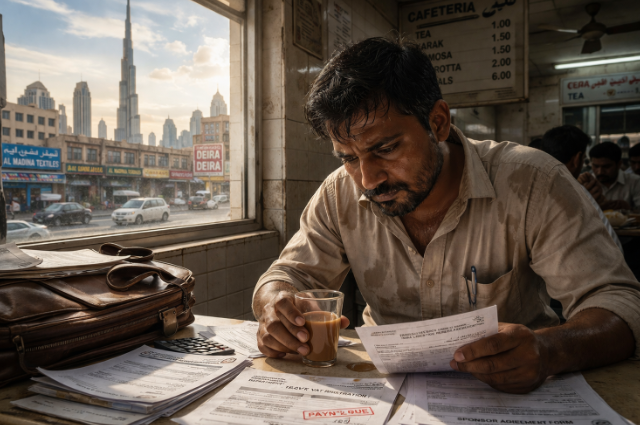
On a suffocatingly humid morning in the bustling, older district of Deira, her father sat in a cramped cafeteria, sweating through the collar of his crisp formal shirt. The ceiling fan above him did little to cut the heat. Before him lay a mounting pile of intimidating commercial paperwork—hefty Trade License renewal fees, complex VAT registration forms, sponsor agreements, and endless bureaucratic demands. The financial cost of breathing life into a small business was draining him, dirham by dirham.
He made quiet, invisible sacrifices every single day. He routinely skipped his afternoon meals, opting for a cheap cup of cafeteria tea just to save a few coins toward his licensing fees. He walked miles in the unforgiving sun to avoid taxi fares, and he only called his parents in Kerala late at night when the international phone rates dropped, forcing a cheerful, energetic tone to mask the bone-deep exhaustion in his voice.
Yet, when Ami and her mother finally arrived in the city, he immediately locked his anxieties inside his worn leather briefcase. He wanted his family to see only the magic of Dubai. On the morning of their first big outing, her mother spent twenty minutes helping Ami pin a bright yellow floral dress, carefully brushing her hair and tying it with a matching ribbon so she would look perfect for the family photos. Her mother wiped a smudge of dirt from Ami’s cheek, kissing her forehead with a warm, lingering smile.
As they walked out of their modest, shared apartment, her father scooped Ami up and lifted her onto his shoulders, groaning playfully as if she weighed a ton.
“Don’t worry, Ami,” he told her.
His voice brimming with a fragile, desperate hope as he pointed toward the distant skyscrapers. “Once Papa's shop opens and the paperwork is done, we will go to the very top of the Burj Khalifa every weekend. I promise.”
But the glittering city surrounding them was quietly vibrating with a tension that eager tourists rarely saw. The geopolitical airspace spanning the US, Israel, and Iran was nearing a terrifying boiling point. The dark shadow of military conflict was creeping closer to the supposedly impenetrable, cosmopolitan bubble of the UAE.
The first signs of this silent storm bled into everyday civilian life in strange, technological ways. While riding in a taxi down the crowded, multi-lane Sheikh Zayed Road, their driver suddenly grew frantic, tapping his dashboard monitor angrily in Arabic.
The navigation system was violently spinning, showing their car plunging into the middle of the Arabian Gulf. It was GPS spoofing—military signal jamming designed to confuse the targeting systems of incoming drones, indiscriminately bleeding over into the civilian infrastructure.
Later that afternoon, while Ami happily ate strawberry ice cream on a bustling tourist boulevard, the mobile phones of dozens of people around them chirped in unison with a harsh, piercing tone. It was a government emergency alert system testing its broadcast. Ami’s mother quickly wiped the melting pink ice cream from Ami’s chin, forcing a vivid smile to shield her daughter from the sudden, chilling wave of anxiety that washed over the adult faces in the crowd. They were in one of the safest, most technologically advanced cities on earth; surely, they were untouchable.
Then came March 16, 2026.
The family was in a taxi again, navigating the complex highway loops heading toward a massive shopping mall near the airport perimeter. It was a typically bright, scorching afternoon. Inside the cool, air-conditioned cabin of the car, Ami was sitting in the back seat, quietly humming a Malayalam lullaby and tracing the carved wooden ears of her elephant. Her mother was resting a gentle hand on Ami’s knee. In the front, her father was laughing, joking with the driver about the erratic, spinning GPS signals to keep the mood light.
It started not with an explosion, but with a sudden, localised pressure that seemed to suck the air out of the car aggressively. Far in the distance came the heavy, terrifying, rhythmic thud-thud-thud of ground-to-air defence batteries aggressively firing into the atmosphere.
Ami looked through the tinted window, confused. The clouds she once thought were cotton candy now trembled ominously. Then came a sharp, mechanical tearing sound—louder and more unnatural than any thunder she had ever heard during the Kerala monsoons.
High above the chaos of the highway, she saw a sudden, blinding flash of white light, followed immediately by thick grey smoke blooming violently across the clear sky.
A military drone, part of a sprawling regional retaliation, had been targeted and successfully destroyed by the city's advanced air defence interceptors. But while the multimillion-dollar technology did its job high in the atmosphere, gravity mercilessly claimed the rest. Hundreds of pounds of superheated, jagged, flaming metal—the shattered remains of both the drone and the interceptor missile—began raining down across the congested civilian highway like deadly meteorites.
In the fraction of a millisecond before a massive, burning fragment of the intercepted drone struck the roof of their taxi with the devastating cinematic force of a bomb, Ami smelled the strange, dusty scent of the hot fabric of the car seats and the sudden, choking stench of burning sulfur.
Then, the world shattered.
The invisible wall of the shockwave slammed the taxi sideways, crushing it against the concrete highway barriers. The safety glass of the windows exploded inward in a blinding storm of crystalline shards. The terrified screams of trapped passengers mixed with the deafening, continuous blaring of crushed car horns. In his final, desperate act of love, her father threw his body backwards over the seat, his arms outstretched to shield his little girl as the roof crumpled catastrophically under the weight of falling, burning debris.
Everything went black.
When Ami finally opened her eyes again, the acrid smell of burning rubber and aviation fuel had been replaced by the sharp, sterile sting of hospital antiseptic. The magical, towering kingdom of Dubai had completely vanished, replaced by a cold, fluorescent-lit white room. Her small body was heavily bruised, wrapped in thick bandages, and aching deeply, but her young mind was trapped in absolute, suffocating terror.
A nurse walked hurriedly into the room. Hearing Ami whimper softly in Malayalam, the nurse—a migrant worker from Kerala herself—stopped dead in her tracks. Recognising the familiar, musical accent of her homeland coming from this shattered, solitary child, the nurse broke down internally, her professional medical composure cracking under the weight of the tragedy.
Ami looked up with wide, tear-filled eyes. In her bandaged hand, she was still tightly clutching the wooden elephant. “When is Papa coming with the ice cream as he promised?” she whispered, her voice trembling.
The nurse swallowed the massive, aching lump in her throat. She stepped forward and gently held Ami’s tiny, bruised hand, offering the only mercy she had left. “He is getting better, Moley,” she whispered back in Malayalam, her voice breaking. “You will see him soon.”
Ami nodded slowly and rested her heavy head against the stiff hospital pillow. She would wait.
But Papa never came. Mama never came. In one blinding, violent flash on the airport road, their hopeful, hard-fought new life was erased. They were crushed not by any personal hatred directed toward them, but by the cold, distant, mathematical calculations of modern war.
Incidents like the March 16 strikes force us to confront the darkest hypocrisies of global conflict. We live in an era where the pinnacle of human technology failed to protect the most vulnerable among us. It highlights a cruel, unforgiving contrast: the multi-million-dollar cost of a single, tactical drone, weighed against the few thousand dirhams an Indian migrant father desperately scraped together to build a humble business. In this brutal equation, the weapons of war always win, and human dreams are reduced to ash.
For the world at large, these catastrophic events are quickly sanitised. They are reduced to sterile headlines, debated by geopolitical analysts, and dismissed into the cold, technical terminology of "collateral damage."

But there is nothing technical about a four-year-old girl waking up alone in a foreign hospital. For Ami, the war did not end with a negotiated ceasefire or a signature on a political treaty. It ended with a haunting question that no diplomat, soldier, or politician could ever answer: When will my father come back?
References:
- Reuters Staff, Dubai Airport Hub Rattled After Drone Strike Spotlights Iran Crisis, Reuters, Mar. 16, 2026.
- Al Jazeera Staff, Drone Strike Disrupts Dubai Flights as Iran Continues Gulf Attacks, Al Jazeera, Mar. 16, 2026.
- Human Rights Watch, Iran: Unlawful Strikes Across Gulf Endanger Civilians, Mar. 17, 2026.
- Wikipedia Contributors, 2026 Iranian Strikes on the United Arab Emirates, Wikipedia, The Free Encyclopedia, last modified Mar. 31, 2026.