
Disclaimer:
This narrative is inspired by real events during the COVID-19 crisis of April 2021. While certain characters and details have been fictionalised for storytelling purposes, the situations depicted reflect the lived experiences of many individuals affected during that period.
To understand the deepest sorrow of the human heart, you do not need to read fictional tragedies. You only need to look back at the terrifying month of April 2021. For the world, it is now just another chapter in a history book. But for millions of families in our country, it is an open, bleeding wound that will never heal.
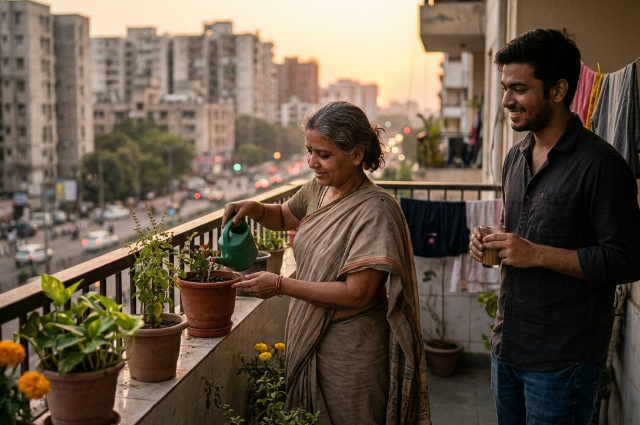
Rohan was a twenty-eight-year-old accountant living in a modest, rented apartment in the city. His entire world was his sixty-year-old mother, Mrs. Meera. She was a retired primary school teacher, a gentle, gray-haired woman who spent her quiet evenings watering the small potted plants on their balcony and reading old books. Since Rohan’s father had passed away many years ago, it was just the two of them against the world. Mother and son, sharing every meal and every secret.
When the brutal second wave of the virus hit the city, the medical infrastructure collapsed completely overnight. Huge hospitals ran out of beds within hours, pharmacies ran out of basic life-saving medicines, and the air itself seemed heavily poisoned.
One terrible Tuesday morning, Mrs. Meera developed a dry, painful cough. By Thursday, a burning fever took over her fragile body. By Saturday night, the dreaded digital numbers on the small pulse oximeter clamped to her finger began to drop rapidly. 88. Then 85. Then 82.
Rohan’s hands shook violently as he watched his mother struggling to take a single, full breath. Her chest heaved up and down, and her gentle eyes, usually full of warmth, were wide open with a silent, helpless terror. She was drowning in the open air.
"Rohan," she whispered, her voice cracking and weak.
"I can't...
the air...
It doesn't go inside."
Thus began the most terrifying twenty-four hours of Rohan's life. He wrapped his shivering mother in a thick woolen blanket, carried her carefully into the back seat of his small car, and drove out into the dark, silent city.
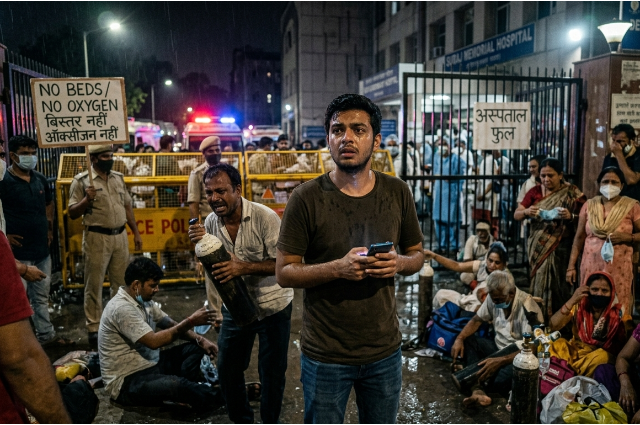
He drove to the biggest government hospital first. Outside the massive iron gates, hundreds of people were crying, shouting, and begging doctors for help. A large wooden chalkboard hanging on the gate simply read:
NO BEDS. NO OXYGEN.
He drove to a very expensive private nursing home next. A tired doctor, sweating inside a thick plastic suit, looked at Rohan with entirely defeated eyes and shook his head. "We have twenty patients sharing five cylinders right now, son. Our own supplies are empty. Take her back home. All you can do is pray."
But Rohan absolutely refused to give up. He drove his dying mother back to their apartment and made her lie down gently on her bed. Her breathing was becoming shallower, sounding like dry paper rubbing together. Her oxygen level dropped to a terrifying 75.
"I will get an oxygen cylinder, Ma," Rohan said, kissing her hot, sweaty forehead. He tried desperately to hide the hot tears falling from his eyes. "I promise you. Just hold on. Please, stay awake. Give me two hours."
Mrs. Meera weakly held his hand. Her fingers were becoming ice-cold. She managed a small, painful, loving smile. "Drive safely on the bike, beta," she gasped. Even as she was slowly suffocating to death, her only worry was her son’s safety on the dark roads.
Rohan left her with a glass of water on the nightstand and locked the front door. He got on his motorcycle and rode into the terrifying black market of human desperation. It is a cruel, factual reality of our world that in times of mass tragedy and suffering, absolute human greed shows its ugly face.
For the next four hours, standing on dark street corners, Rohan made over a hundred phone calls. He contacted internet leads, suspicious medical dealers, and old college friends. Finally, past midnight, a man gave him an address in an empty industrial area ten kilometers outside the city. The dealer had one small oxygen cylinder left. The price was seventy-five thousand rupees—ten times its actual, legal cost.
It was every single rupee Rohan had in his bank account, money he had saved for his future wedding. He transferred the money from his phone without a single second of hesitation.
He strapped the heavy, cold green metal cylinder to the back seat of his motorcycle using thick ropes. The heavy metal felt like the most precious gold in the entire universe. It was his mother's life. It was his promise to her.
As he rode aggressively back toward his apartment, swerving dangerously through the empty roads, his mobile phone rang loudly in his pocket. He could not stop to answer it. He was driving entirely on adrenaline, fear, and pure love. The heavy metal cylinder banged painfully against his spine with every pothole he crossed, bruising his back, but he did not care.
When he finally rushed up the dark, concrete stairs of his apartment building, carrying the heavy fifty-pound cylinder on his shoulder, his chest was burning with exhaustion. His hands were bleeding from gripping the rough metal valve so tightly.
He kicked the front door open, panting heavily.
"Ma! I got it! I got the oxygen!" he shouted joyfully, dragging the heavy cylinder across the living room floor.
The apartment was absolutely, terrifyingly silent.
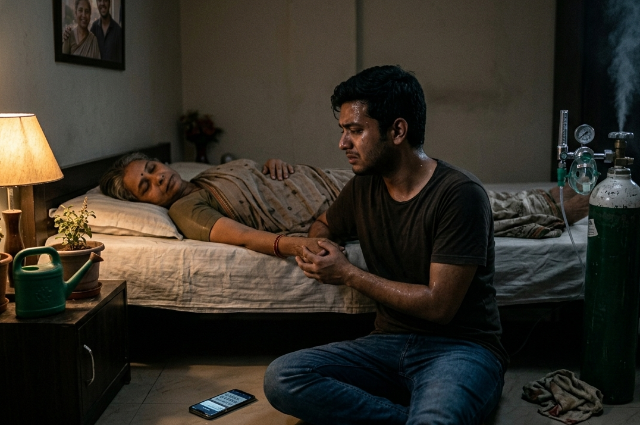
Rohan ran into the bedroom. His mother was lying exactly where he had left her. But her chest was no longer rising and falling. Her eyes were peacefully closed. The small pulse oximeter had slipped off her cold finger and was lying on the bedsheet, its digital screen completely blank.
Rohan fell hard to his knees. He grabbed the plastic oxygen mask, attached it to the cylinder with shaking hands, and turned the valve aggressively. The crisp, sweet, hissing sound of pure, lifesaving oxygen immediately filled the small room. But there were no lungs left to breathe it.
He held her cold, lifeless face in his hands and screamed. He screamed until his own throat tore, until the neighbors came rushing into the room, until his vision went entirely black. He had brought the precious air she begged for, but he was exactly twenty minutes too late.
Later that terrible night, sitting on the cold floor beside her covered body, Rohan slowly pulled his mobile phone from his pocket. There was one missed call from his mother, received right while he was riding his motorcycle back home. There was also a short, thirty-second voicemail.
With trembling fingers, he pressed play.
Through the hissing static of the phone speaker, he heard his mother taking slow, agonizing, suffocating breaths.
"Rohan..." her voice was barely a whisper, incredibly weak but filled with absolute, unconditional love.
"Don't spend all your money... on me... I am so tired now, beta... I think I am going to sleep.
You are such a good boy. Please, have your dinner on time tomorrow... I love you..."
The recording clicked and ended. Rohan sat in the dark, clutching the phone tightly to his chest, weeping uncontrollably as the untouched, expensive green oxygen cylinder hissed softly into the empty, silent room.
The massive tragedy of April 2021 leaves us with extremely painful questions that our modern society must answer. When a young, desperate son is forced to buy his dying mother's breath on a criminal black market at ten times the price, it is not just a medical failure; it is a profound moral and systemic collapse of a nation.
Real stories like Mrs. Meera's reveal the terrifying vulnerability of the common citizen. They highlight a cruel, factual reality where healthcare is treated as a highly profitable business rather than a fundamental human right. While powerful politicians held massive election rallies and wealthy businessmen flew away safely on private jets, ordinary sons, daughters, and husbands were left crying and begging on the streets for a single cylinder of compressed gas.
We must never forget this dark chapter of our history. We must aggressively demand a robust, equal, and corruption-free healthcare system that protects everyone, regardless of their bank balance. Because if we ever forget the silent tears of people like Rohan, we lose our humanity entirely. And no amount of oxygen or money in the world can revive a society that has forgotten how to care for its most vulnerable people.
References:
- India’s COVID-19 Crisis: Oxygen Shortage and Healthcare Collapse, World Health Organisation, www.who.int (last visited Mar. 31, 2026).
- India Covid: Delhi Hospitals Run Out of Oxygen Amid Surge, BBC News (Apr. 24, 2021), www.bbc.com
- Explained: The Oxygen Crisis During India’s Second Wave, The Indian Express (Apr. 26, 2021), indianexpress.com.
- Covid-19 in India: Why the Second Coronavirus Wave Was So Severe, The Lancet, Vol. 397 (2021). “People Are Dying Because of Lack of Oxygen”: India’s COVID-19 Crisis,
- Human Rights Watch (Apr. 30, 2021), hrw.org