
Disclaimer:
The following story is a work of fiction inspired by real-world events and the systemic challenges faced by gig economy workers in India. While the characters and specific incidents are products of the author’s imagination, the life-threatening pressures of rapid-delivery algorithms and the lack of social security for "delivery partners" are documented realities. This narrative serves as a tribute to those lost in the pursuit of "magic" convenience and a call for empathy and systemic reform.
The Price of Ten Minutes
If you open your smartphone right now, you are only three taps away from magic. In the bright, colourful screens of modern start-up applications, you can order a hot cappuccino, a box of luxury chocolates, or a fresh pizza, and a digital timer will proudly promise to deliver it to your doorstep in exactly ten minutes.
It feels like a technological miracle. But there is a dark, painful truth hidden behind the bright graphics and the billion-dollar valuations of these quick-commerce companies. Magic does not deliver your food. A desperately poor, exhausted human being does. And in the brutal mathematics of the gig economy, a ten-minute delivery window is not a convenience. It is a death sentence.
To understand this modern tragedy, we must look at the life of twenty-three-year-old Tariq.
Tariq was not supposed to be delivering groceries. He was a bright young man from a lower-middle-class family who had spent three years studying late into the night to earn a Bachelor’s degree in Commerce. His parents, an ageing security guard and a domestic helper, had taken massive loans from local moneylenders to pay his college fees. They dreamed that Tariq would wear a clean shirt, sit in an air-conditioned office, and finally pull their family out of grinding poverty.
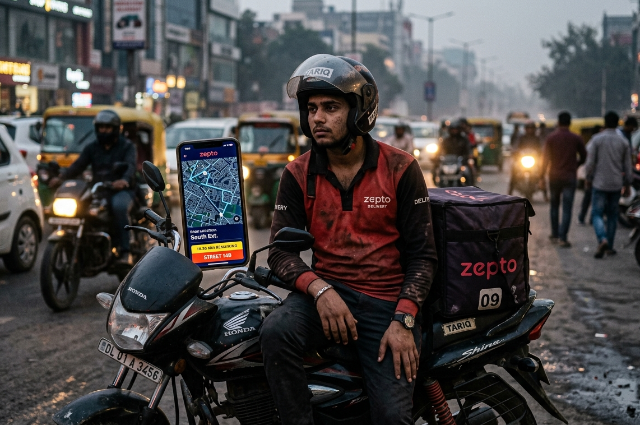
But the reality of the modern job market is cruel. Despite his degree, Tariq could not find formal employment. The interest on his parents' loan was growing rapidly, and the family was suffocating under the debt. With no other options, Tariq took the only job that was immediately available: he became a "Delivery Partner" for one of India's largest quick-delivery start-ups.
The start-up companies use very clever language to hide their exploitation. They do not call young men like Tariq "employees." They call them "independent contractors" or "delivery partners." By using these specific legal words, the billion-dollar company legally escapes all human responsibilities. Tariq received no medical insurance, no provident fund, and no fixed monthly salary. He was paid only for the exact number of deliveries he completed. If his motorcycle broke down, he paid for the repairs. If he fell sick, he simply starved.
Tariq’s entire human existence was compressed into a tiny, blinking blue dot on a digital map.
To make enough money to feed his family and pay the loan, Tariq had to work fourteen-hour shifts. He rode his second-hand motorcycle through the suffocating pollution, the aggressive city traffic, and the scorching summer heat. But the greatest enemy Tariq faced was not the traffic; it was the start-up’s algorithm.
The mobile application operated like an invisible, heartless dictator. Every time an order popped up on his screen, a countdown timer started ticking. Ten minutes. If Tariq delivered the package on time, he earned a few rupees. But if he was late—even by two minutes—the algorithm would brutally punish him. It would deduct money from his daily earnings or, worse, temporarily block his ID, leaving him with no income for the day.
The algorithm did not care if the road was blocked by construction. The algorithm did not care if a stray cow was sitting in the middle of the highway. And most dangerously, the algorithm did not care if it was raining.
On a Tuesday night in July, the city was hit by a massive, blinding monsoon rainstorm. The streets quickly flooded with thick, muddy water, hiding the deep, dangerous potholes. Most sensible citizens were sitting safely inside their dry homes, watching television.

At 11:30 PM, Tariq’s phone beeped aggressively. An order had come in from a wealthy luxury apartment complex four kilometres away. The customer, resting in an air-conditioned bedroom, had ordered a single tub of chocolate ice cream.
The screen flashed red: Delivery Time - 12 Minutes.
Under normal conditions, a four-kilometre ride took fifteen minutes. In this blinding rain, navigating flooded, slippery roads, it was a twenty-five-minute journey. But the algorithm demanded a miracle. If Tariq rejected the order, he would face large monetary penalties. Knowing his mother needed her diabetes medicine the next morning, Tariq zipped up his cheap, torn raincoat, put on his helmet, and drove his motorcycle into the furious storm.
The icy rain hit his face like tiny needles. His motorcycle tires struggled to grip the wet, slippery asphalt. Every time he slowed down to safely cross a pothole, the screen mounted on his handle beeped loudly, reminding him that the clock was ticking. Eight minutes left. Six minutes left. He had to ride faster.
In a desperate attempt to meet the cruel deadline, Tariq took a sharp turn onto a dimly lit main road. He was pushing the speed limit, completely blinded by the heavy rain and the bright, glaring headlights of an incoming truck.
He never saw the deep, uncovered sewer hole in the middle of the flooded road.
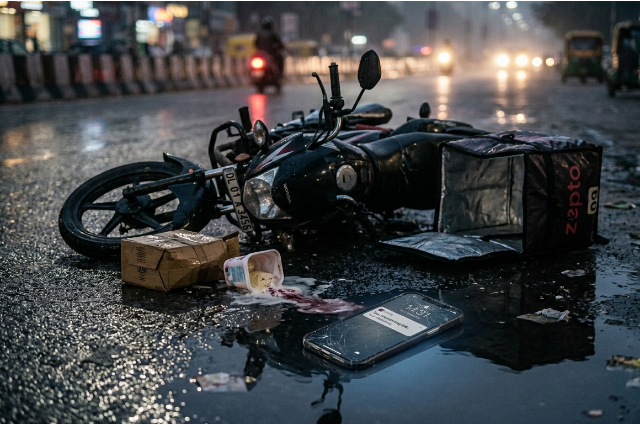
The front tyre of Tariq’s motorcycle smashed into the concrete edge of the hole. The impact was violently explosive. Tariq was thrown over the handlebars, flying through the heavy rain before his body slammed brutally onto the hard, wet road. His helmet, cheap and cracked, flew off his head. His motorcycle skidded for twenty meters, striking a metal pole with a deafening crash.
The plastic delivery bag tore open, and the tub of premium chocolate ice cream rolled out onto the dirty street, mixing with the rain and the dark pool of blood slowly spreading from Tariq’s head.
There was no one around to help him. The road was empty. Tariq lay on the cold asphalt, his body broken, staring up at the dark, crying sky. A few feet away, his cracked mobile phone lay in a puddle. The screen was still glowing brightly in the dark. The start-up’s application was beeping its automated warning: You are running late. Customer is waiting.
Back in the luxury apartment, the customer grew annoyed. They opened the app, saw that the blue dot had stopped moving, and angrily tapped the "Cancel Order" button, instantly receiving a full refund. They went to sleep, completely unaware that a young man's life had just ended on a cold street for their late-night craving.
When the police finally arrived and informed Tariq's devastatingly poor parents, the quick-commerce company did what modern start-ups always do: they completely washed their hands of the tragedy. Because Tariq was an "independent contractor," the company offered no compensation, no widow's pension, and no insurance money to his heavily indebted family. They simply deactivated his digital ID and assigned the next delivery to another desperate young man.
Tariq’s story forces us to look in the mirror and confront the horrifying reality of our modern, technology-driven convenience. When did we become a society that values a quick delivery of ice cream more than the heartbeat of a twenty-three-year-old boy?
The billion-dollar valuations of today’s delivery start-ups are not built on brilliant software coding or innovative supply chains. They are built on the broken backs, the cheap labour, and the extremely high-risk lives of thousands of poor, desperate youths. These companies create aggressive algorithms that actively encourage reckless driving, knowing perfectly well that the inevitable accidents will be paid for by the workers' families, not the corporate balance sheets.
We must demand strict labour laws to protect gig workers. We must demand that these companies provide mandatory health and life insurance, and we must legally abolish the inhumane "ten-minute" delivery promises that turn city streets into death traps.
Until we stop treating human beings as disposable, moving dots on a digital map, the real cost of our fast, modern convenience will not be measured in rupees. It will be measured in the terrifying silence of parents waiting for a son who will never ride his motorcycle home again.
References:
- The Code on Social Security, No. 36 of 2020, § 2(35), India Code (2020) (defining "gig worker" and "platform worker" as distinct from traditional employees).
- The Motor Vehicles Act, No. 59 of 1988 (as amended by the Motor Vehicles (Amendment) Act, 2019), India Code (2019) (concerning road safety and liability).
- Indian Federation of App-based Transport Workers (IFAT) v. Union of India, W.P. (Civil) No. 1068/2021 (Sup. Ct. India) (seeking social security benefits for gig workers under the right to life and livelihood).
- See also National Federation of Delivery Workers v. State of Maharashtra, 2022 SCC OnLine Bom 1432 (discussing the duty of care owed to delivery personnel).
- NITI Aayog, India’s Booming Gig and Platform Economy: Perspectives and Recommendations on the Future of Work (2022), https://www.niti.gov.in.
- Fairwork India, Fairwork India Ratings 2023: Labour Standards in the Platform Economy (2023) (addressing the risks of algorithmic management and "10-minute" delivery targets).