
Another year has quietly passed since my spring. I notice a few more silver strands in my hair, and instead of worrying about them, I find myself wondering what they are counting—the years, perhaps, or the experiences that have accumulated along the way.
Birthdays have gradually changed meaning for me. Once, they were occasions to look forward to: celebrations, food, gifts, photographs and the excitement of being surrounded by people. Now they make me pause. I find myself looking back at the different versions of myself I have been, and at the experiences that have slowly shaped the person I am becoming.
Perhaps my story really began much earlier than I realised.
As a child, I was drawn to our ancient scriptures. I studied the Veda mantras and the Gītā as part of the curriculum at my Ānandamārga school, and I loved reciting them in Sanskrit, paying particular attention to pronunciation and rhythm. At almost the same age, I developed a natural attraction towards classical music. Hindustani or Karnatik, vocal or instrumental—it hardly mattered. I simply loved listening to it. I was too young to explain what I found beautiful in it, but I could feel that there was something there.
Sometimes I wonder whether I was, in some strange way, an ancient soul. Perhaps some things reach us before we are intellectually ready to understand them.
Then I grew up. The curriculum changed, life changed, and those early impressions gradually became less conscious. Looking back now, I sometimes wonder whether I loved music itself, or whether, at some point, I became attracted to everything that surrounded it—the applause, the colours, the excitement and the recognition. Perhaps I had learnt to notice the surface before I had learnt to understand the depth.
That understanding came to me through something quite different: water.
I learnt swimming when I was five. In the beginning, I was terrified. I cried when my mother tried to prepare me for it, and when my father took me to the swimming class, I resisted so strongly that he practically had to drag me inside. At that age, I could not understand why my parents were insisting that I enter something I feared so much.
Today, I am deeply grateful to them.
They thought they were simply teaching me how to swim. In retrospect, I think they were teaching me something I would understand much later: how to enter a depth without being defeated by the fear of it.
My relationship with water changed completely. The same water that once frightened me became something I loved—the movement of it, the sensation of floating, the sound of the surface and, most of all, the silence underneath it.
Perhaps that is why, as I grew older, I began to see music and education in much the same way. Both seemed to me like oceans. The more one learns, the more one discovers that there is no final shore.
I once wanted to become a lecturer and, someday, perhaps a Professor. I knew I was good at teaching, and I will admit that I was also attracted to the financial security that came with the profession. There is no reason to romanticise that part of my ambition. I wanted meaningful work, but I also wanted the stability and independence that a good career could provide.
Over nearly thirteen or fourteen years in the education sector—as a guest faculty lecturer, a UGC-NET JRF and later an SRF—I experienced both the sweetness and bitterness of academic life. Those experiences gradually changed the way I looked at education.
I began to understand that education itself is an ocean. The salary, the comfortable life, the admiration of students, recognition and the feeling of being ‘someone’ may all be attractive, but they belong largely to the surface. When one begins to go deeper, the perspective changes. One realises how enormous the field actually is and how small one's own contribution may be within it.
For me, that realisation became even stronger in music. The deeper I went, the less important it seemed to be seen. The deeper the water, after all, the quieter it becomes.
And perhaps this is one of the strange things about growing older in music and in life: you begin by wanting to be noticed, and gradually you begin to value understanding more than recognition.
That journey eventually brought me to research.
Today, I am an independent researcher, carrying a Doctorate earned after years of questioning, searching, reading, writing and learning. At one point in my academic journey, I was the first UGC-NET JRF from the General Category in my Department. One might imagine that such an achievement would automatically bring admiration and encouragement.
My experience was more complicated.
At times, I sensed a certain uneasiness around me, even in places where I had expected encouragement—from peers as well as from people occupying higher academic positions. I often wondered why.
Perhaps some journeys make people uncomfortable, not because the person travelling them is trying to rise above others, but because the journey refuses to stop growing despite the hurdles deliberately placed along the way.
Over time, I learnt something important: I could not seek validation from every shore.
Water does not become deep because someone acknowledges its depth. It becomes deep through everything that shapes it—the distance it travels, the rocks it encounters, the storms it survives and the time it takes to reach that depth.
I think research taught me something similar.
I remain genuinely grateful to the UGC for the opportunities that sustained me at different stages of my journey. What began as small opportunities gradually became a humble source of financial independence for me, rather like a small tree growing from seeds that had once seemed insignificant.
But research itself gave me much more than a degree.
It taught me patience. It taught me to wait, to question, to begin again and to remain comfortable with uncertainty. It taught me things that no classroom could have taught me—about people, institutions, solitude, perseverance and, perhaps most importantly, about myself.
The tree may still be small, but it has roots now. And I have learnt that roots matter just as much as branches. The branches may be visible, but it is the roots that allow a tree to survive and continue growing.
Somewhere along this journey, Rabindranath Tagore became more than a subject of my research.
His philosophy gradually changed the way I looked at freedom, human existence and our relationship with the world. His aesthetics taught me to look at beauty not simply as something pleasing to the senses, but as a way of perceiving life more deeply.
The more I study Tagore, the more conscious I become of how much remains to be understood.
His writings have accompanied me through different stages of my own becoming. They have encouraged me to listen more carefully, to question more honestly, to remain open to uncertainty and to recognise that knowledge does not necessarily end with an answer.
I began by researching Rabindranath.
Somewhere along the way, I felt that Rabindranath had begun researching me.
Perhaps that is what happens when a subject of research becomes part of one's intellectual and inner life. One stops merely studying the thinker and starts allowing oneself to be changed by the encounter.
My academic journey has also taken me into conversations with editors and scholars from different parts of the world, including Poland, Switzerland and Turkey. Those interactions have sometimes made me reflect on my own academic environment.
I have often wondered why the experience can feel so different.
In our academic spaces, scholars and researchers—even those with the highest academic qualifications—can sometimes continue to be treated simply as ‘students’. Of course, I understand that we remain students throughout our lives. I consider myself a student of Life even today. But there is a difference between choosing lifelong learning and being made to feel that one's scholarship has little value.
In my interactions with scholars and editors abroad, I have often experienced a different kind of academic exchange. They have not necessarily placed me on a pedestal. Instead, they have spoken to me as a fellow researcher and thinking human being. We discuss ideas, disagree, exchange perspectives and encourage one another to explore further. Some have encouraged me to write more, think more deeply and take my research in new directions.
At times, those experiences have made me wonder whether I should leave.
My soulmate has always encouraged me to explore the world beyond familiar shores. And perhaps there are many places where my work could find new possibilities.
But whenever I seriously think about leaving, something pulls me back.
I think of my country.
My soil.
My people.
My Ma.
My man.
There are some loves that geography cannot replace.
So I have realised that I do not necessarily want to abandon the soil that raised me. I want to continue learning here, questioning here, writing here and, in whatever small way I can, contributing here.
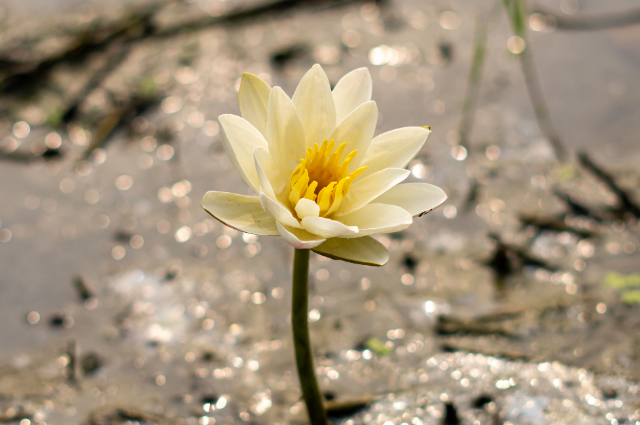
Perhaps the challenge is not always to escape the mud.
Perhaps sometimes the challenge is to remain in it and still try to bloom.
I want to remain in this mud and keep trying to become a lotus.
Looking back at all of this, I realise that there may be a connection between many things that once appeared separate in my life.
During my B.Ed., I encountered the word correlation. At the time, it was an academic term, something to be understood within the context of education. But life has gradually given that word a much more personal meaning.
For me, correlation is not merely about establishing a relationship between two measurable things. It is also about recognising the invisible connections between experiences that initially appear unrelated.
Music and education.
Water and depth.
Experience and knowledge.
Art and philosophy.
Science and wonder.
The measurable and the immeasurable.
Perhaps every form of learning begins with a question—a way of looking at the world and wondering about what lies beyond what we already know. Science may measure, calculate, test and demonstrate. Mathematics may give us equations. Research may give us evidence.
And yet, even after all that, there remains something beyond the boundary of what we have understood.
Another question.
Another possibility.
Another depth.
Perhaps that is where philosophy begins.
The older I become, the more I feel that music and education are not really two separate oceans. They are different ways of entering the same vastness. The more deeply I go into music, the more I find myself thinking about education; the more deeply I enter education and research, the more music returns to me.
Perhaps the boundaries we create between disciplines are necessary for organising knowledge, but beneath those boundaries there may be a much larger continuity.
This, perhaps, is what I have learnt from growing older.
Life does not always teach us by giving us answers. Sometimes it teaches us by making us stay with the questions a little longer.
Perhaps correlation is that quiet bridge between knowing and wondering—between what we can prove and what we can only perceive.
And perhaps that is why I keep returning to the image of water.
When I was five, I was afraid to enter it.
Today, I understand that I have spent much of my life learning to swim—not only in water, but in music, education, research, relationships, disappointments, questions and uncertainty.
The journey has not always been easy. Some hurdles came naturally with life. Others, I felt, were deliberately placed along the way. But each of them changed the way I moved forward.
Perhaps that is what another year of life means to me now.
Not simply becoming older.
Becoming deeper.
Another year has passed since my spring. There are a few more silver lines in my hair, perhaps a little more wisdom, perhaps a little less noise.
I look back at the waves I have crossed, the depths I have touched, the people who shaped me, the experiences that hurt, the ones that healed, and the person I am still becoming.
A birthday, for me, is no longer merely about celebration, gifts, food or photographs.
It is an opportunity to pause and ask:
What have I learnt?
What have I understood?
What remains unknown?
And where do I want to go from here?
I do not think I have arrived anywhere.
Perhaps I never will.
The ocean has no final shore, and learning has no final depth.
So I continue to swim.
Through Music.
Through Research.
Through Rabindranath.
Through Life.
Through Love.
Still learning.
Still questioning.
Still becoming.
And perhaps, after all these years, that is my real birthday gift—not another year added to my life, but another layer of depth added to the years I have already lived.