
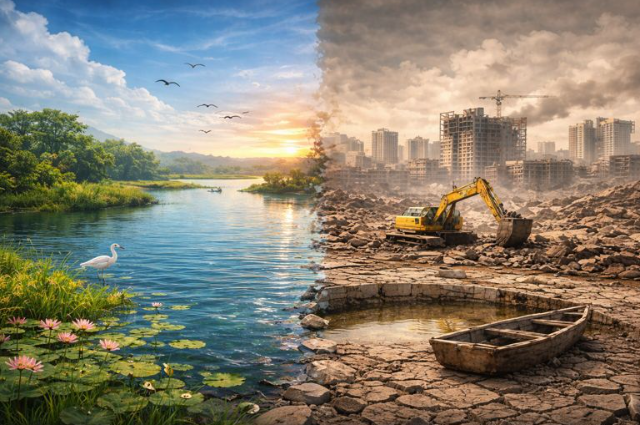
Lakes are lifelines- natural reservoirs that sustain ecosystems, provide drinking water, and buffer cities against floods. Yet, across India, these vital ecosystems are disappearing at an alarming rate, victims of unchecked urbanisation and human greed. From Bengaluru to Mumbai, the story is the same: lakes once teeming with life are being swallowed by concrete, leaving behind environmental ruin and fragile urban resilience.
The Crisis in Bengaluru: A City Running on Empty
Once a sanctuary of shimmering lakes, Bengaluru’s heart now beats with the rhythm of concrete. Where peacocks once danced near emerald shores, glass towers now rise. The city’s 42 lost lakes- 28 claimed by the Bengaluru Development Authority (BDA)- are more than ecological victims. They are chapters of a forgotten heritage, swallowed by ambition, leaving Bengaluru parched and gasping.
Rajajinagar, Koramangala, BTM, names we now associate with comfort and prosperity were once shaped by water. Beneath the concrete and busy streets lies a forgotten history of lakes and wetlands that gave birth to these neighbourhoods. The BDA’s “development” policies turned wetlands into real estate, severing the city’s natural arteries. Floods now drown roads; reservoirs gurgle dry. The 2023 monsoon saw Bellandur Lake erupt in toxic foam—a grotesque omen. Meanwhile, groundwater plummets, and the poor pay the price. Yet, skyscrapers rise, unyielding.
A report by the House Committee on lake encroachment reveals that 88 lakes in Bengaluru Urban district have vanished, reducing from 51 healthy lakes in 1985 to just 17 today. The Enzyme Tech Park, for instance, has encroached 136 acres of lake space, a stark symbol of prioritising profit over preservation. As floods plague the city, the lack of functional lakes compounds the crisis, proving what Karnataka Revenue Minister R Ashok warned: “Our lakes have the capacity to store 2 to 4 TMC of water. If maintained, there would be no question of overflow.”
In an apartment overlooked by a mall’s neon sign, a child whispers, “Mama, what’s a lake?” Somewhere, a peacock’s cry fades. The crisis is not just environmental but existential. Bengaluru’s soul lies in its drowned lakes. To revive them is to revive a city- a gamble between growth and survival.
Mumbai and Hyderabad: Caught Between Concrete and Water
Amid Mumbai’s heavy monsoon rains and Hyderabad’s sun-baked streets, a quiet but serious crisis is unfolding. Once rich with nature’s abundance, these cities are now struggling with the dry remnants of what they once had. Sixty lakes vanish in Mumbai’s shadow, their waters devoured by concrete. Hyderabad’s Hussain Sagar, a jewel of the Deccan, withers to half its former glory, choked by the greed of progress. The story is told through Amrita, a hydrologist fighting to save the city’s disappearing lakes. Her father, a poet, once wrote about the ‘blue veins’ that helped Mumbai breathe. Today, Amrita moves through layers of bureaucracy and neglect, her hands still muddy from surveying the suffocating waters of Lake Vihar. ‘Every lake we lose is like losing a lung,’ she tells a sceptical developer.
The tragedy isn’t confined to Bengaluru. In Mumbai, 60 of the city’s original 86 lakes have vanished, leaving only 20, with 8 of those already dead. According to NGO Watchdog Foundation member Godfrey Pimenta, encroachment and pollution have choked Mumbai’s remaining lakes, demanding urgent revival.
Imagine a Hyderabad where the majestic Hussain Sagar Lake shines like a beacon of natural beauty, its waters pristine and abundant, supporting a thriving ecosystem. Unfortunately, the reality is far from this vision. Over 40% of the lake's original area has been lost to concrete structures, and the once-natural drainage channels are now blocked, disrupting water flow and groundwater recharge.
Mumbai’s skyline mirrors itself in one surviving lake, while in Hyderabad, children plant lotus seeds in dry, cracked soil. It is a reminder that cities are not built only from steel and sand, but from rivers, rain, and a shared respect for the living world.
The Vanishing Lakes of Delhi: A Tale of Human Negligence
Delhi, the capital city of India, was once home to over 1,000 lakes and water bodies. However, a stark reality has emerged, revealing the devastating impact of human activities on these vital ecosystems. According to official reports and government data, a significant number of lakes in Delhi have been destroyed or severely degraded due to human neglect and encroachment.
The revenue records of Delhi reveal that there were 1,045 official water bodies in the city. However, a physical survey conducted on the ground found only 631 of these lakes to exist. This means that over 400 lakes have vanished or are no longer identifiable. Furthermore, satellite imagery identified 322 additional water bodies, but only 43 of these could be located physically. This shocking discrepancy highlights the alarming rate at which Delhi's lakes are being destroyed or encroached upon.
A recent study by the Indian National Trust for Art and Cultural Heritage (Intach) reveals a stark decline in Delhi’s water bodies, with 21 lakes lost between 1997-98 and 2013 due to urban encroachment and land use changes. The Delhi State Action Plan on Climate Change (SAPCC) corroborates this, citing government data that lists 1,022 water bodies, including lakes, ponds, and reservoirs, within the National Capital Territory. However, many have degraded, dried up, or been filled over the years, driven by unchecked urbanization. This loss is not merely environmental but ecological and social- a disruption of groundwater recharge, biodiversity, and local climate regulation.
The consequences are serious. Falling groundwater levels and rising temperatures are making Delhi more vulnerable to climate stress, while communities that once depended on these water bodies are now facing growing water shortages. Conservationists are calling for stronger enforcement of environmental laws, greater community participation in restoration efforts, and more thoughtful urban planning. Without urgent action, Delhi risks losing its long-standing connection with water- a resource that has shaped both its survival and its history.
Earth5R’s Mission: Restoring Lakes, Restoring Hope
Amidst this crisis, organizations like Earth5R are leading the charge to revive dying lakes. Their three-phase approach offers a roadmap for ecological revival:
- Once the initial research is done, Earth5R clearly defines what needs to be achieved.
- The focus is on reducing waste in the lake, improving water quality, and bringing back plants and animals that once lived there.
- The team sets scientific targets, such as lowering BOD and COD levels by at least 30% within six months.
- The return of native plant and fish species is closely observed to understand how well the lake is recovering.
- A major part of the work involves the local community.
- Earth5R conducts awareness programs and workshops in schools, housing societies, and nearby public spaces.
- These sessions help people understand why lakes are important and how pollution harms them, encouraging them to take responsibility for protecting the lake.
- In the next phase, Earth5R begins the actual restoration work on the lake.
- This stage focuses on physically cleaning and reviving the lake using both manual labour and eco-engineering methods.
- Volunteers remove plastic waste, invasive plants, and accumulated silt from the lakebed to allow natural water flow.
- Where sludge buildup is heavy, desilting is carried out using a mix of manual work and machines to restore the lake’s depth and storage capacity.
- Throughout the process, Earth5R follows strict eco-friendly practices.
- Biodegradable bags are used, and all collected waste is carefully sorted for recycling and safe disposal.
- For example, during the Mithi River cleanup, more than 60% of the waste collected was sent for recycling, helping reduce the amount dumped in landfills.
Reimagining Lakes: Urban Creativity Meets Nature’s Resilience
Urban growth has taken a heavy toll on nature, with lakes often giving way to concrete and construction. But today, new and innovative approaches are beginning to change that story, showing that development and nature can exist side by side.
Community-Led Revival: Bridging Past and Present
In Chennai, India, local groups revived the Muthanga Lake by reviving ancient rainwater harvesting techniques. By restoring traditional tank systems and involving residents in waste management, communities turned a dying lake into a thriving green space. Such grassroots efforts prove that blending ancestral wisdom with modern science can heal ecosystems while fostering stewardship.
Revitalizing Lakes Through Innovation: A Blueprint for Urban Resilience
Another innovative approach is floating solar farms, where solar panels float on lakes- either restored or newly built. These systems serve a double purpose: they generate clean electricity while reducing water evaporation and controlling algal growth by limiting sunlight reaching the water. Singapore’s Tengeh Reservoir (Tengeh Reservoir in western Singapore is a freshwater reservoir managed by PUB, providing part of the city’s water supply. It hosts Southeast Asia’s largest floating solar farm, generating clean energy while reducing evaporation and algal growth. The reservoir exemplifying sustainable water and energy management in urban infrastructure), home to Southeast Asia’s largest floating solar farm, is a prime example. It produces around 60,000 kWh of energy annually while keeping the reservoir’s open water healthy and usable.
Lake-Friendly Urbanization
The destruction of lakes due to urbanization is a pressing issue that requires immediate attention and creative solutions. As cities expand, natural water bodies are being filled and destroyed to make way for concrete structures, posing a significant threat to the environment and ecosystem. To combat this, innovative and sustainable solutions can be implemented. One such idea is to incorporate lakes into urban planning, designing cities around these natural water bodies rather than destroying them. This approach, known as "lake-friendly urbanization," can help preserve the ecological balance while also providing recreational spaces and aesthetic value to the city. Additionally, floating gardens and green roofs can be built on lakes, not only preserving the water body but also increasing the city's green cover.
Another way to protect lakes is by creating eco-parks around them, acting as a buffer between the city and the water while preventing pollution and safeguarding the ecosystem. Community-led efforts, like lake adoption programs and citizen science projects, can also involve local residents and raise awareness about the importance of lake conservation. By embracing these ideas, we can preserve lakes for future generations while supporting sustainable urban growth.
How Lakes Can Feed Cities
In an era of urbanization and climate uncertainty, lakes are often dismissed as static landscapes, can transform into dynamic, self-sustaining ecosystems that feed, educate, and connect cities. One groundbreaking approach is the rise of floating farms, which merge agritecture (agricultural architecture) with water-based innovation. Imagine modular, solar-powered platforms anchored in urban lakes, where residents cultivate hydroponic gardens, aquaponic fish systems, and even algae farms. These floating hubs don’t just yield organic produce; they purify water by filtering nutrients and carbon, creating a symbiotic relationship between human needs and aquatic health.
The "floating farms" initiative is not only providing a sustainable source of fresh, organic produce, but also fostering a sense of community and creativity among its participants.
Imagine strolling along a serene lake on a crisp morning, the sun casting a golden glow over the water. As you walk, you notice a series of modular platforms, each one bustling with life. These are the "floating farms," where local residents have come together to grow their own fruits and vegetables using cutting-edge hydroponics. The system is a marvel of circular economy, where the water is cleaned and purified as the plants absorb the nutrients they need to thrive.
But the impact of these floating farms extends far beyond the produce they yield. They have become a hub for community activity, a space where people from all walks of life can come together to learn, share, and connect. The Amsterdam Floating Pavilion, a sleek and modern structure that serves as an educational center, is at the heart of this movement. Here, visitors can attend workshops, seminars, and exhibitions that showcase the latest innovations in sustainable living and urban farming.
As you step inside the pavilion, you're struck by the sense of energy and enthusiasm that fills the air. Children are enthusiastically learning about the importance of bees in pollination, while their parents are discussing the finer points of aquaponics with a group of experts. The space is filled with the scent of fresh herbs and the sound of laughter, creating a sense of warmth and belonging that is hard to find in today's fast-paced urban environments.
As the project grows, the impact of community involvement extends far beyond Amsterdam’s lakes. The floating farms initiative could inspire similar efforts in cities worldwide, showing that even unexpected spaces can be transformed into vibrant hubs for farming, learning, and community connection.
In a world where urbanization and technology often dominate the headlines, it's refreshing to see a project that celebrates the power of human connection and community-led innovation. As we look to the future, it's clear that the floating farms and pavilion will remain a beacon of hope and creativity, a reminder that even the smallest of ripples can create a wave of positive change that resonates far beyond its shores.
Protecting Our Water Heritage: The Crisis of India’s Lakes
The destruction of lakes in India has reached an alarming stage, with human activities being the primary culprit. Over the years, the country has witnessed a significant decline in the number of lakes, with many being destroyed or degraded due to various human-induced factors.
India has lost many of its lakes in the past few decades, with the majority of these being smaller water bodies. The main reasons for this destruction include encroachment, pollution, and conversion of lake areas into agricultural land, residential complexes, and industrial sites. The loss of these lakes has not only disrupted the ecosystem but also affected the livelihoods of people dependent on them for fishing, irrigation, and other purposes. The destruction of lakes has also led to a decline in biodiversity, increased flood risk, and reduced groundwater recharge.
When people gather on modular platforms, tending hydroponic gardens that purify water and nourish bodies, they’re doing more than growing lettuce. They’re cultivating a mindset, one where stewardship and creativity flow as freely as the water beneath them. The Floating Pavilion is not just a building; it is a bridge between past harm and future harmony, a testament to what happens when we stop asking, “What have we lost?” and start asking, “What can we grow together?”
Where water and wonder meet, communities bloom. Every drop nurtures not just plants, but hope and connection. Here, the future grows that is rooted in care, and rising with imagination.