
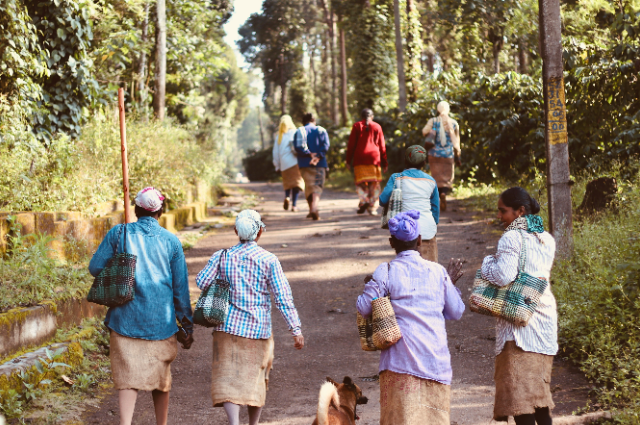
Photo by Ravi N Jha on Unsplash
India likes to imagine itself as a rising power. We talk confidently about becoming a five trillion-dollar economy, about global leadership, digital revolutions, and demographic dividends. There is an almost obsessive fixation on scale. Bigger highways. Faster trains. Larger defence budgets. More unicorns. Growth is the grammar of our political imagination.
But scratch the surface of this shiny narrative, and you find a quieter truth. India’s growth story is held together by unpaid labour, underpaid labour, unrecognized and deeply gendered labour. The country does not run on efficiency. It runs on women stretching themselves thin.
This is not accidental. It is political. And it is convenient.
The Myth of the Self-Reliant Indian Family
Indian policymaking is deeply invested in the idea of the family as a natural welfare unit. The family is expected to absorb shocks that the state refuses to plan for. Illness, unemployment, disability, ageing, childcare, mental health crises. All of it is quietly delegated to households.
And within households, it is delegated to women.
This is why care work is systematically excluded from serious economic conversations. If we acknowledge the sheer volume of unpaid labour women perform, the entire idea of “cheap” growth collapses. India’s economy is not efficient. It is subsidised by women’s unpaid time; It is powered by women’s unpaid labour!
When politicians talk about India’s low fiscal deficit or controlled welfare spending, what they are really celebrating is the transfer of responsibility from the state to women’s bodies. Care is privatised, feminised, and moralised. It becomes a duty and a sacrifice. Never labour.
Unpaid Work Is Not a Cultural Quirk. It Is a Political Design.
There is a tendency to explain women’s unpaid work as culture or tradition, as if it exists outside politics. This is a convenient excuse. Culture does not exist in a vacuum. It is shaped, reinforced, and rewarded by policy choices.
When the state underfunds public childcare, it is not neutral. When schools operate limited hours without after-school support, it is not neutral. When healthcare is expensive and fragmented, it is not neutral. Each of these decisions assumes that someone, somewhere, will pick up the slack. That someone is usually a woman.
The Time Use Survey of India did not reveal a surprise. We already knew women work longer hours than men when paid and unpaid labour are combined. What the data did was expose how systematically invisible this labour is. Despite this, unpaid care work is still treated as a side issue, something to be acknowledged on Women’s Day panels and promptly forgotten during budget allocations.
The Hypocrisy of “Nari Shakti”
Indian political rhetoric is full of praise for women. Nari Shakti is celebrated endlessly. Women are invoked as symbols of strength and sacrifice. But symbolism is cheap. Structural change is expensive.
Consider this contradiction. On one hand, women are glorified as caregivers, homemakers, and community anchors. On the other hand, the same state refuses to recognise care workers as workers. Anganwadi and ASHA workers are the clearest example of this hypocrisy.
These women are responsible for nutrition, maternal health, child development, immunisation outreach, and public health surveillance. During COVID-19, they were literally the frontline. Yet they are still classified as “volunteers.” This is not semantics. This classification strips them of labour rights, job security, pensions, and dignity.
Calling them volunteers allows the state to benefit from their labour without paying its moral or financial dues. It is exploitation with a smile.
When these women protest, as they frequently do, they are accused of being political, disruptive, or ungrateful. As if demanding fair wages is a betrayal of service. As if their exhaustion is a personal failure, not a policy outcome.
Care Work and the Illusion of Choice
There is a persistent narrative that women “choose” to stay out of the workforce. This argument is lazy and dishonest. Choice does not exist in a vacuum. It exists within constraints.
If a woman has to choose between a low-paying, insecure job and unpaid care work that society already expects her to do, that is not a choice. That is coercion disguised as agency.
India’s female labour force participation rate is among the lowest in the world. This is not because Indian women lack ambition or skill. It is because the economy is structured in a way that makes women’s participation conditional and fragile.
The moment care needs increase, women drop out. Pregnancy, childbirth, ageing parents, and disabled family members. There is no safety net. No affordable childcare. No universal elder care. No meaningful support for caregivers of persons with disabilities.
The state’s silence on this is telling. Women’s labour is welcome only when it does not inconvenience patriarchal expectations.
Caste, Care, and Dirty Work
Care work in India is not only gendered. It is caste-coded.
Sanitation work, domestic work, waste picking, nursing, and caregiving are disproportionately done by women from Dalit, Adivasi, and marginalised communities. Their labour is essential, yet deeply stigmatised. They are expected to serve, but not to demand.
Middle-class feminism often celebrates outsourcing domestic work as “liberation.” But liberation for whom? One woman’s freedom is built on another woman’s precarity. The care economy exposes the uncomfortable truth that gender oppression and caste oppression are deeply intertwined.
Despite this, domestic workers remain outside comprehensive labour protection. Attempts to formalise the sector are slow, uneven, and often resisted by those who benefit from informality.
The political message is clear. Care work is necessary, but caregivers are disposable.
Welfare Without Rights Is Not Empowerment
India’s welfare architecture has expanded in recent years. Cash transfers, ration schemes, and insurance coverage. These interventions matter. But they are not substitutes for structural reform.
Welfare without rights keeps people dependent. It does not redistribute power.
Most schemes targeted at women frame them as beneficiaries, not workers or rights-bearing citizens. Women receive aid as mothers or caretakers, not as individuals with economic claims.
This framing is dangerous. It reinforces the idea that women’s primary value lies in their reproductive and caregiving roles. It also allows the state to appear benevolent while avoiding deeper redistribution.
Real empowerment would mean recognising care as infrastructure. Just as roads enable mobility, care services enable participation. Without them, democracy remains skewed in favour of those with fewer caregiving responsibilities, usually men.
Democracy, Time Poverty, and Political Exclusion
Political participation requires time. Time to attend meetings. Time to campaign. Time to read, discuss, organise, and dissent.
Women are time-poor. This is not incidental. It is the direct result of unequal care burdens.
When women are exhausted, democracy loses voices. When caregiving is treated as a private responsibility, public life becomes exclusionary. This is why representation alone is not enough. Without structural support, even elected women representatives are constrained by domestic expectations.
This is also why care work is a democratic issue. A democracy that relies on invisible labour while privileging visible power is not inclusive. It is extractive.
The GDP Obsession and What It Erases
India’s economic success is measured almost entirely through GDP. But GDP does not count unpaid work. It does not count emotional labour. It does not count social reproduction.
This creates a distorted picture of value. A factory that pollutes water adds to GDP. A woman who spends her day caring for children, elders, and the sick adds nothing on paper.
This is absurd. But it is also ideological. What we measure reflects what we value. By excluding care, we signal that it does not matter.
Feminist economists have long argued for alternative metrics that include care work. India has flirted with these ideas but never committed. Because counting care would force uncomfortable questions. Who benefits from invisibility? Who bears the cost?
Why the State Resists a Care-Centred Model
Let’s be honest. A care-centred economic model would be expensive. It would require higher public spending, stronger labour protections, and redistribution of resources. It would also challenge patriarchal power structures that rely on women’s unpaid labour.
It is easier to celebrate women’s resilience than to dismantle the systems that demand it.
It is easier to praise motherhood than to fund childcare.
It is easier to clap for frontline workers than to pay them.
This is why care remains marginal in political debates. Not because it is unimportant, but because it threatens existing hierarchies.
Democracy Beyond the Ballot
At its core, the question of care work is a question about democracy. Who is heard? Whose labour is recognised? Whose exhaustion is normalised?
A democracy that relies on invisible labour while celebrating visible power is an incomplete one. When women’s time is treated as an infinite resource, their political participation also suffers. Attending meetings, campaigning, or even voting can become a logistical challenge when care responsibilities are non-negotiable and unsupported.
This is why representation matters, but not just in numbers. Women in decision-making spaces need the political will to question economic models that externalise care costs onto households. They need to push for budgets that reflect lived realities, not just macroeconomic ambitions.
Rethinking Growth, Rethinking Value
India is at a point where it wants to project itself as a global economic power. But growth that ignores care is brittle. It rests on burnout, inequality, and silent labour.
Recognising the care economy does not mean romanticising it. It means valuing it honestly. It means counting it in national accounts, investing in public services, formalising care work, and redistributing responsibility across genders, families, markets, and the state.
It also means changing how we talk about work. Productivity is not only about output per hour. It is also about well-being and social reproduction. A society that exhausts its caregivers is not efficient. It is shortsighted.
Where Do We Go From Here?
There are signs of movement. Feminist economists and labour unions have long been pushing these conversations. Time-use surveys, care policies, and global discussions around a care-led recovery offer tools and frameworks.
But political will remains uneven. Care work still struggles to compete with headline-friendly infrastructure projects. It still lacks the drama of megaprojects and the symbolism of national pride.
Perhaps the real challenge is narrative. Care work does not look powerful in the traditional sense. It is slow, repetitive, and intimate. It does not fit easily into slogans. Yet it is precisely this work that allows everything else to function.
If Indian democracy is serious about inclusion and justice, it must learn to speak the language of care, not as charity, but as politics.
Because the hands that hold society together should not have to remain invisible for the system to stand.
Imagining a Different Political Future
What would it mean to take care seriously?
It would mean universal childcare as a right, not a privilege.
It would mean formal recognition and fair wages for care workers.
It would mean pensions and social security for caregivers.
It would mean shared responsibility across genders, backed by policy, not just moral appeals.
It would mean measuring success not just by growth rates, but by well-being.
This is not radical. It is rational. Societies that invest in care are more resilient, more equitable, and more democratic.
India does not lack resources. It lacks political courage.
Final Thoughts: Care Is Political, Whether We Admit It or Not
Care is not soft. It is not secondary. It is not apolitical.
It is the foundation on which everything else rests.
Ignoring it is not neutrality. It is a choice. A choice to maintain inequality. A choice to protect power. A choice to let women absorb the cost of development.
If India truly wants to be a global leader, it must stop treating care as charity and start treating it as justice.
Because a nation that grows by exhausting its caregivers is not rising. It is eroding from within.
. . .
References:
- Government of India, Ministry of Statistics and Programme Implementation. Time Use Survey, 2019.
- International Labour Organization. Care Work and Care Jobs for the Future of Decent Work.
- UN Women. Progress of the World’s Women: Families in a Changing World.
- Devaki Jain. Women, Development, and the UN.
- Oxfam India. Inequality Kills and COVID-19 Impact Reports.
- Jayati Ghosh, various writings on labour, informality, and the care economy.
- Feminist Economics Journal, multiple articles on unpaid labour and GDP limitations.
- National Platform for Domestic Workers reports on informality and labour rights.