
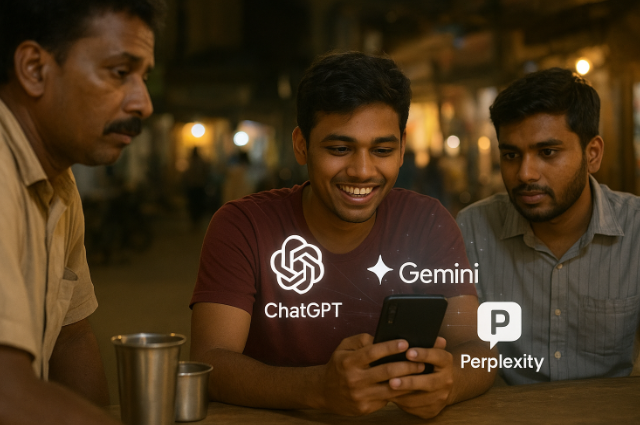
One evening at a chai stall in Pune, I overheard a college student tell his friend, “Bro, Gemini Pro is free for 18 months if you use Jio. I’m ditching ChatGPT.” His tone was triumphant, as if he’d discovered a cheat code to life. The friend nodded, eyes glued to his phone, scrolling through Reels about “Top 5 Free AI Tools You Must Try.” The stall owner, who had just learned how to use UPI, listened silently, perhaps wondering what this “AI” thing was, and whether it would soon start demanding QR payments too.
That small scene—three Indians, three worlds—captures our moment. A nation of over a billion, connected by fibre optics and faith in “free.” From free data to free streaming to free AI, India’s digital story has always begun with a gift. But as every Indian knows, even prasad comes after devotion. The question is: devotion to what?
1. From Free Data to Free Thinking
In 2016, Jio changed everything. Data became cheaper than cutting chai. The average Indian went from consuming 0.3 GB a month to 17 GB. Families that once argued over who’d use the TV remote now fought over bandwidth. Suddenly, even the most remote corners of the country began humming with YouTube videos, WhatsApp forwards, and new dreams.
That “free data revolution” did more than connect India—it rewired it. The poor were now online, the middle class was addicted, and the rich were quietly building the apps everyone else would use. The playing field looked level; in truth, the ground had only shifted. Reliance gave us data; in return, it got the keys to our habits.
Today, that playbook has returned, wearing a smarter face and a smoother voice. Instead of data, we are being offered “intelligence”—for free. Gemini Pro, Perplexity, Copilot, and Claude—all eager to serve the Indian user, for no cost. Just a few clicks, a few prompts, a few billion thoughts in exchange.
Free data connected our hands. Free AI now connects our minds.
2. The Trojan Horse of Generosity
We called it a “strategic Trojan horse.” The phrase fits perfectly. No empire walks in with armies anymore; they come as apps, updates, and “user-friendly” AI companions. When Jio offered free data, it wasn’t charity. It was a calculated capture of attention. Once you became dependent, payment was only a matter of time. The same is happening with AI. Jio now offers 18 months of free Gemini Pro access. Airtel has tied up with Perplexity to give “free premium” tools. For now, everything sparkles under the banner of generosity. But as history teaches us, “free” is the most expensive business model of all.
Behind the benevolence lies the quiet harvest of data. Every query you ask, every paragraph you draft, every doubt you whisper to your chatbot—it all becomes a data point in someone else’s model. The machine learns not just your words but your rhythm, your politics, your insecurities. What earlier required armies of ethnographers and surveyors now flows freely through chat windows.
India is not just a market anymore; it is a living laboratory. Over 600 million smartphone users, 80 million active internet users, one of the youngest populations in the world—what better testbed could there be for training machines to think like humans? And not just any humans, but Indians—those who switch between Hindi and English mid-sentence, who ask “AI, tell me in a simple way yaar,” and who trust digital miracles more than government ones.
3. The Gold Mine of Diversity
For decades, India’s diversity was its bureaucratic nightmare. Too many languages, too many customs, too many forms of thought. Now, suddenly, it’s our most valuable export. AI giants see in our multiplicity a gold mine of training data. A Tamil tweet, a Bengali blog, a Punjabi meme—all of it feeds the global intelligence economy. The machine learns how we talk, think, argue, pray, and procrastinate. Our pluralism becomes someone else’s algorithm.
When the transcript says, “India is the largest living laboratory of the human,” it isn’t an exaggeration. Each time we speak to AI in mixed tongues—“Bhai, tell me today’s temperature in Celsius please”—we’re not just using technology; we’re training it. We’re turning India’s messy, musical way of thinking into a commodity. In the old colonial days, British ships carried cotton and spices from Indian ports. Today, cables carry our digital essence across oceans—our searches, our slang, our secrets. Data colonialism doesn’t wear a crown; it wears a user interface.
4. A Nation of Habits
An old Indian is saying: “A seed sown in habit becomes destiny.” The new AI wave isn’t about creating smarter Indians—it’s about creating habitual ones. Remember how Jio first offered everything free—calls, data, movies—and then slowly began to charge once everyone was hooked? That was not innovation. That was behavioural economics wrapped in patriotism. The same psychology now powers AI. Give the public something free long enough, and they’ll forget it ever had a price.
Dependency is not built overnight; it’s engineered. Every chatbot reply that saves you a minute, every AI tool that writes your emails or summaries—each of these conveniences quietly reduces your discomfort with outsourcing thought. You start by asking AI to write an email. Soon, you ask it to explain a concept. Then, one day, you find yourself asking it what you believe. We called it “mental rut”—a condition where our cognitive muscles atrophy from disuse. A generation that once prided itself on jugaad and intuition may now need prompts to think.
5. The Intelligence Economy
In the twentieth century, nations fought for oil. In the twenty-first century, they fight for data. But in this new “intelligence economy,” the currency is subtler: human attention, behavioural patterns, linguistic nuance, emotional vulnerability. AI doesn’t just need data—it needs personality. It needs to know how Indians disagree, flirt, debate, or evade. It needs to understand what keeps us scrolling at midnight. That is why India is irresistible: a billion untapped behavioural datasets waiting to be mined.
The irony is, while global firms rush to capture our cognitive markets, our domestic ecosystem still struggles for GPUs, policy clarity, and funding. Training a large model costs over $100 million; India imports 90% of its GPUs. So, we welcome partnerships with open arms, hoping to “collaborate” while they quietly colonise. Meanwhile, Indian AI startups play catch-up, feeding on crumbs of open-source generosity. By the time our regulation wakes up, the ecosystem will already be owned—our minds running on foreign code, our imagination filtered through corporate APIs.
6. The Ghost of Jio Past
Every revolution has its ghosts. The ghost of Jio still haunts us.
When Reliance entered telecom with free data, it flattened an entire industry. Smaller players vanished, unable to compete. Once the monopoly was achieved, the price of “free” became clear. We traded diversity for dominance, competition for convenience. Now, the same script unfolds in the AI world. First comes the flood of free tools—sleek, multilingual, “inclusive.” Then comes the lock-in, the premium tier, the ecosystem capture. You won’t pay at first, but you’ll adapt. And once you adapt, you’ll comply.
It’s the oldest trick in capitalism: train the customer, then train the price. The educator’s line—“Free is not charity; it’s a weapon to capture the future market”—should be engraved in our digital constitution. Every free feature is a psychological handshake, a way of saying: “Let me inside your head; I’ll charge you later.”
7. Between Dependence and Dignity
The tragedy of digital dependence is not that machines replace us, but that they redefine us. When algorithms start predicting your next thought, individuality begins to blur. Your creativity, once spontaneous, becomes statistically probable. Consider how many Indians now write using AI-assisted tools—students, lawyers, marketers, even essayists. The tone, structure, and style begin to converge. We start sounding the same because the same algorithm edits our thoughts.
There’s a silent flattening happening—a loss of texture in the Indian voice. The chaos that once defined our culture—the mix of Urdu idioms, Sanskrit echoes, and Hinglish humour—is being streamlined into “globally understandable English.” Machines love order; India has always thrived on disorder. In that tension lies the real question: Can India remain India once its mind is standardised?
8. Regulation in Slow Motion
By the time our lawmakers draft a policy, the technology has already evolved. The Digital Personal Data Protection Act is still catching up to yesterday’s internet, while AI has already moved on to tomorrow’s consciousness. Regulation moves in months; algorithms move in milliseconds. The educator rightly observed that global firms “build dominance before regulations catch up.” It’s a pattern we’ve seen before—with social media, e-commerce, fintech. We legalise after the fact.
India’s AI regulation remains a draft on the table while our youth feed petabytes of conversational data into foreign models daily. Once dependence sets in, legislation becomes symbolic. You can’t regulate what people are addicted to. You can only normalise it.
9. The New Digital Faith
Every Indian generation has had its own faith. Our grandparents believed in the nation. Our parents believed in jobs. We, the post-Jio generation, believe in algorithms. We wake up and ask ChatGPT for motivation, use Google Maps to avoid getting lost, ask Gemini to summarise news, and rely on Perplexity to answer existential questions. Slowly, human trust migrates from priests and teachers to predictive models.
AI becomes our new temple—omniscient, responsive, mostly kind. But it’s a god with a billing plan. The spiritual irony is striking. We used to chant “Sarvam Vishnumayam”—everything is filled with the divine. Now, our daily mantra could be “Sarvam Algorithmayam”—everything is filled with data. We once feared losing our souls to materialism. Today, we risk losing them to machine learning.
10. What Does “Free” Really Cost?
When a farmer gives you a free mango, you know it’s out of affection. When a multinational gives you a free app, it’s out of strategy. The real price of free AI is not money; it’s mindshare. Each time you let a chatbot finish your thought, you pay with a fragment of autonomy. Each time you rely on AI to explain the world, you surrender a piece of your curiosity.
India has always prided itself on thinking differently—from Gandhi’s salt march to Narayan’s small-town stories. We’ve resisted uniformity, celebrated confusion, and questioned authority. Yet today, we risk trading that freedom of thought for the convenience of ready answers. The revolution that began with “Free Data” now threatens to end with “Free Thinking”—thinking that costs us nothing, because it’s no longer ours.
11. The Reflection
So what happens next? Will India, the ancient land of ideas, outsource its thinking to machines? Or will we learn to use AI without losing our souls? Perhaps the answer lies not in rejection but in reflection. We can build our own models—trained on our languages, our ethics, our memories. We can insist that technology serves our pluralism instead of flattening it. But for that, we must first remember what the word “free” really means. In Sanskrit, “mukti” means liberation. In modern India, “free” means offer. We’ve confused emancipation with marketing.
To be truly free in the age of Free AI, we must reclaim the right to think, to doubt, to be inconveniently human. The machines can help us write, but they must never write for us. Because the moment India stops thinking for itself, it won’t matter how intelligent our machines become. The light that once guided civilisations will flicker—not from lack of data, but from lack of depth.