
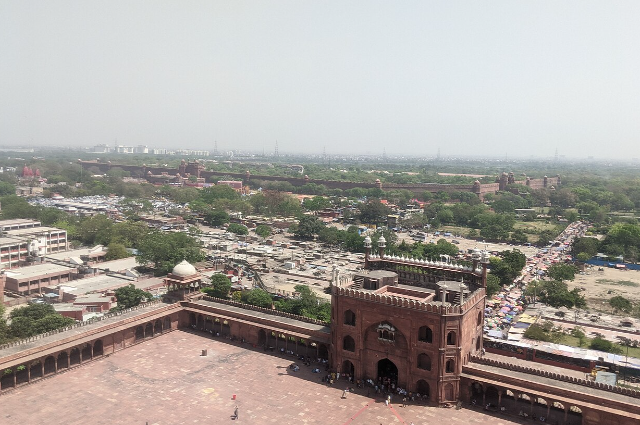
There is a peculiar kind of quiet that follows a loud event—and I don’t mean the silence that follows thunder in a summer monsoon. I mean the muted swirl of uncertainty, the lull that comes when glass has shattered, and we are left listening not to the sound of a bomb, but to the space it carved out in our lives.
On the evening of 10 November 2025, as the evening dusk settled over Delhi, a blast near the majestic ramparts of the Red Fort jolted more than steel, more than concrete. It jolted our sense of safety, the social contract, our collective reflexes. A car emerging slowly from a parking lot near the golden mosque, taking a U-turn, stopping at a red light, and then—nothing prepared the onlookers for the explosion. Lives lost, 150-metre-distant debris flying, street-lights dying, shop-keepers shaken, glass raining on innocent bystanders. The shock was physical and symbolic.
But after the siege of noise, the hushed investigations began. Empty corridors of unanswered questions. Families left scrambling. The avalanche of speculation began even before the facts had settled. And amid it all, we the citizens stood—with our phones, our biases, our fears, our cameras rolling.
This incident, raw and tragic, is more than one more “blast report” in the newspapers. It is a prism through which we can examine three intertwined realities of contemporary India: our vulnerability, our institutional fragility, and the burden of meaning-making in times of trauma.
1. Vulnerability in Public Space
It’s easy to think of public spaces as neutral grounds—roads, metros, junctions, plazas. But they are never neutral. They carry our aspirations, our freedoms, our fears. On that cool November evening, the blast near the metro station gate at the Red Fort told us something vital: vulnerability is not remote; it is adjacent.
The car that had started slowly from the mosque-parking lot, near the rich tapestry of Mughal walls and tourist footfall, came to a halt. Then the explosion. Six cars and three autorickshaws went up in flames. Glass from other vehicles shattered. Meters of debris flew across the road. The blast was heard up to ITO, 2.5 km away.
What does it mean when the ‘public’ becomes a site of terror? Think of the commuter at the metro gate, the shop-owner selling saris and lehengas a few feet away. The rickshaw driver ferries daily wages. A housewife stepping out for groceries. The danger is not in the missile or grenade but more tragically in the banal everyday trajectory: stop at a red light, turn into a lane, stand near a barrier, get hit. The blast turned them from background figures into victims. Real names followed later: a cab-driver, a rickshaw puller and their families. The human cost was immediate: of the twenty-plus injured, eight died before reaching the hospital; official records put the fatalities at thirteen.
For us, this raises a question we prefer to ignore: how safe is the “everyday”? We chase mega infrastructure, smart cities, tech-zones—yet, just off the roads of history’s splendour, a bomb can rend the ordinary. For many urban Indians, vulnerability is not a film scene or distant headline—it is the red light, the autorickshaw, the commuter’s pause.
And if we look beyond the city, imagine a small town in Kerala, or a village in northern India. No busy metro gates. No tourist hordes. But the same logic: the everyday is perilous. The shopkeeper, the schoolmaster, the afternoon tea-vendor. The “when the unexpected happens” doesn’t look like an alien plot—it looks like routine turned upside down. The blast is the exception—but what it exposes is the habitual: we live in fragile shells of security.
2. Institutional Fragility and the Long Shadow of Delay
We like to believe in big, strong institutions. The Home Ministry. Police. Anti-terror squads. Investigative agencies. They are our guardians in stories we tell ourselves. But the Red Fort incident lays bare something else: the gap between expectation and reality.
Here is how it unfolded: At approximately 6:55 PM, the call went to the Delhi Fire Services. Seven fire tenders were sent. Within 10 minutes (by around 7:00), the police arrived. Ambulances arrived by about 7:15. Residents of Chandni Chowk helped victims even before ambulances arrived. That’s commendable citizen solidarity—but the real question is: why did our formal systems act only after a wave of destruction had occurred?
Then comes the investigative machinery. The National Investigation Agency (NIA), the National Security Guard (NSG), forensic teams, and bomb-disposal squads all arrived. Yet the government offers no official explanation of who did what and why. Six identities of the deceased have been confirmed—many families still wait.
And then the reveal of a larger link. On the same date, arrests were made in Faridabad: two doctors, alleged to be tied to militant organisations, explosives, weapons, and a possible link to the blast. Some media reported a connection between these arrests and the Red Fort explosion. The flip-side: not officially confirmed. Still, the suspicion is fueling the media engine.
When we depend on institutions for protection, clarity, transparency and accountability, what happens when they falter or respond late or only murkily? The blast asks us this plainly.
A lawyer, a startup-founder, an entrepreneur, we know the value of contracts, of audit trails, of accountability. What we witnessed here is a contract broken: the state promises security, we pay with taxes, and we hold tight to our everyday lives. Yet the shield slipped, and the investigation limped.
In India’s long history of unresolved events, this is unfortunately common. Attacks whose details drag on, scars that remain open, victims who wait. Red Fort is not unique—but it is perhaps emblematic. Safety is promised; we live as though it exists; then we are jolted awake.
And post-event, the media swirl: the TV channels chasing sensational angles, social-media trolls spinning narratives of hate, the public jumping to conclusions without data. The reality warns about three threats: sensationalist media, hate-mongering trolls, and our own biases. That is ammunition not for bombs but for breakdowns of trust.
3. The Meaning-making Imperative: Memory, Guilt, and the Future
After trauma—whether national or personal—what we do next matters. We remember. We forget. We ask why. We live on. In the days after the blast, media churned, and official statements emerged (for example, the Prime Minister calling it a conspiracy). But memory isn’t just official press releases. It is how we incorporate the event into our collective psyche, how we rebuild normalcy, how the lives of the 13 lost become not just footnotes but cautionary tales or catalysts of reform—or simply vanish into statistics.
Let me tell you a story. In a village in Kerala, months after a small fire in a toddy shop (not remote but humble), people gathered—not immediately for blame or politics—but for talking. Over tea. “We didn’t know our wiring was so old,” said one. “We didn’t realise how fast fire can spread.” What happened there wasn’t a grand conspiracy—it was neglect. But the community still chose to remember: the day, the time, the loss.
In Delhi, though, you have larger stakes: geopolitics, terrorism, institutions, identity. The victims had names: Lokesh Agrawal from UP visiting his son’s family; Ashok Kumar, the DTC bus-conductor from Amroha; Pankaj Saini, the cab-driver; Dinesh Mishra, the salesman in a saree-shop; Noman in a cosmetic store; Jumman Mohammad, the e-rickshaw driver and sole earner of his family. These are not faceless numbers—they were fathers, sons, earners, workers. Their absence ripples in homes left behind.
We owe them meaning—not just news headlines. We must ask: What has changed for their families? What is the fix in the procedure so this doesn’t recur? Will investigations conclude or vanish into dust? Will the next red-light stop be safer because of this? Will our society build empathy fast enough?
Here’s the deeper reflection: entropy is always working. Memories fade, reform languishes, and daily life resumes. The bomb went off. The streetlights died. Glass shattered. But in weeks, we might shrug and carry on. That’s the risk: that the disruption becomes routine.
We have to remind ourselves to keep our cool. Don’t buy into sensationalism, don’t spread hasty conspiracy theories, don’t let hate-mongers win. Maintain a critical lens. It is piercingly honest. But it’s more than that: it’s an invitation to regenerate compassion. To say: yes, it was horrible, but now we step forward.
I think of the shopkeepers who were seconds away from disaster. They will open their shutters again. The rickshaw drivers will gather at stands. Commuters will queue at the metro. Life resumes. But what we do in that resumption is important. Do we change the wiring of trust? Do we upgrade our safety systems? Do we revisit our biases when we hear unverified claims?
Because underneath the blast lies a more persistent enemy: complacency.
4. The Politics of Fear and the Business of Blame
There is a caution about jumping to conclusions: “Without any evidence… reaching conclusions… is wrong.” But it also highlights political and investigative angles: the fact that an FIR under the Unlawful Activities (Prevention) Act (UAPA) has been filed—a law used for terrorism. The Prime Minister’s statement called it a conspiracy. So the public narrative is already being shaped before the final facts.
In Indian public life, fear is a currency. The infrastructure of fear—surveillance, laws, media coverage—is already in place. A blast near a national monument easily becomes a story of national security, of borders, of ideological wars. Whether or not the motive is fully known, the frame is set: terrorism, conspiracies, national enemy.
So what happens when fear becomes the default lens?
- Policy gap widens. We may support stronger laws, bigger forces, maybe at the cost of civil liberties.
- We become suspicious of neighbours, communities. The troll-machine gears up: “See, they did this because….” “They are traitors because….”
- We shine less light on root causes like poor enforcement, missing checks, and institutional sloppiness because it is easier to say “terror” than “negligence”.
We tend to jump to conclusions, plug things into political plots, or see electoral angles—“blast day just ahead of Bihar elections, so it must be connected”. That’s both human and hazardous.
As a society, we must ask: are we reacting because of logic or because of preloaded scripts? When a blast happens, the script of “terror attack” is ready. The script of “infrastructure failure” or “poor oversight” rarely gets prime headlines. Yet both are real.
In our current moment—entrepreneurs, lawyers, thinkers—there’s a role for us: not to leap into the first headline, but to ask the harder questions: Why were 3,000 kg of explosives in a rented house in Faridabad? How did a vehicle with a suspicious number plate chain migrate across owners? Who really gets held accountable when the public square is assaulted?
Because if we don’t demand those questions—and real answers—then even if the criminals are caught, the systemic rot remains.
5. Healing and Responsibility: The Micro and the Macro
In the wake of this tragedy, we see citizen responses: residents of Chandni Chowk helping victims before ambulance arrival. Demonstrations of humanity amidst horror. That’s the micro level. At the macro level, governments are issuing high alerts in Mumbai and across India. The investigative machinery kicked in.
But healing and responsibility work differently: they are long-term, patient, infrastructural. It means: reviewing rules for vehicle tracking, explosives control, public-space audits, and metro-station perimeters. It means: compensating victim-families with dignity, not just cheque-book gestures. It means: building trust so that next time the citizen doesn't wait for the ambulance while neighbours scramble.
And for each of us: the responsibility of witnessing. Not as passive bystanders but as engaged citizens. When cameras roll, when phones capture disaster—remember the human behind the images. When media bursts with speculation—pause. When we see ourselves pointing fingers, check our biases.
There is also something bigger: the responsibility of memory. For the families of the 13 dead, this will not be a one-week news cycle. For them, it will be a lifetime of unanswered questions. We owe them more than communal hashtags and minute-silence screen fillers. We owe them empathy that persists.
Here, amid the national monument and high politics, we too need small acts: checking street-lighting, verifying taxi credentials, asking for regular audits of public spaces. For the entrepreneur: building safety in projects. For the lawyer: insisting on accountability frameworks. For the writer: refusing the trendy narrative until the facts emerge.
The explosion near the Red Fort is not just a blast. It is a mirror. It mirrors our vulnerabilities, our institutional lacunae, our impulses toward fear, our rush to blame, and the simultaneous hope that something better is still possible.
When the smoke clears, when the media cameras move on, when life resumes its rhythm of unaccented days, what remains is our collective choice. Will we default to suspicion and division, or will we rebuild the ambient safety of public life? Will we treat the victims’ lives as mere numbers in a security bulletin or as calls to action?
In the end, trauma does not vanish by itself. It demands to be remembered—not to bind us in guilt but to awake us in responsibility. The streets near the metro gate will see commuters again. The saris and lehengas in the shop will hang again. The rickshaw will wait. But we must ask: will they be safer? Will our institutions be clearer? Will our society be kinder and more vigilant?
In this country of millions of small disruptions and bigger silences, we must not let this story slip into the background. Because everyday vulnerability, institutional gaps, the business of blame, the demand for meaning—they are all parts of our shared architecture. And to build better, we need to talk about them. Not just in TV anchors’ shouting zones—but over tea, in the dim light of conversation, in the quiet corners of reflection.
The glass shattered. The lamp went out. But the flame of remembering, the lamp of accountability, still flickers. It is for us to keep it alive.