
You can be a student or a working professional; it doesn’t matter; you will be using AI in one form or another in your day-to-day life. It helps us complete our work faster and provides us with the information and data we need in a split second.
Students use it to study, writers use it to generate first drafts and explore ideas, and working professionals will be using it to draft emails, reports, and so on. AI is being used in different fields like engineering, education, and even healthcare.

So, as I said before, you are going to be using AI directly or indirectly in one form or another. Every company out there is trying to stuff AI into their product. We have AI computers, AI fridges, AI washing machines, AI wardrobe managers, and even an AI for designing a bathroom.
So you see, AI has become an integral part of our lives in one way or another, which cannot be denied.
But like Morgan Housel, the author of The Psychology of Money, once quoted,
“Everything has a price, but not all prices appear on the label,”
we are here to discuss the unseen price we are paying for using AI.
To be honest, this quote was meant for a completely different scenario in one of his books, but I had to include this quote because it sums up the entire article perfectly.
AI and Water Consumption
Before we see the relationship between AI and water and its impact on the environment, we must first understand how exactly an AI works and why it needs water.

AI and Data Center
In simple terms, an AI data center is the place where the infrastructure needed to train and keep AI running is housed. An AI data center is much more powerful than a normal data center.
Both have some similarities, but the major difference arises from its power consumption and the resulting heat generated, which in turn requires advanced cooling systems.
This is where the problems start. AI data centers are occupying large acres of land, it devours too much electricity, and it then consumes too much water to keep the machines cool.
AI data centers need a large amount of land, which the Lincoln Institute of Land Policy notes will not be available for nature, agriculture, or even humans to live. To clearly show you how much land data centers occupy, let's look at some examples.
The United Nations University’s Institute for Water, Environment and Health estimates that the land footprint (real amount of land used) associated with training GPT-4 is roughly 126 football fields, and for GPT-5, it is 210 football fields; and this is just for 2 training models.
In an article published by the United Nations, it is estimated that by the end of 2030, the land footprint associated with AI will be approximately 14,500 square kilometres. Forget football fields for a second; this is equivalent to a city. The same article states that this is more or less twice the size of the Jakarta metropolitan area.
So that's one thing. The next problem would be the amount of electricity it uses. As I said earlier, AI data centers are much more complex and powerful than traditional data centers, so naturally the amount of electricity needed will also be really high. In a report published by IEA.org, it is stated that in 2024, data centers consumed around 1.5% of global electricity consumption, or around 415 terawatt-hours.
And it is not stopping there. The demand and usage of AI just keep growing, meaning that the associated electricity consumption will also increase. It is so high that Goldman Sachs Research estimates a 160% increase in power demand by 2030.
Now comes the important area of concern and the core of our article. AI data centers also need tremendous amounts of water.
Why does AI need water?
We have seen that it requires a lot of power, and there is advanced equipment in a data center. So, when machines work, it produces heat. And with this much processing and electrical consumption, it is bound to produce a high level of heat.
This is where the water comes in. To cool these machines and to keep them from overheating, water is used. But why water, and why not any other means to cool the machines?
Because water is much more effective in transferring heat. If we fail to reduce the heat generated by these servers, it may lead to hardware failure, data loss, server downtime, etc, which is not something to be taken lightly, especially in this digital-first era.
By now you must be wondering why this water can’t be reused again and again.
Unfortunately, most of the water will be lost during evaporation, and the remaining water will be slightly contaminated, which cannot be used to cool the machines as it might damage them.
Again, the next question would be: what about salt water?
Salt water would leave behind salt and other minerals, which again can damage the machines.
So this is the reason why freshwater is being used instead of other forms of cooling.
How much water does AI use?
Due to high amounts of heat, the amount of water required to cool it is also massive.
It is said that even mid-sized data centers can consume water equivalent to what a small town consumes. Some sources state that this can go up to 5 million gallons per day, but the amount of water used depends on factors like the size of the center, the location, etc.
In 2020, the data centers in the US used approximately 659 billion litres of water for cooling collectively.
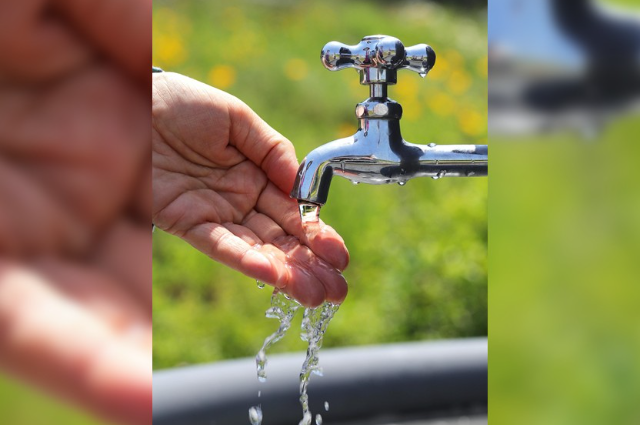
Image by HeungSoon from Pixabay
There are even claims that to write just a short email, AI can use half to three litres of water, just for a simple and short email.
The UN estimates that by the end of the decade, water used to cool these centers will equal what 1.3 billion people will use annually for domestic purposes alone.
As you know, today AI is accessible to almost all people in every nook and corner of the world. You just need a device with an internet connection. So, as estimated by the UN, somewhere around 2.5 billion prompts are processed in just one day.
Yes, in a single day.
So think about it: even small prompts consume a significant amount of water; combine that with people all around the world using it, and companies all around the world integrating it into virtually all products, from browsers and mobile apps to even physical devices like fridges and PCs. The energy and water usage also depends on the model being used; the more powerful the model, the more resources it consumes.
So, you can see why this is becoming a bigger issue. If data centers continue to use fresh water, it will definitely lead to a water shortage.
How are people reacting?
Honestly, I don't think most people know about this because the end user can’t see what’s happening out there; for example, we know about air pollution because we can see it with our own eyes, but in this case, we can’t directly see it. The only way to know about this is either by reading it somewhere or by someone telling you about it.
And those who do know about it mostly oppose it, and if you have read this article, you would understand why. There have been protests globally; this is not just in one or two countries but literally every major country where data centers were planned, from the US and Europe to India and Indonesia.
The reason for these protests is common: FEAR.
Fear of water and resource scarcity.
Can you really stop using AI once and for all?
I think that's not really possible at this point. With everything revolving around AI, I don’t know how that will turn out.
We also must accept the importance of AI. AI is being used to tackle some serious crises, from improving crop yields to environmental monitoring, which is kind of ironic considering what we are discussing here, but it's true.
AI is helping us in unimaginable ways. AI is helping us save water, food, and so many other resources. It helps us tackle serious issues in fields like healthcare and engineering. So we can’t deny the fact that AI is useful and effective.
Image by Vilius Kukanauskas from Pixabay
As I mentioned at the start of this article, it also helps us with our daily activities like learning, planning, idea generation, etc.
Being in the tech industry, I have seen the usefulness of AI. I am a content writer, and everyone in this field knows how hard and boring it can be. Coming up with ideas, drafting the content, researching, etc.
This would normally take days and even up to a week in some cases. But with the help of AI, I can do this considerably faster.
So there is no denying the fact that AI is useful. But on the other hand, we must also acknowledge and understand its trade-offs. Only then can we make sure that we are using AI to its fullest potential while also reducing its negative impact.
The more we understand it, the better we can plan and regulate it.
So the next logical step would be to find sustainable ways to operate the data centers.
Initiatives taken to reduce water and resource usage
The good news is, companies and governments are starting to realise the damage and have started working towards responsible AI usage.
The United Nations urges them to use sustainable and efficient ways to reduce resource wastage. One notable example of this would be New York, which became the first US state to temporarily pause data center construction for a year in 2026, in order to first prepare a strong framework to reduce resource depletion and save the community. The main aim of this framework is to build data centers in a sustainable way without affecting the community around them.
New methods of cooling are already being tested and introduced, such as direct-to-chip cooling, immersion cooling, free cooling, etc.
Also, EESI.org states that if the data centers switch to renewable energy sources, this can significantly reduce indirect water consumption associated with electricity production. You see, almost 56% of the electricity used by these data centers is produced by fossil fuels, which come from sources like coal plants, which consume a lot of water to produce electricity. Therefore, by replacing the centers with renewable sources like solar, we can drastically reduce indirect water consumption like this.
This means “WATER FOR ALL”
In addition, the UK Government Sustainable ICT blog states several sustainable ways to reduce environmental impact related to AI usage. It includes avoiding constructing data centres in places where there is already a water shortage and constructing data centers in a way that doesn’t affect the biodiversity in that area.
Another notable strategy highlighted by OECD.AI in their blog is using tailored strategies. This means adapting to the environment around it. For instance, let's say a data center is located in areas with severe water shortages, so techniques like zero or low water cooling can be implemented. Likewise, if a data center is located near a cold environment, an air cooling strategy can be implemented where cold air is used to cool down the servers instead of water.
This is definitely a vital strategy to consider because Bloomberg News found that a majority of the data centers established since 2022 are in areas where there is a water shortage, specifically in the US.
Following these sustainable ways helps us drastically reduce resource usage.
Tech giants like Amazon, Google, Microsoft, and many others have started transitioning towards renewable and carbon-free electricity. Many firms are also in the process of creating new resource-efficient AI models and workflows, which can help save significant resources.
Conclusion
So now I ask you guys, what do you think we should do?
I am not saying AI is useless; it is really useful. It makes our lives easier; we learn new things, and it helps us to be productive, so there is no denying the positive impact it has.
All I am trying to say is that its negative impact also cannot be ignored. We can use AI, but it must be in a responsible way.
This is not just for AI; even normal data centers use an incredible amount of water. Just because it is not AI doesn’t mean it can't use up fresh water. And this is not only for data centers; several other industries use massive amounts of water.
Though I wrote this article about AI and its impact on water, the core idea is around one thing: taking care of our natural resources.
We need nature to survive: the air we breathe, the food we eat, the land we live on, and the water we drink. Without these, there is no life.
We need technology to live and function today, but it must be in a sustainable way. So all I am trying to say is simple.
No amount of technology or comfort is worth destroying our natural resources.
References
- https://www.ibm.com/
- https://www.cisco.com
- https://foe.org
- https://www.rcrwireless.com
- https://news.un.org/
- https://www.eesi.org
- https://www.sciencedirect.com
- Aczel M., Chamanara S., Matin M., Farsi A., Marwala T., Madani K. (2026) Environmental Cost of AI's Energy Use: Carbon, Water and Land Footprints, United Nations University Institute for Water, Environment and Health (UNU-INWEH), Richmond Hill, Ontario, Canada, doi: 10.53328/INR26RMA002. Link: https://unu.edu/inweh
- https://sustainableict.blog.gov.uk
- https://www.independent.co.uk
- https://oecd.ai
- https://www.bcg.com
- https://www.bloomberg.com
- https://www.weforum.org
- https://www.lincolninst.edu
- https://www.iea.org
- https://www.goldmansachs.com
- https://electronics.howstuffworks.com
- https://thinklandscape.globallandscapesforum.org
- https://www.theguardian.com
- https://time.com
- https://www.downtoearth.org.in
- https://earthjournalism.net