
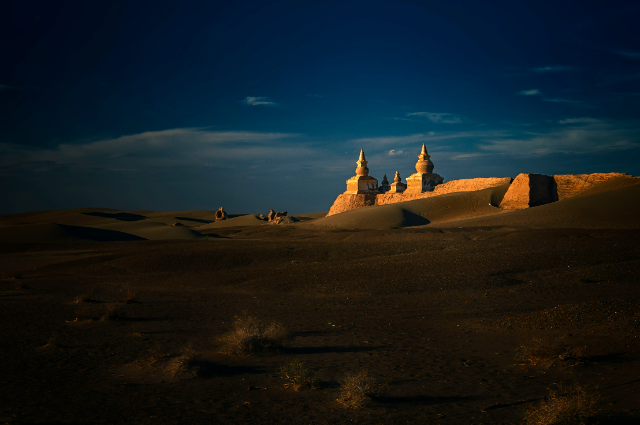
In the vast and dry stretches of Rajasthan’s Thar Desert, close to the India–Pakistan border, stands the Tanot Mata Temple. At first glance, it appears like a simple desert shrine. However, its history is deeply connected to war, survival, and an unexplained mystery that continues to fascinate soldiers, devotees, and researchers alike.
The temple gained national attention because of its strange connection with the Indo–Pakistan wars of 1965 and 1971. During both conflicts, the area around Tanot experienced intense military action. Bombs, shells, and tanks dominated the desert landscape. Many posts and villages suffered heavy damage. Yet, the Tanot Mata Temple remained completely unharmed. This unexpected survival turned the temple into a symbol of mystery and belief, often referred to as “The Miracle Temple.”
The 1965 War: Bombs That Refused to Explode
The first major incident occurred during the 1965 Indo–Pakistan war. The Tanot region was of strategic importance, and Pakistani forces attempted to weaken Indian positions by launching a powerful artillery attack. It is estimated that nearly 3,000 shells were fired towards the Tanot sector during this period.
What followed shocked everyone involved.
Hundreds of shells landed in and around the temple complex. Reports suggest that nearly 450 bombs fell directly inside the temple courtyard. In normal circumstances, such shelling would have reduced the structure to rubble. Surprisingly, none of the bombs exploded. The shells lay scattered on the ground, inactive and silent.
Even more astonishing was the condition of the temple. The walls remained intact, the structure showed no damage, and there were no visible signs of destruction. Soldiers stationed nearby could hardly believe what they were witnessing. The repeated failure of artillery shells raised serious questions, even among experienced military personnel.
Stories from the Soldiers
Alongside official military reports, personal stories from Indian soldiers began to emerge. Many soldiers believed that the protection of the temple was not accidental. According to popular belief, Tanot Mata appeared in the dreams of several soldiers during the period of heavy shelling.
In these dreams, the goddess assured them that they would be safe if they continued their duty without fear. This belief gave the soldiers emotional strength at a time when danger surrounded them. Several soldiers later said that their fear slowly turned into confidence after these experiences.
For them, the unexploded bombs were a clear sign that the temple was under divine protection.
The 1971 War and the Longewala Region
The mystery deepened during the 1971 Indo–Pakistan war. The desert areas around Tanot once again became a battlefield, especially during the famous Battle of Longewala. Tanks moved through the sand, artillery fire echoed through the night, and air strikes caused destruction across the region.
The Tanot Mata Temple was once again located dangerously close to the conflict zone.
Despite the heavy fighting all around, the temple remained untouched. While nearby areas showed damage caused by war, the shrine stood unharmed, just as it had in 1965. The repetition of this event made it even harder to dismiss as a coincidence.
After the war, many unexploded shells from both conflicts were carefully collected. These shells are now displayed in the Tanot Mata Temple Museum, allowing visitors to see the remains of the weapons that failed to explode.
Respect Beyond Borders
The story of Tanot Mata did not remain limited to Indian soldiers and civilians. According to widely shared accounts, even Pakistani officers were affected by the events. It is believed that Pakistani Brigadier Shaukat Ali, after learning about the unexploded bombs, visited the temple after the war.
As a mark of respect, he reportedly donated a silver chhatra (canopy) to the shrine. Such an act from an officer of the opposing side is rare and highlights how deeply the incident impressed people, regardless of nationality or religion.
Scientific Views and Logical Explanations
While many see the events at Tanot Mata as a miracle, scientists and military experts have offered logical explanations. One commonly discussed theory focuses on the soft desert sand. The deep sand of the Thar Desert may have absorbed the impact of the shells, preventing the fuses from activating.
Another explanation suggests a technical failure in ammunition. During wartime, shells are often produced in large numbers and used rapidly. Faulty fuses, storage issues, or manufacturing defects could have caused some shells to malfunction.
However, critics argue that while a few shells failing is understandable, the failure of hundreds of bombs in the same area is extremely rare. This makes the scientific explanation incomplete and keeps the mystery alive.
The Role of the Border Security Force
Today, the Border Security Force (BSF) manages and maintains the Tanot Mata Temple. Soldiers posted in the border area regularly visit the temple to offer prayers. For them, the shrine is not just a religious place but a source of mental strength.
Many BSF personnel carry a small amount of sand from the temple while on duty. They believe it offers protection and courage in difficult situations. Whether this belief is spiritual or psychological, it plays a positive role in maintaining morale in a sensitive border region.
A Symbol of Hope in a Land of Conflict
Beyond debates of science and faith, the story of Tanot Mata represents something deeper. In a place marked by violence and uncertainty, the temple became a symbol of hope. It reminded soldiers and civilians that survival is possible even in the harshest conditions.
The unexploded bombs displayed in the museum are not just weapons; they are reminders of how close destruction came—and how it somehow failed.
The mystery of Tanot Mata and the unexploded bombs remains unresolved. Science provides partial explanations, while faith offers emotional meaning. Perhaps the truth lies somewhere between logic and belief.
What is undeniable is that the temple’s survival during two major wars is extraordinary. Standing silently in the desert, Tanot Mata continues to remind us that some events cannot be easily explained—and that belief, in times of war, can be as powerful as any weapon.
References
- Tanot Mata Temple survived heavy shelling in both the 1965 and 1971 Indo-Pakistan wars, and unexploded bombs from these conflicts are now displayed at the site.
- During the 1965 war, thousands of bombs were reportedly fired around the temple area, but many did not explode, which locals consider miraculous.
- The temple is maintained by the Border Security Force (BSF), and it has become a symbol of faith and resilience for soldiers and visitors.
- Accounts of unexploded shells and the temple’s connection to the Battle of Longewala during the 1971 war are part of contemporary folklore and military history.
- Reports mention over 450 unexploded ordnances found near the temple, which are preserved as evidence of what many call a mystery.