
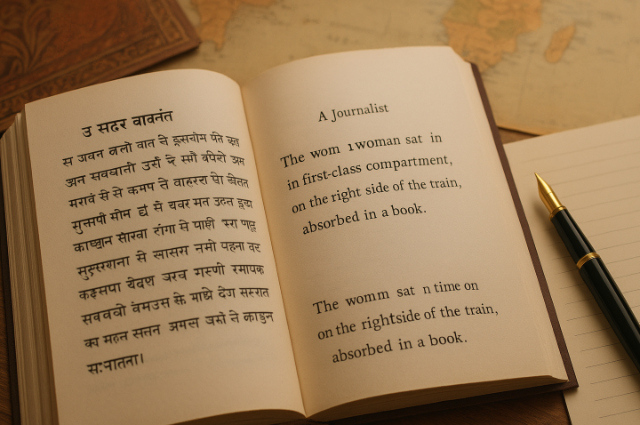
This is the trendy topic of our country, which deals with everyday life. India faces such challenges regarding translating trauma. It deals with many conflicts in terms of caste discrimination, conflicts related to regional issues, migration problems, clashes due to languages, disputes regarding gender, and is one of the tough experiences India has been facing, but our Indian stories have been respected internationally when translated into the English language.
The concept of translating trauma is deeply rooted in India’s historical, cultural, and emotional experiences. India, being a country of diverse backgrounds, has witnessed various traumatic episodes throughout its history—the partition of 1947, communal riots, caste conflict, gender-based violence, politically motivated oppression, and displacement due to migration or development projects. These traumas often remain silent within regional boundaries because they are expressed in local dialects spoken in smaller pockets of the nation. Literature becomes the voice of the unheard, giving identity and language to grief, injustice, and survival. When these stories are translated, the trauma of millions crosses borders, enters global conversations, and becomes part of world literature and academic research.
Trauma in Indian fiction is not only personal—it is social trauma. Writers like Manto, Mahasweta Devi, Premchand, Perumal Murugan, and many others showcase how individuals carry collective suffering. Translation plays an important role in ensuring that such stories do not remain limited to the region in which they were written. It becomes the messenger that carries emotional truth beyond language barriers.
The critical role of high-quality translation in bringing complex, regional Indian social narratives to international literary prominence.
India is a country that has 22 Official languages, of which many other languages spoken all over India. Every state has a different language. There are many well-regional writers in India through whom the Indian stories have gained enormous recognition. To read and understand all the languages is not easy and possible for everybody. People all over the world respects our stories. Indian writers have made it possible because they are well translated and have marked the growing experience worldwide.
Translation requires not only language knowledge but cultural sensitivity. A translator is not just rewriting words; they are transferring the soul of the story. They decide which cultural references to keep, which metaphors to adapt, and how to convey humour, sarcasm, and emotional tone without losing authenticity. The challenge is that Indian literature is heavily tied to regional identity—food names, festivals, rituals, caste surnames, and even landscape descriptions carry symbolic meaning. If translated literally, they may confuse readers; if changed too much, meaning is lost.
Translations are so well written that they carry powerful globalisation, or literal interpretation may impact our culture values, emotional nuance, caste terms, and religious terms, which require skills to understand. Translation plays a huge role in terms of understanding languages. While good interpretation marks a huge difference in terms of understanding the cultural values, casteism, gender differences and regionalism. The examination of Indian stories written in different languages is now being read and acknowledged. Many well-translated stories have received awards. It has been internationally published and has reached to global readers.
Furthermore, translation enables the formation of cultural diplomacy—it softens differences and builds bridges. When a story about caste trauma reaches Europe, or a novel about gender conflict is studied in America, global readers start recognising the complexity of Indian society beyond stereotypes. This international dialogue builds empathy, removes ignorance, and creates space for India to be understood not only as a land of mythology and spirituality but as a nation facing modern challenges with intellectual and emotional depth.
Academic institutions around the world now include translated Indian literature in courses related to postcolonial studies, diaspora writing, gender politics, subaltern voices, and conflict trauma. This visibility contributes to India’s global literary identity, proving that regional writers are not only local storytellers but voices of universal human experience.
‘Tomb of Sand’ – How English translation created global accessibility and success
The examination of this case, named “Tomb Of Sand“, is phenomenally interpreted by Daisy Rockwell from the Indian Novel “Ret Samadhi“ written by Geetanjali Shree. This book has won the “International Booker Prize” for its best version of Indian Stories, beautifully presented with Indian Themes, Motherhood, Gender Identity, Trauma related to partition, and Cultural Memory, clearly understandable to international audiences.
The translation of Ret Samadhi into Tomb of Sand brought global readers closer to the emotional wounds left behind by the partition of India. The story is layered with satire, wit, grief, and philosophical reflection, which is extremely difficult to translate without losing tone. Daisy Rockwell maintained the eccentricity of Geetanjali Shree’s writing style, preserving the poetic rhythm and cultural flavor of Hindi while making it accessible to those unfamiliar with the subcontinent’s cultural vocabulary.
The case study proves how Indian Stories play a crucial role in understanding the best interpretations about trauma and social conflict that have been internationally successful. A skilled translator preserves the humour, trauma of the original text, making attainable and relevant to international readers.
Additionally, the success of Tomb of Sand opened doors for more translations from Indian regional languages to be taken seriously in the global publishing industry. It communicated that regional trauma has universal relevance—the struggle of a refugee, the search for identity, the sorrow of separation, and the pain of cultural displacement are shared human emotions. The book demonstrated that translation is not a secondary version of literature but an artistic creation of its own.
Many publishers now actively search for regional works. Stories from Dalit literature, North-Eastern narratives, and tribal perspectives are being recognised. Trauma is no longer viewed only as a Western psychological concept but as a lived reality across cultures.
Translating trauma in Indian fiction is not just about rewriting words—it is about carrying cultural memory across borders. It preserves forgotten histories, dignifies marginalised voices, and ensures that global readers engage with the realities that shape modern India. Skilled translation transforms local pain into universal understanding, making Indian storytelling a global phenomenon. By presenting conflict, identity, displacement, gender injustice, and social struggle in relatable ways, translation ensures that trauma becomes testimony, silence becomes narrative, and lived experience becomes literature.