
Photo by Karollyne Videira Hubert on Unsplash / Representative Image
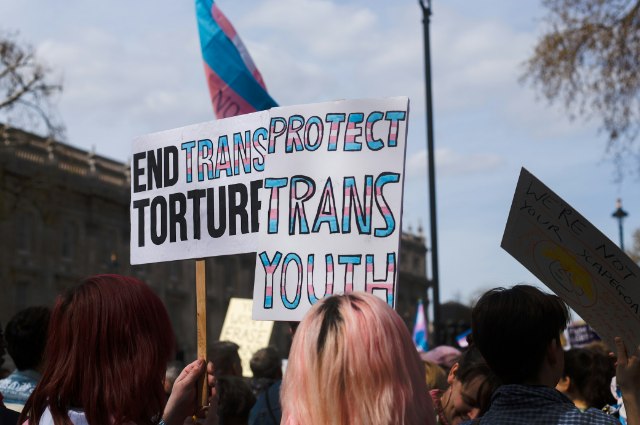
On a Sunday in late March 2026, a crowd gathered at Lansdowne Chowk in Dehradun. They were transgender people, activists, and members of social organisations. They were not there to celebrate. They were there to protest.
The cause of their anger was the Transgender Persons (Protection of Rights) Amendment Bill, 2026, introduced in the Lok Sabha on March 13 by Union Minister for Social Justice and Empowerment Virendra Kumar. The Bill was expected to come up for discussion in Parliament that very week.
This was not just a local gathering. Similar protests were reported across several Indian cities, including Delhi, Chennai, Hyderabad and Madurai, where activists, student groups and civil society organisations demanded that the Bill be either withdrawn or substantially revised.
So, what exactly is in this Bill that has brought people out onto the streets?
A Step Backward, Not Forward
To understand the protest, you need to go back to 2014. That year, the Supreme Court of India made a landmark decision in a case called NALSA vs Union of India. The court recognised transgender persons as a "third gender" and affirmed their right to determine their own gender identity under the Constitution. The ruling also required governments to ensure equality, dignity and access to social welfare for transgender individuals.
This was a big moment. For the first time, the law acknowledged that a person has the right to say who they are without needing a doctor or a government official to verify it. That ruling later shaped the Transgender Persons (Protection of Rights) Act of 2019, which prohibited discrimination against transgender persons in education, employment and healthcare. It was imperfect, where activists had complained that it still had too much bureaucracy and too little protection, but it was at least grounded in the spirit of that 2014 judgment. The 2026 amendment, critics say, moves in the opposite direction.
What does the New Bill Actually Say?
The protesters in Dehradun raised several specific concerns about what the amendment proposes. First, the definition of who counts as transgender has been changed and narrowed down. According to community leaders, the revised definition limits recognition to certain socio-cultural groups such as Hijra, Kinnar, Aravani or Jogti. This means that many people who identify as transgender but do not belong to these specific groups could be left without any legal recognition at all.
Worse, the Bill implies that transgender identity arises only from "mutilation, coercion or intersex variations." Activists strongly reject this characterisation. It treats being transgender not as a natural part of who a person is, but as something that happens to them through trauma or biology, which is a deeply damaging idea.
Second, and perhaps most controversially, the amendment proposes mandatory medical board verification before a district magistrate can issue a transgender identity certificate. In simple terms, this means a person would have to appear before a group of doctors and prove their gender identity before the state would officially recognise them. Activists say this is both invasive and unnecessary, as it replaces personal dignity with a medical test.
Third, the amendments also propose expanded punitive provisions, including penalties for those who allegedly "allure" or force someone into adopting a transgender identity. The language here is vague, and activists argue it could be used to criminalise the very community spaces and support networks that transgender people rely on.
The Government's Argument
The government has not been silent. Officials have argued that the changes are meant to prevent misuse of welfare schemes and ensure that benefits reach genuine beneficiaries. In other words, they say the verification process is about making sure that government resources are not exploited.
This is a reasonable concern in principle. Public welfare schemes do face misuse, and there is a legitimate need for accountability.
But here is the problem that you do not solve fraud by treating an entire community as suspects. Requiring every transgender person to undergo a medical examination before getting an identity card is not a targeted anti-fraud measure. It is a blanket restriction that affects everyone, including the most vulnerable people who have already faced a lifetime of exclusion and discrimination.
The Community Speaks
The people at Lansdowne Chowk were not just there to oppose a piece of paper. They were there because this Bill directly affects their lives.
Shaman Gupta, founder of the Misfyt Transgender Youth Foundation, put it plainly: "This removes the right to self-identify." Hardeep of Queer Collective Dehradun raised the concern that the Bill mixes being intersex with being transgender, which are two different things and that this confusion is built into the very foundation of the proposed law.
Protesters also argued that the amendment was introduced without adequate consultation with the transgender community, including members of the National Council for Transgender Persons, which is the very body that exists to represent their interests. Some opposition politicians resonated with these concerns in Parliament.
What does this mean?
Laws do not exist in a vacuum. They shape how society sees a group of people. When a law says that your identity needs to be verified by a medical board before it becomes real, it sends a message that you are not trusted and you are a problem to be managed, not a person to be respected.
India has spent over a decade building a legal framework that recognises the dignity of transgender people. That work is imperfect, but it is real. The 2026 amendment, as currently written, risks pulling to pieces that foundation not in the name of hatred, perhaps, but through the quiet violence of bureaucracy and mistrust. The protesters in Dehradun are asking for something simple that talk to us before you write laws about us. That is not too much to ask.
. . .
References: