
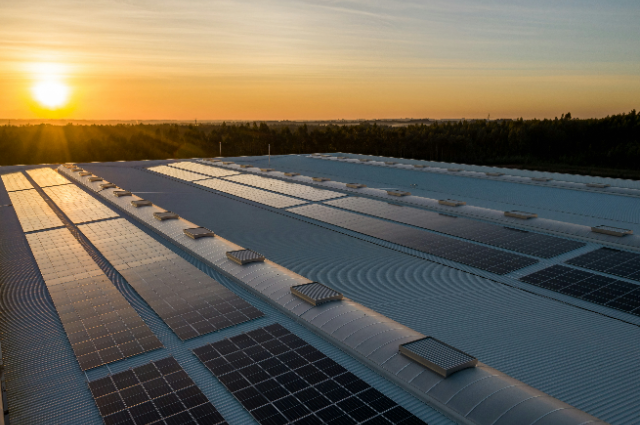
Photo by Nuno Marques on Unsplash
In recent years, India’s solar industry has been a shining star on the global stage, positioning itself as a primary alternative to Chinese dominance in renewable energy. However, that momentum has hit a massive regulatory wall. The United States Department of Commerce (DOC) recently sent shockwaves through the industry by slapping a preliminary anti-dumping duty of approximately 126% on Indian solar imports. When combined with other existing levies, this "tariff shock" effectively pushes the total tax burden toward a staggering 250%, threatening to lock Indian manufacturers out of one of their most lucrative markets.
To understand how we reached this point, we must look past the complex words of international trade and examine the mechanics of "dumping," the strategy behind US protectionism, and the specific impact on India’s green energy giants.
The Anatomy of the 126% Penalty
At the heart of this dispute is a concept known as "anti-dumping." In international trade, dumping occurs when a country exports a product at a price lower than its domestic market price or below the cost of production. To the importing country (the US), this looks like an unfair attempt to undercut local businesses and seize market share.
The US Department of Commerce’s preliminary investigation concluded that Indian solar cells and modules were being sold in the US at unfairly low prices. As a result, they imposed a preliminary duty of 126.28%. This isn't just a small tax; it is a price-doubling measure. If an Indian solar panel cost $100 to import previously, this duty alone would drive the cost up to over $226.
The "Critical Circumstances" Clause
One of the most alarming aspects for Indian manufacturers such as Adani Solar, Waaree Energies, and Vikram Solar is the US’s invocation of "critical circumstances." Usually, trade duties are applied from the date of the ruling moving forward. However, by declaring critical circumstances, the US has the authority to apply these duties retroactively.
This means that shipments that arrived in the US upto 90 days before the official announcement could be hit with these massive taxes. For businesses that operate on thin margins, having a 126% tax applied to products already delivered is a financial nightmare. It creates an atmosphere of extreme uncertainty; exporters no longer know the true cost of their business until months after the sale is made.
The Cumulative Shock is Reaching at 250%
While the 126% figure is the headline, the reality for the Indian solar industry is even bleaker. This anti-dumping duty (ADD) does not exist in a vacuum. It is often stacked on top of Countervailing Duties (CVD), which are intended to offset subsidies provided by the Indian government to its manufacturers.
When you combine the ADD, the CVD, and other existing trade barriers, the effective tariff can reach as high as 250%. At this level, Indian solar products become economically unviable in the American market. The US is essentially using these tariffs to build a protective "glass wall," ensuring that its own domestic manufacturers, who are currently being heavily incentivised by US domestic policy, don't have to compete with cheaper foreign imports.
Impact on Indian Manufacturers
India’s solar sector has invested billions of dollars into scaling up production capacity, largely with the US market in mind. For major players like Waaree and Vikram Solar, the US represents a massive portion of their export revenue.
The immediate fallout is twofold:
- Market Exclusion: With a 250% price hike, Indian panels are no longer competitive against US-made panels or imports from other countries that aren't facing similar duties.
- Financial Risk: The threat of retroactive duties makes US buyers hesitant to sign new contracts with Indian firms, fearing they might get stuck with a massive tax bill later.
Industry leaders have flagged these developments as a sign of "rising protectionism." While the US claims it is merely levelling the playing field, Indian industry experts argue that these measures are designed to force a total decoupling from foreign supply chains.
A Conflict of Interests
From an editorial standpoint, this situation highlights a painful irony in global climate politics. On one hand, the world is in a desperate race to transition to green energy to meet climate goals. On the other hand, trade wars are making the tools of that transition to solar panels prohibitively expensive.
By effectively locking out the Indian solar industry, the US is prioritising its domestic manufacturing jobs over the speed of its own green energy rollout. While it is understandable that any nation wants to protect its internal industries from "dumped" goods, the scale of these duties (250%) suggests something more than just a "correction." It suggests a strategic move to insulate the US market entirely.
For India, this is a wake-up call. The heavy reliance on a single export market like the US carries immense geopolitical risk. This "tariff shock" may force Indian manufacturers to pivot toward domestic installations or seek out markets in Europe and Africa, where trade barriers are currently less aggressive.
The 126% duty is currently "preliminary," meaning a final determination will be made in the coming months. However, the damage to market confidence has already been done. The US-India solar trade, once a promising avenue for cooperation in the fight against climate change, has now become a primary theatre for trade conflict.
As protectionism rises, the Indian solar industry finds itself at a crossroads. To survive the 250% tariff wall, it must either prove to the US regulators that its pricing is fair or accelerate the diversification of its global footprint. One thing is certain that the era of easy access to the American solar market is over, and a new, more expensive reality has begun.
. . .
References: