
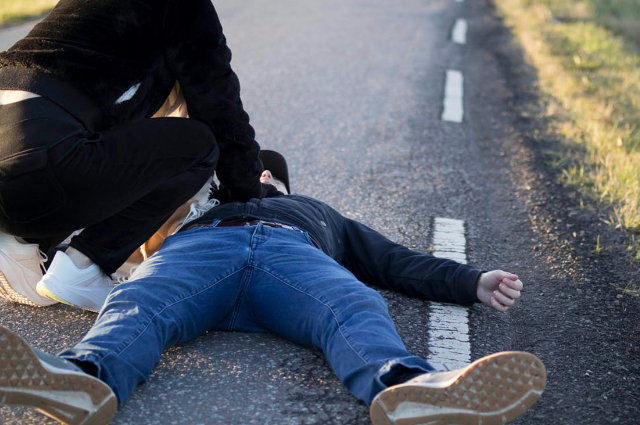
Photo by www.testen.no on Unsplash / Representative Image
A young man is dead. A teenage girl lies unconscious in a hospital bed. Two drivers fled into the night, and a road that was built for convenience has, once again, delivered tragedy. In the early hours of March 3, 2026, 23-year-old Prashant Vijay Jamdade and 17-year-old Harman Kaur were riding home on Palm Beach Road in Navi Mumbai after meeting friends. They never made it back. Somewhere between Sarsole junction and Moraj Circle, their motorcycle is believed to have skidded, and within about 30 seconds, two cars travelling behind ran over Jamdade. He died on the spot. Harman Kaur survived, but remains unconscious at DY Patil Hospital in Nerul. Her mother, a single parent, is struggling to pay the medical bills and is now looking at crowdfunding to keep her daughter alive.
The two cars, a Skoda and a Maruti Brezza, have since been identified. The drivers, both in their early twenties and residents of Ghansoli, did not stop after the crash. They drove away and left a young man's body on the road. Let that sink in for a moment.
What happened on Palm Beach Road is not just a crime story
It is a failure story, and the failure belongs to all of us. Palm Beach Road is a six-lane, 10-kilometre stretch connecting Vashi, Sanpada, Nerul, and Belapur. It is smooth, wide, and relatively empty at night, which is precisely why so many drivers treat it like a racetrack after midnight. The official speed limit is 80 km/h. Local traffic police say vehicles routinely travel between 100 and 150 km/h during the late hours. Residents have been saying for years that the road turns dangerous after the bars close. Nobody seems to have listened.
This is not the first time Palm Beach Road has claimed a life. In December 2025, a 22-year-old motorcyclist was killed near the same Moraj Circle after a speeding car hit his bike late at night. In July 2025, a high-speed Mercedes lost control on the same road and overturned. These are not random, isolated events. This is a pattern, and patterns have causes.
The cause here is not mysterious: It is speed, combined with license
When a road is wide, empty, and poorly surveilled at night, some drivers will push their luck. When there are no speed cameras, no consistent night patrols, and no serious consequences for reckless behaviour, the luck-pushing continues. The two young men behind the wheel of the Skoda and the Brezza were not alone; each had friends with them in the car. No one stopped. No one called for help. A group of young people drove away from a dying man and a critically injured girl without a second thought. That is not just a legal failure. It is a moral one.
Police have confirmed that there was no CCTV camera at the exact location of the crash. Investigators had to piece together what happened by reviewing footage from cameras installed at the two nearest junctions. This gap in surveillance coverage on a known accident-prone road is not acceptable. It is the kind of administrative oversight that costs lives and then conveniently disappears into a chargesheet.
The response to this tragedy will likely follow a familiar script.
The accused will be charged. There will be calls for better enforcement. Officials will speak about installing more cameras and increasing night patrols. A few weeks will pass, and the road will return to what it was again - fast, dark, and dangerous. That cycle needs to break.
What Palm Beach Road actually needs is a combination of things where more speed cameras are placed, not just at junctions but along the entire stretch, proper crash barriers, consistent late-night policing, not occasional checks, but a real, visible presence and better street lighting in the darker sections. The planned Sanpada underpass, which is meant to ease congestion at Moraj Circle, has been discussed for a long time. It has not yet made the road any safer.
Beyond infrastructure, there is a deeper question about the culture of driving in India, particularly among young people. The attitude that a wide, empty road at 3 am is an invitation to speed is not just reckless, it is deadly. Road safety awareness needs to be part of how young drivers are taught, not just an afterthought.
Prashant Jamdade was just 23, and Harman Kaur is 17
They were coming home from meeting friends, which is the most ordinary thing in the world. One of them did not survive. The other lies in a hospital, her mother sitting beside her, wondering how to pay for the next day of treatment.
The drivers who hit them and drove away were also young. They made a choice in those seconds after the crash, and they chose to leave. Whether that choice came from panic, selfishness, or simply a belief that they could get away with it, we cannot say. But we can say that a road safety system that makes such a choice feel possible has already failed.
Palm Beach Road will see more traffic tonight. Some of those vehicles will be going far too fast. Until something changes and really changes, where the next tragedy is not a question of if, it is only a question of when. The names of the accused have been reported by the police. No court has yet determined their guilt. The investigation is ongoing.
. . .
References: