
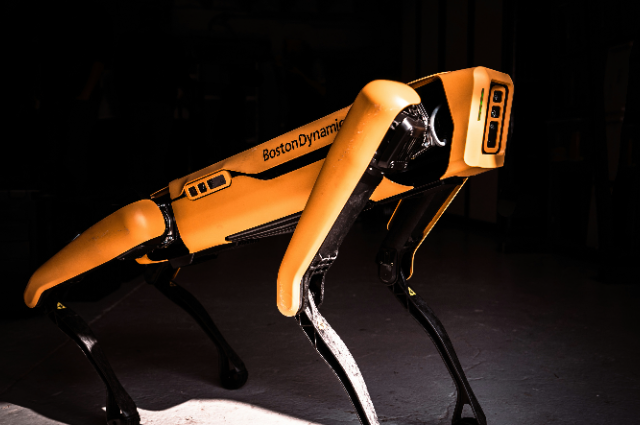
India hosted one of the most significant artificial intelligence events in its history in February 2026. Leaders from across the world gathered at Bharat Mandapam in Delhi for the India AI Impact Summit, a platform designed to show the world that India is a serious player in the global race for technological leadership. Startups, innovators, and institutions were given a stage to prove themselves. It was, by any measure, a big moment. Then a four-legged robot dog walked right into the middle of it and caused a national scandal.
The robot dog in question was called "Orion." It was displayed at the pavilion of Galgotias University, a private university based in Greater Noida. During media interactions at the summit, a professor from the university Neha Singh, a Professor of Communications told a DD News reporter that Orion had been developed by the university's Centre of Excellence. She described it as a landmark innovation by the university's students. There was just one problem: it wasn't made by the university at all.
The Lie That the Internet Caught
Within hours, people on social media and technology experts had identified the robot as the Unitree Go2, a commercially available product made by Unitree Robotics, a Chinese company. The device sells for roughly two to three lakh rupees and can be bought by anyone. It was not a homegrown Indian invention. It was not created by students. It was an imported product that had simply been put on display and, apparently, incorrectly described.
The internet, as it often does, moved fast. Video clips spread widely. Comments poured in. People were angry, not just about the false claim itself, but about what it represented. This was India's biggest AI summit, attended by global leaders and international media. The reflections of an Indian university appearing to pass off a Chinese-made product as its own innovation were damaging, to say the least. Chinese media reportedly picked up the story too, using it as an opportunity to highlight the episode.
A Weak Explanation That Made Things Worse
Galgotias University's first response made things worse. Initially, the university said it had never claimed to have built the robot on its own and that it had been purchased from Unitree as a learning tool for students. That explanation, while perhaps partly true, did nothing to address why the professor had so confidently described it as a student-made innovation on national television. An X Community Note, a fact-checking feature on the social media platform flagged the university's clarification as misleading, pointing out that the robot had been named Orion and presented in a way that clearly suggested it was the university's own work.
Packing Up and Going Home
Facing mounting pressure from all sides, Galgotias University eventually issued a full apology. They admitted the professor who spoke to the media was "ill-informed" and said she gave "factually incorrect information" even though she was not authorised to speak to the press at all. By the evening of 18th February, the university had been asked to leave the summit entirely. The lights at their stall were turned off. Staff were seen packing up and leaving.
Politicians Step In
Politicians weighed in as well. Members of Parliament from the Shiv Sena (UBT) party demanded that the university face financial penalties, not just be sent home. MP Priyanka Chaturvedi said that the incident had caused not just national embarrassment but international ridicule, and argued that organisers should have done proper checks on exhibitors before letting them set up stalls at such a high-profile event. Her colleague Anil Desai raised another pointed question that if the robot was made in China, how did the authorities not notice this before allowing the university to display it? Who is accountable for the verification process? The government itself said it wanted only "genuine and actual work" shown at platforms like this, and that it would not tolerate misinformation.
There is a fair question buried in all of this about what exactly Galgotias University intended. Universities all over the world buy and use advanced equipment to teach their students. There is nothing wrong with purchasing a cutting-edge robot from China, Japan, or anywhere else and using it to expose students to new technology. That is a reasonable and even commendable thing to do. The problem was not the purchase. The problem was the misleading information and the decision, whether deliberate or careless, to let a representative stand before cameras at a national summit and describe a commercially bought machine as a product of student innovation.
The Symbolism India Cannot Afford
In a country where the government has placed enormous emphasis on building home-grown technology, encouraging domestic manufacturing, and reducing dependence on Chinese goods, the symbolism of this moment was hard to ignore. The summit was meant to project India's strength. Instead, one university's carelessness handed critics, both at home and abroad, a ready-made story about dull claims and borrowed glory.
The broader lesson here is not complicated. At a time when India genuinely has remarkable things to show the world in technology, education, and innovation, the temptation to exaggerate or embellish is both unnecessary and dangerous. Social media moves quickly. Fact-checkers are everywhere. Claims made on camera in the morning can be pulled to pieces by evening. Galgotias University's pavilion at the AI Summit was meant to inspire. Instead, a robot dog named Orion became a symbol of something far less flattering, and the gap between what India wants the world to believe and what India actually needs to build. The difference between the two can only be closed by honest, patient work and not by putting a Chinese robot on a pedestal and hoping no one notices. One professor was called ill-informed. But the institution that let her speak, and the culture that made such a moment possible, carries a responsibility that an apology alone cannot settle.
. . .
References: