
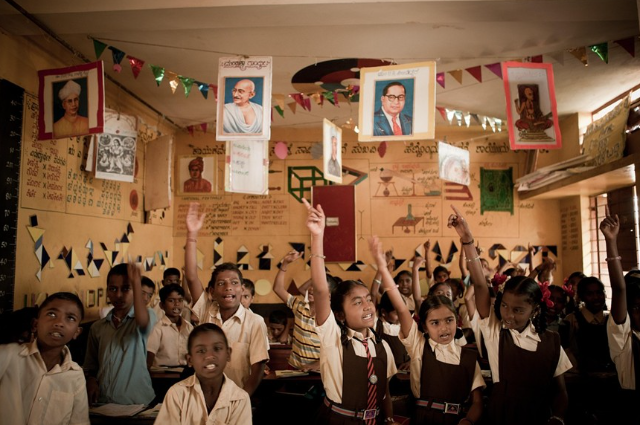
Image by AkshayaPatra Foundation from Pixabay
The Supreme Court’s recent intervention in the debate surrounding the CBSE’s three-language policy is not a rejection of multilingual education. Instead, it is a reminder that educational reforms, no matter how well-intentioned, must be implemented carefully and fairly. By directing the CBSE to consider extending the same relaxation given to Class 7 students to those currently in Class 6, the Court has highlighted an important principle that students should not bear the burden of policy changes that schools are not fully prepared to implement.
Understanding the Controversy
The dispute began after the CBSE aligned its language policy with the National Education Policy (NEP) 2020 and the National Curriculum Framework for School Education 2023. Under the revised framework, students are required to study three languages, with at least two being Indian languages.
While the objective appears positive, promoting linguistic diversity and encouraging students to learn more Indian languages, the manner and pace of implementation sparked concerns among parents, schools, and students. Several petitions were filed before the Supreme Court challenging aspects of the policy, particularly its immediate impact on students already studying under a different language structure.
The Court was therefore faced with a practical question: should students who are already partway through their schooling suddenly be expected to adapt to an entirely new language requirement?
What the Supreme Court Said
The Supreme Court directed the CBSE to extend to Class 6 students the same relaxation already available to students in Classes 7, 8, and 9. These students have been granted a transitional benefit under which they will not have to take a CBSE board examination in the third language when they reach Class 10. Instead, the language will be evaluated internally by schools without any pass or fail consequences in the board examination.
Justice Joymalya Bagchi emphasised that children should be comfortable during this transition. The Court's concern was not whether students were capable of adapting but whether it was fair to impose new academic demands abruptly.
This distinction is crucial. Educational policy should not only focus on outcomes but also on the experience of students who must live through these changes. The Court’s observations suggest that educational reforms should prioritise student well-being alongside academic objectives.
The Real Issue Is Implementation
One of the most significant aspects of the Court’s observations was its focus on implementation rather than ideology. The judges did not question the broader goals of the NEP or multilingual education. Rather, they questioned whether the existing infrastructure was sufficient to support such a major shift.
Petitioners argued that many schools lack qualified language teachers, adequate study material, and sufficient language options. Some also pointed out that textbooks were not always easily accessible, particularly for students in rural areas.
These concerns are not trivial. A policy can look excellent on paper, but without trained educators and proper resources, its implementation can create confusion instead of learning. Students may struggle not because they are unwilling to learn a new language but because the support system around them is incomplete.
Educational reforms often succeed or fail not because of the idea behind them, but because of the manner in which they are implemented. A strong policy requires equally strong preparation. If schools are not fully equipped, students inevitably become the ones who face the consequences.
Why the Court’s Approach Is Balanced
The Supreme Court’s approach stands out because it seeks a middle path. Instead of completely blocking the policy, the Court has encouraged a phased and practical implementation.
This is important because education reforms often face resistance when they are introduced too quickly. Students already enrolled in a particular system build their academic plans around existing rules. Sudden changes can create anxiety, increase workload, and disrupt learning habits developed over several years.
By suggesting that current Class 6 students receive the same transitional protection as Class 7 students, the Court is not opposing multilingual education. It is simply ensuring that reforms do not unfairly affect a specific group of students caught in the middle of a policy transition.
This balanced approach is perhaps the strongest aspect of the ruling. It recognises the value of learning multiple languages while also acknowledging the practical difficulties associated with implementing such changes immediately.
Justice Bagchi’s observation that the issue is about student comfort rather than adaptability reflects a student-centred approach to education. A student may eventually adapt to a difficult transition, but unnecessary stress and uncertainty can still negatively affect learning outcomes.
Educational reforms should inspire students, not overwhelm them. When children feel supported and confident, they are more likely to learn effectively and achieve their full potential.
Conclusion
The Supreme Court’s direction regarding the CBSE three-language policy serves as an important reminder that successful education reform requires careful planning, adequate infrastructure, and sensitivity towards students. The Court has not challenged the goal of multilingual education. Instead, it has emphasised the need for a smoother transition that protects students from sudden academic disruptions.
Learning multiple languages can undoubtedly enrich students and strengthen India’s cultural fabric. However, introducing such a policy without ensuring readiness in schools could undermine its very purpose. Reform is most effective when it is gradual, inclusive, and backed by strong support systems.
In the end, the Supreme Court’s intervention is less about language and more about fairness. It acknowledges that educational progress should not come at the cost of student well-being. As policymakers, educators, and parents continue this conversation, the focus must remain on creating a system where students can learn confidently, comfortably, and successfully.
References