
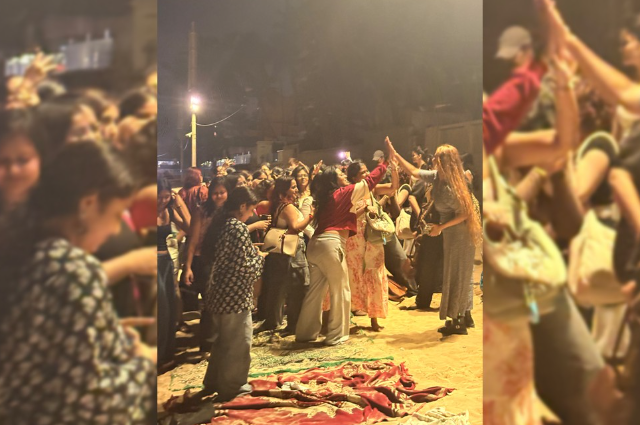
It was 10 pm on Juhu beach. The tide was somewhere behind us, the streetlight was doing most of the work, and I was sitting on the sand with a woman I met five minutes earlier.
We were talking about how fast rape cases are rising in this country. Not as news, not as statistics, but the way women actually talk about it, which is to say we both already knew. Neither of us had to establish that it was bad. We skipped all of that and went straight to the part nobody says in polite company.
Because the rules always land on us. Take the one in Delhi. A seventeen year old girl was raped in a park, and the government simply answered that girls would not be allowed in parks after sunset. Read that again, slowly. A girl was attacked, and the state responded by taking the park away from every other girl in the city. Not one line about the man who did it. Not one line about what the police would do differently tomorrow. No new patrol, no faster court, no accountability for anybody who failed her. Just a curfew, handed to the half of the population that did nothing wrong.
Somebody sat in a room and genuinely believed that was a solution. Somebody drafted it, somebody approved it, and nobody in that room asked the obvious question, which is why the people being punished are the people who were already afraid. It is easier to lock up a park than to fix a country, so they locked up the park.
We were furious. And we sat there and got angrier together, which is a very different thing from getting angry alone in your room at midnight.
But we did not want to stop there, because anger that goes nowhere just turns into exhaustion, and most of us are already exhausted. So we started making plans instead. Events, ideas, small things we could actually run, anything with a shape to it. I have never spoken to anybody about any of this in that much depth, not at home, not at work, not with people I have known for years. And if I had not come to that beach, I would never have met her at all.
That is exactly why the rest of them were there too. Not to be rescued, not to be counselled, not to be told to be careful. Just to step out of the house, find each other, and say the unsayable things out loud, in public, after dark, in a city that had spent the whole week suggesting we do the opposite.
Bahar Milo.
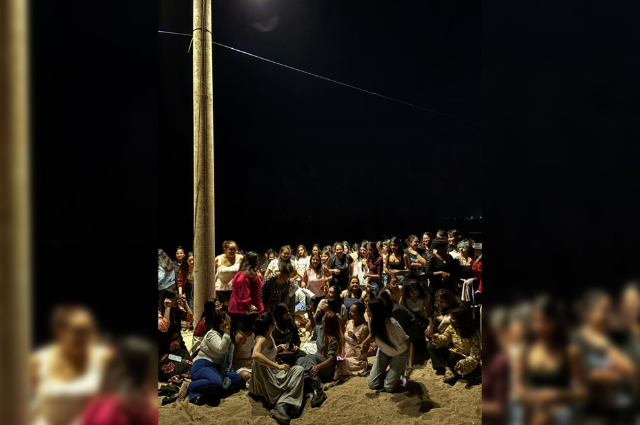
Why Bahar Milo began?
The Delhi rule set the whole country off. Women everywhere refused to take it quietly, because every one of us recognised the reflex behind it. Something happens to a woman, and the country turns around and looks at women.
Then somebody flipped it. If the plan is to keep us inside, the answer is to go outside. Not with slogans, not with placards, not asking anybody for permission. Just come out, be together, take up space, and enjoy yourselves in full view of a city that would rather you went home.
That is a far more dangerous idea than a protest. A protest can be ignored once it ends. Women who have discovered what it feels like to own a public space at night do not forget it.
Everybody was there, and everybody belonged
The first thing that hit me when I reached was how wide the crowd was. Women of every age had come. Girls who had just started working, women older than my mother, and a few who had brought their children along, because there was no reason not to.
Queer individuals were there too, and nobody treated them as guests. That is not a small thing in this country. I sat with a few of them for a long time and listened to what their days actually look like, at home, at work, in front of a government counter. They told me about the rights they are still fighting for, and what stayed with me is how basic those asks are. To be recognised. To be safe. To be left alone. Things most people never have to ask anyone for.
Nobody was performing. People were just themselves, out in the open, and it was so clear how rarely any of us get to do that. You realise then how much of your ordinary behaviour is actually caution, and how exhausting it has been to carry it every day without noticing.
Playing, singing, and one very good birthday
And it was fun. That is the part people do not expect when you tell them why we gathered.
There were games everywhere. I kicked off my shoes and socks and ran into a volleyball match with women I had not met two minutes before. We introduced ourselves between serves, and somewhere around the third round the talk turned, the way it kept turning all night.
We talked about how men in this country have lost all sense. Not all men, but enough of them, and enough is the whole problem. We talked about what we are supposed to do with that. How do you fight something that large just to survive your own commute.
Then we went somewhere else entirely, because we were standing on a volleyball court and nobody plays volleyball in India. We got into how cricket swallows everything. One sport is treated like a religion and the rest live on scraps.
And even inside cricket, look how long it took. Women have been playing this game in this country for decades, winning matches, reaching finals, and the country only properly turned to look at them in the last few years. Same sport, same whites, same grounds. The men were worshipped from the start, the women had to earn an audience that was sitting right there the whole time.
Everything outside cricket gets even less. Hockey, athletics, wrestling, football, boxing, kabaddi. We only remember those players when one of them wins something internationally, and then we go quiet again until the next medal. Every single one of us on that court had a story about a game she loved and quietly gave up, because there was nowhere to take it and nobody to take it to.
Within minutes we were all on the same page, arriving at the same conclusions from completely different lives. That was the startling thing about the night. Nobody had to be convinced of anything from the beginning.
I played until my arms gave up. Nearby another group had started singing, and others were dancing to whatever came next.
Then somebody announced that it was a girl's birthday. I realised I had been playing volleyball with her an hour earlier and had no idea. Everybody started pulling out whatever money they had, somebody ran off and came back with three cakes, one kilo each, and then more than a hundred women, almost all of them strangers to her that morning, stood on a beach and sang her the birthday song.
She said it was the best birthday of her life. I believed her.
I keep coming back to how easy it was. Nobody knew her. Nobody had to do it. Somebody said it was her day, and a hundred women decided she deserved a good one. That is the smallest possible version of women standing up for women, and it cost us fifty rupees each and four minutes of singing.
But it is the same instinct everything else runs on. The woman who walks you to your cab. The one who warns you about a boss before you take the job. The one who believes you the first time you tell her, without asking what you were wearing. That is the raw material of every change we are asking for. Not a campaign, not a hashtag. Women deciding that another woman's day, or safety, or rage, is worth their time.
A hundred strangers can make one girl's birthday the best of her life. Imagine what the same hundred will do when she needs something harder than cake.
What we talked about…!!
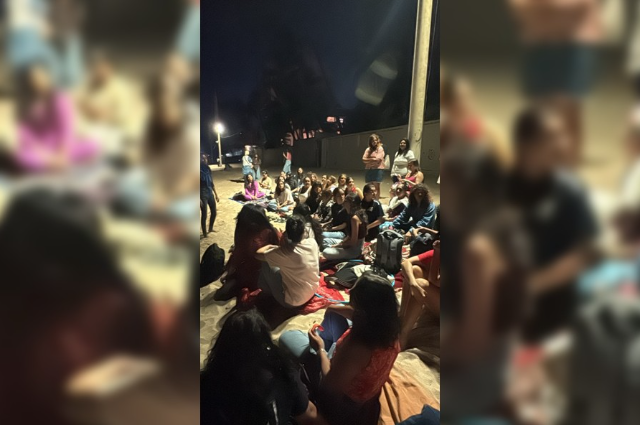
In between all of it, the conversations kept going, and they went deep.
We talked about patriarchy, and how far inside us it already sits. It is in our roots. There are things we do every single day without once stopping to ask why, and that is the hardest part, because you cannot fight what you cannot even see. Half the work is simply learning to see it.
We talked about how often religion gets used as a leash. Not faith itself, but the way it gets picked up and pointed at us, to decide what we wear, where we go, who we speak to, and by what hour we should be home.
We talked about Afghanistan, and what has been done to women there. Somebody said out loud what several of us had been circling. It never arrives all at once. It comes one rule at a time, and every rule sounds reasonable on its own, and by the time it stops sounding reasonable there is nobody left who is allowed to say so. That is precisely why a rule about park timings deserves a national fight.
One woman I met had spent twelve years in the US working in tech, and then she was laid off. She told me what those weeks were like, how quickly a career turns into a countdown, how the fear was not really about the job at all but about being sent back from a place she had made her home. One email from a company, and you no longer get to exist in a country.
So she came back. And then she said the line I have not been able to shake since. There she was unsafe but stable. Here she is stable but not safe.
She has her family here, her language, a job nobody can deport her from. What she does not have is the ability to come home at ten at night without planning the route. Then she added something that stopped me. Mumbai is safe, she said, but only in certain areas, and those are the expensive ones. The buildings with guards. The lanes that stay lit. The neighbourhoods where a cab will actually come at midnight.
I have lived here all my life and I had never heard it put that plainly. Safety has a price tag. We treat it like a civic fact, something the city either gives you or does not, when really it is being sold, and your rent decides how much of it you get. A woman in a tower sleeps differently from a woman twenty minutes away, and nobody wrote that rule down anywhere, which is exactly why nobody is accountable for it.
So when they tell us to stay home after dark, they are not only taking away the park. They are telling every woman who cannot afford the right postcode that her safety was never really on the table.
The long walk out
Saying goodbye took me a full ten minutes, because there were many people I had actually spoken to.
Then came the small problem. The gate I had come in from was shut, and I had no idea how to get out. So I started walking along the beach looking for another way, and that walk turned out to be the best part of the night.
It was quiet by then. Just me, the sand, the water somewhere on my left, and a city that had spent the whole week telling women to stay indoors after dark. I was walking through it anyway, at eleven at night, and I was not afraid, because a few hundred of us had just spent four hours proving that the fear was never ours to carry alone.
Think about what actually happened there. Nobody formed a committee. Nobody applied for anything. Nobody waited for a leader. One post, one group, one patch of sand under a streetlight, and a hundred and fifty women became a hundred and fifty women who know each other. That is how it starts every time, and that is exactly why they would rather we stayed home.
They can pass all the curfews they want. Every one of them is an admission that they have given up on controlling men and decided to control us instead. We are done accepting that trade. We are not asking for anything new, anything extra, anything generous. We are still asking for the two most basic things there are, our rights and our safety, and we have been asking politely for a very long time.
The group is still on my phone. I have made a few more friends in it since that night, and the next one is already being planned.