
The delicate balance between economic ambition and environmental protection has once again taken centre stage. The Bombay High Court made a pivotal decision, allowing the National Highways Authority of India (NHAI) to clear a specific patch of mangrove trees. This clearance is for building an eight-lane highway that will connect the mainland to the upcoming mega Vadhvan Port project in Palghar, Maharashtra.
The court’s decision highlights a long-standing debate in modern governance; How do we build world-class infrastructure without permanently damaging the nature that protects our coastlines? By analysing the court’s reasoning, the environmental trade-offs, and the sheer scale of the project, we can better understand this massive development and its impact.
The Big Project: What is Vadhvan Port?
To understand why the court stepped in, we first need to look at what is being built. The Vadhvan Port is a massive, upcoming shipping port in Palghar, located just north of Mumbai. The project carries an enormous price tag of over ₹76,220 crore. When finished, it aims to position India directly into the global big leagues of maritime trade, with the goal of becoming one of the top ten container ports in the entire world.
A port of this size cannot function in isolation. Millions of tons of cargo will arrive by sea and must be moved inland quickly. To do this, the port requires heavy-duty connectivity, which is where the NHAI comes in. The NHAI planned an eight-lane, access-controlled highway to link the new port directly to National Highway 48 (NH-48). However, a major environmental roadblock lay directly in the path of this proposed road, a dense ecosystem of protective mangrove trees.
The Legal Hurdle: Protecting the Mangroves
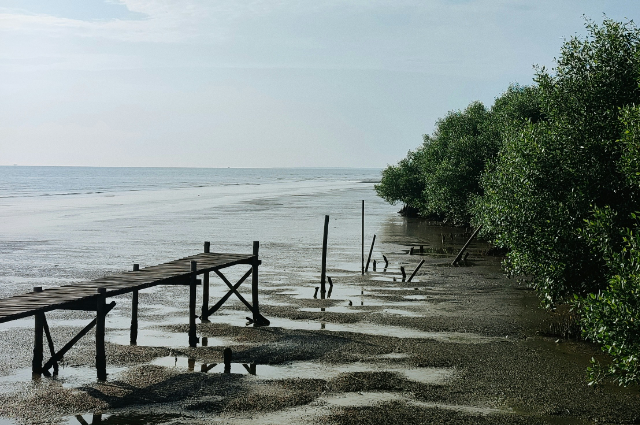
Mangroves are unique trees and shrubs that grow in coastal intertidal zones. They act as nature’s shock absorbers, protecting coastal areas from fierce storm surges, reducing erosion, and acting as vital nurseries for marine life. Because of their critical ecological role, previous legal rulings in Maharashtra placed strict protections on them. Anyone wishing to cut even a single mangrove tree for a public project must first secure permission from the High Court.
In this instance, the NHAI approached the Bombay High Court seeking permission to fell 208 mangrove trees located in the project's reclamation zone. While 208 trees might sound like a relatively small number compared to large-scale forest clearings, the legal precedent dictates that any destruction of coastal green cover must be thoroughly scrutinized to prevent unchecked environmental damage.
The Court’s View: National Importance vs. Local Ecology
A division bench consisting of Justices Bharati Dangre and Manjusha Deshpande evaluated the case. In their final ruling, the judges focused on the concept of "public utility of national importance."
The court pointed out that the Vadhvan Port is not just a local commercial venture; it is a national asset with massive economic significance for India's trade infrastructure. The highway, therefore, was deemed an indispensable part of a project that could elevate the country's status on the global economic stage. Because all necessary environmental, forest, and Coastal Regulation Zone (CRZ) clearances had already been secured from the central government, the court decided that the public benefit of the road outweighed the immediate loss of the 208 trees.
The Eco-Compromise: Planting for the Future
To balance this environmental loss, the legal system relies on a process called "compensatory afforestation." This essentially means that if an agency cuts down trees in one place for development, they must plant significantly more somewhere else to make up for the damage.
The court noted that the NHAI had already taken extensive steps to fulfill this requirement:
- Massive Replanting: The NHAI has undertaken the plantation of over 1.3 lakh (130,000) mangrove trees across 30 hectares of land.
- Financial Commitments: The authority deposited more than ₹4.8 crore specifically dedicated to mangrove compensatory afforestation and met all other financial conditions tied to its forest clearances.
By enforcing these measures, the legal framework attempts to ensure that while a specific local patch of environment is lost to a road, the larger coastal ecosystem receives a net positive influx of new growth over time.
Understanding the Broader Impact
This ruling serves as a classic case study in how developing nations handle the friction between growth and conservation. For economy and trade advocates, the decision is a green light for progress, ensuring that a multi-billion-crore port is not choked by a lack of road connectivity before it even opens. They argue that infrastructure like the eight-lane highway is vital for job creation, cheaper transport of goods, and overall national wealth.
On the other side, environmental advocates often view these trade-offs with caution. While planting 130,000 new trees to replace 208 seems like a generous deal on paper, young, newly planted saplings take years to mature. They cannot immediately replicate the complex, established ecosystem of older mangroves, which support local fish populations and protect the immediate shoreline from erosion today.
The Road Ahead
With the Bombay High Court's permission secured, the NHAI can now proceed with clearing the reclamation zone and laying down the asphalt for the eight-lane corridor. The foundation stone for the port was laid by Prime Minister Narendra Modi in August 2024, and the project is moving steadily from blueprints into physical reality.
Ultimately, the Vadhvan Port connectivity project illustrates that modern development rarely offers simple choices. As India continues to expand its economic footprint and build infrastructure capable of competing globally, the challenge will remain the same by ensuring that the environmental checks and balances like court oversight and mandatory replanting, actually work in practice, keeping our coastlines safe while our economy moves forward.
. . .
References: