
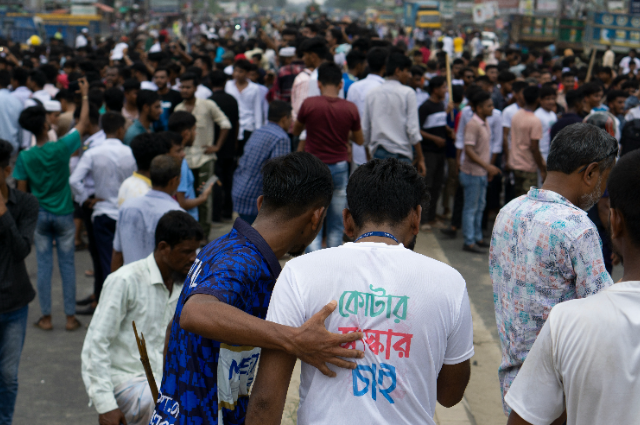
The unpleasant smell of smoke rising from Dhaka's Karwan Bazar in the early hours of the morning tells a story far more troubling than the physical destruction it represents. What unfolded across Bangladesh on previous week, following the death of Inqilab Moncho convenor Sharif Osman bin Hadi wasn't just an outbreak of grief-fueled rage. It was a calculated assault on the very pillars that hold democratic societies together - the free press, cultural institutions, and civilians themselves.
Bangladesh finds itself at a dangerous crossroads. The interim government led by Nobel laureate Muhammad Yunus, installed after the 2024 uprising that ousted former Prime Minister Sheikh Hasina, faces its most severe test yet. With elections scheduled for February approaching rapidly, the assassination of 32-year-old Hadi, shot by masked attackers after leaving a mosque, has exposed the nature of Bangladesh's democratic transition.
Hadi wasn't merely another political figure. As a senior leader of the student protest group Inqilab Mancha, he represented the youthful aspirations that powered last year's uprising. His planned candidacy as an independent in the upcoming elections symbolised a break from traditional political machines. His death, occurring suspiciously close to the election announcement, raises uncomfortable questions about who benefits when Bangladesh descends into chaos.
When Grief Becomes Weaponised
What's particularly disturbing about the previous week night's violence is its targeted nature. This wasn't a spontaneous outpouring of grief; it was an arranged destruction aimed at specific institutions. The attacks on The Daily Star and Prothom Alo - two of Bangladesh's most respected newspapers represent an attack on journalistic freedom that should alarm anyone who values democratic accountability.
Consider the disturbing scene of 28 journalists trapped on a tenth-floor rooftop as smoke filled the building below, unable to drop away because a mob controlled the ground floor. When a canteen worker attempted escape by the fire exit ladder, he was caught and beaten as a brutal message to anyone else considering the same route. Senior journalist Zyma Islam's desperate Facebook post was that, "I can't breathe. So much smoke. I'm inside. You are trying to kill me", captures the pure terror of being hunted for the crime of reporting news.
The symbolism is chilling. When societies want to control narratives, they first silence those who report the truth. The attackers' choice to target these specific newspapers wasn't random, as both publications have historically maintained editorial independence and critical coverage of various political groups.
Cultural Removal as a Political Strategy
Equally significant was the attack on Chhayanaut, the renowned Bengali cultural organisation founded in 1961. Attackers wearing helmets and face coverings forced entry around 1:30 am, systematically destroying furniture and musical instruments before setting fires. Their chants of religious slogans during the attack suggest an ideological dimension to the violence as an attempt to suppress secular cultural expression. Chhayanaut represents more than just an arts institution; it embodies Bangladesh's commitment to Bengali cultural heritage and mixed traditions. Attacking it sends a message about which visions of Bangladesh's identity are acceptable and which must be eliminated through force.
The Failure of Protection
Perhaps most troubling is the apparent inability or unwillingness of security forces to prevent these attacks. While army personnel were eventually deployed, the violence continued for hours. When Editors' Council President Nurul Kabir and photographer Shahidul Alam attempted to calm attackers, Kabir was harassed, verbally abused as an "Awami League agent," and physically assaulted, and his hair pulled as crowds pushed him. Here were respected figures trying to de-escalate, only to become targets themselves. The mob's willingness to attack even those attempting mediation reveals how thoroughly civil discourse has broken down.
The strategic opening of staircase access that allowed attackers to surge upward and resume vandalism raises uncomfortable questions about coordination and complicity. Were security forces genuinely overwhelmed, or was there permission for the violence to unfold?
A Pattern of Terrorization
The violence extended beyond Dhaka. In Rajshahi, an Awami League office was demolished with bulldozers, an act requiring significant equipment and planning. In Chattogram, protesters torched the residence of former city mayor ABM Mohiuddin Chowdhury, while others staged sit-ins outside the Indian Assistant High Commission.
Road blockades paralysed transportation across multiple districts, with protesters in Jhalakathi blocking the Barisal-Khulna highway and Barisal students stranding hundreds of vehicles on the Dhaka-Barisal-Kuakata Highway. The targeting of infrastructure alongside institutions reveals a comprehensive strategy to maximise disruption.
The Irony of the Response
Inqilab Moncho's late-night Facebook appeal urging restraint carries profound irony. The organisation warned that violence and vandalism aimed to weaken Bangladesh as a state, asking citizens to consider "who truly benefits if unrest is created" as elections approach. Yet this violence erupted in the name of their own deceased convenor. The organisation's statement inadvertently highlights a crucial truth that Hadi's death is being exploited by forces that may have little connection to his actual vision or the movement he represented.
Democracy's critical moment
Muhammad Yunus's assertion that "the country's march toward democracy cannot be halted through fear, terror, or bloodshed" is admirable but rings hollow when fear, terror, and bloodshed are precisely what's unfolding. Declaring a day of national mourning addresses symbolism, not security.
Bangladesh stands at a defining moment. The February elections represent a chance to establish democratic legitimacy after last year's uprising. But elections require conditions where candidates can campaign safely, journalists can report freely, and citizens can make informed choices without intimidation.
The Path Forward
What Bangladesh needs now isn't just restoration of order but restoration of trust. Authorities must credibly investigate both Hadi's assassination and the level of violence. Merely deploying troops to disperse crowds treats the problems and not their causes.
The trapped journalists who thought themselves lucky to have "narrowly escaped a major disaster" reflect a society where survival feels like fortune rather than expectation. When journalists wonder "where this country is headed," it's because the destination has become genuinely uncertain.
Bangladesh's transition from authoritarian rule to democracy was never going to be smooth. But that night revealed just how easily democratic progress can be derailed by those willing to weaponise grief, silence dissent through violence, and exploit instability for political gain. Whether Bangladesh's democratic experiment survives may depend on whether its citizens and leaders can distinguish between genuine sadness, planned chaos and respond accordingly.
. . .
References: