
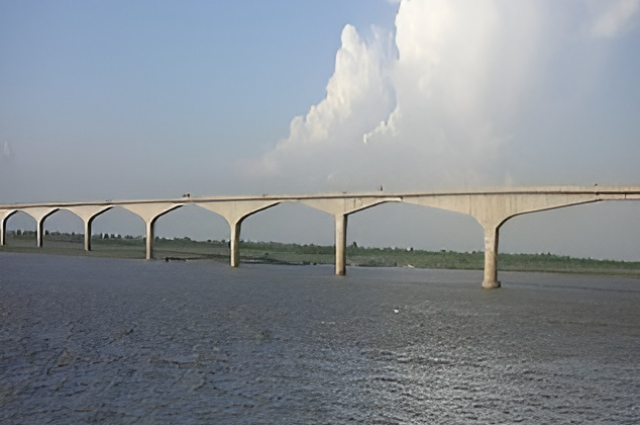

There is a bridge in Bihar that millions of people depend on every single day. It is called the Vikramshila Setu, and it stretches 4.4 kilometres across the Ganga River near Bhagalpur. For the people of eastern Bihar, students going to school, patients heading to hospitals, and traders moving goods, this bridge is not just a convenience. It is the only reliable way to cross the river. Right now, that bridge is in serious trouble.
Reports from this week paint a worrying picture. Three central pillars of the bridge that are numbered 17, 18, and 19 sit in the middle of the Ganga River, and the protective walls built around them have crumbled or are hanging dangerously. This has left the main structure open to constant battering from the river's current and floating debris. To understand why this matters, you need to know what those walls actually do. They act like a shield, which is a protective jacket around each pillar. Without them, the river hits the pillar directly, wearing it down over time, the way water slowly carves through stone.
Inspections reveal a grim picture, and the protection wall of one pillar has completely vanished into the river, another is detached and dangling, while a third has lost roughly half its structure. Engineers warn that the broken pieces of these walls do not just disappear; they keep floating around and striking the pillars again and again, making the damage worse with every hit.
The River Has Changed Its Mind
Part of what makes this situation especially difficult is that it is not simply a case of a poorly built bridge. The Ganga itself has been changing. Research shows that the riverbank downstream of Vikramshila Setu shifted by more than 1,000 metres in just ten years between 2003 and 2011, a rate more than double the erosion seen in the previous 18 years. Rivers are not static. They shift, they erode, they deposit sand in unexpected places. The Ganga near Bhagalpur has been doing exactly that, and the bridge, which is designed for the river as it was, now has to deal with the river as it is.
A professor from IIT Roorkee who studied the bridge warned the Bihar government years ago that climate change and erratic river flow would have a serious impact on Bihar's bridges. He specifically said that it is not just Vikramshila Setu at risk; all bridges built over rivers in Bihar need to be prepared for changing rainfall and flood patterns. That warning, it seems, was not acted upon with enough urgency.
A Pattern of Ignored Warnings
What makes this current crisis harder to accept is that it did not come without warning. Engineers who voluntarily inspected the bridge found that some pillars had already sunk by 15 millimetres, with a major portion of the surrounding walls washed away. That was not yesterday, as these warnings go back years. The bridge has seen temporary fixes before, but clearly, those patches have not held up against a river that keeps pushing back.
The Vikramshila Bridge has long been struggling under traffic far exceeding its original design. It was built for two lanes of traffic. Today, the demand for it is far beyond that, with tens of thousands of vehicles crossing every day. A structure already under stress from overuse is now also fighting a river that has changed course.
Bihar's Broader Infrastructure Problem
Vikramshila Setu's troubles do not exist in isolation. They are part of a bigger and more troubling story about infrastructure in Bihar. Not far from this bridge, the Agwani-Sultanganj bridge, which is a much newer structure that was supposed to ease the pressure on Vikramshila Setu, has collapsed three times in three consecutive years, with portions falling into the Ganga each time. Reconstruction resumed in 2025, with a new deadline of December 2026, though the construction company has already missed several earlier deadlines.
The debris from those collapses caused its own damage. An NGT committee found that no dolphins were spotted in an 8 to 9 kilometre stretch downstream of the collapse site, suggesting the Gangetic dolphins in the area have been disturbed by the concrete and rubble dumped into the river. So, the failure of one bridge rippled outward, harming the ecology of the Ganga and the lives of communities that depend on it.
What Needs to Happen?
The situation at Vikramshila Setu is not simply an engineering problem. It is a governance problem. Rivers change and that is their nature. Engineers and scientists have known for years that the Ganga near Bhagalpur is shifting and eroding at an alarming pace. The question was never whether the bridge would face stress. The question was whether those responsible would act in time.
The answer, so far, has been no. The protective walls around those three central pillars should have been repaired long before they crumbled. The warnings from IIT professors should have triggered urgent action, not slow bureaucratic processes. And the thousands of people who cross this bridge every day, trusting that it will hold deserve better than a structure that has been allowed to deteriorate to this point.
Bihar needs a full structural review of Vikramshila Setu immediately, followed by urgent repairs that go beyond surface-level patching. More importantly, the state needs a long-term plan that accounts for how its rivers are actually behaving today, not how they behaved decades ago when these bridges were first designed. The Ganga has changed. It is time the response to that change becomes urgent, serious, and sustained.
. . .
References: