
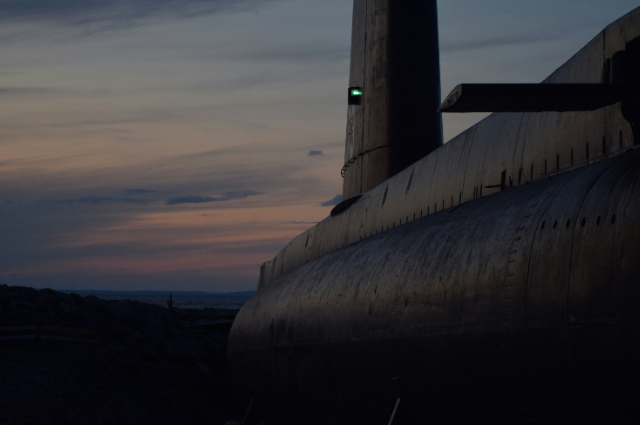
Photo by Marc-Antoine Déry on Unsplash / Representative Image
Somewhere beneath the waters of the Bay of Bengal, a ship is being prepared to silently change the balance of power in Asia. It has no wings, no visible guns, and makes as little noise as possible. Yet its arrival, expected between April and May 2026, may well be the most consequential military development in the region this year. That submarine ship is INS Aridhaman India's third nuclear-powered submarine capable of carrying ballistic missiles.
To understand why this matters, you first need to understand what kind of machine this is. INS Aridhaman is not a conventional warship that patrols coastlines or escorts convoys. It is a vessel designed to stay hidden underwater for long periods, armed with nuclear-capable missiles that can strike targets thousands of kilometres away. In plain terms, it is India's ultimate insurance policy for a weapon that survives any attack on Indian soil and can still hit back with devastating force. That is the whole logic of putting nuclear weapons on submarines. Even if an enemy destroys everything on land, the submarine is already at sea, invisible and waiting.
Built in India, for India
What makes INS Aridhaman particularly notable is where it was made. It was built at the Ship Building Centre in Visakhapatnam, a port city on India's southeastern coast, by private sector company L&T, and it carries nearly 75 percent Indian-made components. This is not a purchased weapon from a foreign power. It is a product of India's own engineering under the government's "Atmanirbhar Bharat" or self-reliant India programme.
This matters beyond national pride. A country that can build its own nuclear submarine has reached a level of technological capability that very few nations in history have achieved. The United States, Russia, the United Kingdom, France, and China are the only countries that have done it before. India is now firmly in that club.
The submarine belongs to what is called the Arihant class. INS Arihant, India's first such vessel, was launched in 2009 and quietly commissioned in 2016. The second, INS Arighaat, was commissioned in August 2024. INS Aridhaman is the third, and it is bigger and more powerful than both.
Bigger, Quieter, More Dangerous
The numbers tell the story clearly. INS Aridhaman weighs about 7,000 tonnes when submerged, which is roughly 1,000 tonnes more than the first ship in its class. It is about 130 metres long. It is powered by an 83-megawatt nuclear reactor, which essentially means it does not need to refuel during operations. It can travel underwater at speeds of up to 24 knots and stay at sea for extended periods without surfacing.
But the single most important upgrade over its older siblings is its missile launch system. Earlier submarines of this class had four tubes for firing missiles. INS Aridhaman has eight. That is double the firepower. It can carry up to eight K-4 missiles, each with a range of 3,500 kilometres, meaning it can reach targets deep inside any neighbouring country while staying safely within the Bay of Bengal. Alternatively, it can carry 24 shorter-range K-15 Sagarika missiles, each with a range of 750 kilometres. These are not conventional weapons; they are nuclear-capable missiles. The submarine can mix and match depending on the mission.
To avoid detection, it is fitted with special sound-absorbing tiles on its outer body and advanced sonar systems built in India. It moves slowly and carefully, prioritising invisibility over speed. The goal is to be undetectable. In military language, this is called a "ghost-like" presence of a vessel that can lurk within an enemy's waters, watch what is happening, and strike if needed, all without ever being found.
The Logic of the "No First Use" Policy
India follows what it calls a "No First Use" nuclear policy. This means India has committed to never using nuclear weapons first in any conflict. It will only use them in response to a nuclear attack on Indian soil or on Indian forces. This sounds restrained, but it creates a serious problem that if an enemy knows India will never strike first, they might consider attacking India's nuclear weapons on land and destroying them before India can respond.
That is exactly where submarines become crucial. A submarine like INS Aridhaman cannot be taken out in a ground attack because nobody knows where it is. It is always at sea, always hidden. Military experts say that to maintain this kind of continuous protection, a country needs at least three such submarines so that one is always on patrol at any given time. India is now reaching that threshold with the addition of Aridhaman.
What This Means for China and Pakistan
India's neighbours cannot ignore what is happening. China has been rapidly expanding its own naval presence across the Indian Ocean and into the wider Indo-Pacific region. Pakistan, meanwhile, is reportedly in discussions to acquire eight submarines from China.
INS Aridhaman directly addresses both of these concerns. Its K-4 missiles, with a range of 3,500 kilometres, can reach well into Chinese territory from the Bay of Bengal. Pakistan is well within range of even the shorter K-15 missiles. But more importantly, because the submarine is hidden, there is no way for either country to know where it is, what it is carrying, or when it might be used. That uncertainty itself is a powerful deterrent.
This is not aggression. It is calculated reassurance that a message of India cannot be cornered or destroyed in a first strike, because part of its nuclear capability will always survive underwater, waiting.
A Turning Point
India's journey to this point has been long and quiet. Unlike some countries that loudly announce every military development, India has built its submarine programme with deliberate secrecy. The Advanced Technology Vessel project, under which these submarines are built, has been running for decades. Its results are only now becoming visible.
The commissioning of INS Aridhaman in the coming months will mark a genuine shift in India's strategic position. It is not merely the arrival of one more warship. It is the completion of India's nuclear capability, which is the ability to deliver nuclear weapons by land, by air, and now reliably and continuously by sea. That is a capability fewer than a handful of nations possess. The ocean is vast, and its depths keep secrets well. India's newest submarine is about to become one of them.
. . .
References: