
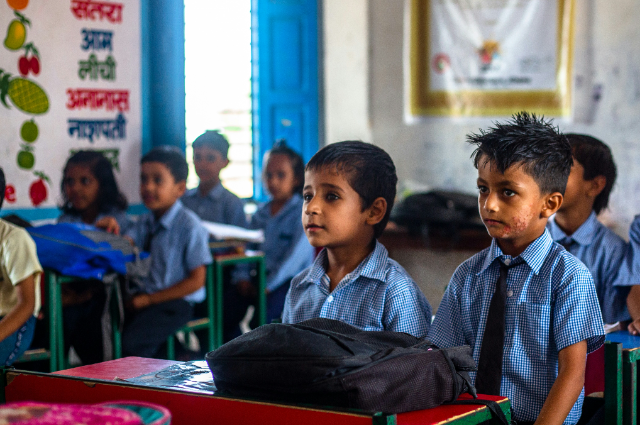
Photo by Swastik Arora on Unsplash
There is something deeply interesting happening in Karnataka's classrooms right now, and it tells us a lot about the gap between what politicians say and what students actually do.
The Government's Move
Earlier this year, the Karnataka government made a bold move. It announced that the third language, and the one most students study, Hindi, would no longer carry any marks in the Class 10 board exam, known as SSLC. Instead of a score out of 100, students would now just get a grade like A, B, C, or D. The third language was dropped from the total, bringing the exam from 625 marks down to 525. The government's message was clear. Karnataka is moving towards a two-language model, Kannada and English, and the state is pushing back against what it sees as Hindi being forced on its students from New Delhi.
The Politics Behind the Policy
It is a politically charged move. Chief Minister Siddaramaiah has long been vocal about not wanting Hindi to be given extra importance in a Kannada-speaking state. The Kannada Development Authority formally wrote to him backing this position, arguing that the central government's three-language policy unfairly benefits Hindi speakers in government job exams like UPSC, SSC, and banking recruitment. Karnataka is not alone, as Tamil Nadu, Maharashtra, Punjab, and Delhi have all pushed back against the same policy in their own ways. So far, so straightforward. But here is where things get complicated.
What the Numbers Actually Say?
Despite all the political noise around Hindi being imposed on Karnataka, nearly 93 per cent of students in the state board have chosen Hindi as their third language. Out of around 8.1 lakh students, over 7.5 lakh picked Hindi. When you add students studying Hindi through the NCERT curriculum in special government schools, the number goes up to about 7.6 lakh. By contrast, only 11,483 students chose Kannada as their third language, and 32,135 picked English. Urdu, Sanskrit, Arabic, Tulu, Konkani, and Marathi together account for a tiny fraction of the rest.
Let that sink in for a moment. The state government is fighting to remove Hindi's importance from school results, while the overwhelming majority of its own students are voluntarily signing up to learn it. This is the contradiction at the heart of this debate, and it deserves an honest conversation.
Where the Government Has a Point?
The government's concern is not entirely without basis. Of the 1,64,000 students who failed the third language exam, 1,48,000 failed in Hindi specifically. That is a striking number. It suggests that while students are choosing Hindi in large numbers, many are struggling to actually learn it. In that sense, removing Hindi's marks from the final result does take away some pressure and prevents students from being pulled down by a subject they find genuinely difficult. Lowering the passing mark to 33 and removing a 100-mark paper from the total can genuinely help a student who is otherwise performing well but stumbling on a language they were not raised speaking.
But the political message the government is sending alongside this decision is a different matter altogether. Framing this as resistance to Hindi imposition, when 93 per cent of students are freely opting for it, does not quite add up. Students and their families are clearly making a practical calculation that Hindi is widely spoken across India, useful for travel, work, and daily life in a way that Sanskrit or Tulu may not be for most people. That is not imposition. That is a choice.
The Legitimate Concern Worth Addressing
The real concern raised by the Kannada Development Authority is more legitimate and worth taking seriously. The argument is that the three-language policy puts non-Hindi speakers at a disadvantage in central government job exams, because Hindi speakers effectively get to treat their mother tongue as one of their language choices. This is a structural unfairness that has been discussed for decades, and it does deserve a national-level conversation.
However, removing Hindi's weight from school marks in Karnataka does not fix that problem. It is a state-level response to a national-level issue. It may ease pressure on students, which is good. But it does not change how UPSC or banking exams are structured in Delhi.
What Students Are Telling Us?
Teachers' associations have pointed out that Hindi continues to be seen as a practical and widely useful choice by students and families alike. The government would do well to listen to that signal rather than dismiss it. If students are choosing Hindi because it helps them in life, then making it easier to learn with better teachers, better textbooks, and more support might serve students far better than making it matter less on paper.
The Bigger Question Karnataka Needs to Answer
What Karnataka is really grappling with is a question that has no easy answer, and how do you protect and promote a regional language like Kannada in a country as large and mobile as India, without putting your own students at a disadvantage? That tension is real. But the answer cannot simply be to strip a subject of its marks while 93 per cent of students keep choosing it anyway. That is not a language policy. That is a political statement dressed up as education reform.
The Karnataka government deserves credit for trying to reduce unnecessary stress on students. But if it truly wants to protect Kannada and give students a fair footing, it needs to go beyond symbolic gestures. It needs to push for structural changes at the national level, invest in making Kannada more relevant and rewarding in the job market, and above all, trust that students are smart enough to make their own choices about which languages help them get ahead in life. The students of Karnataka have already told us what they want. The question is whether the government is listening.
. . .
References: