
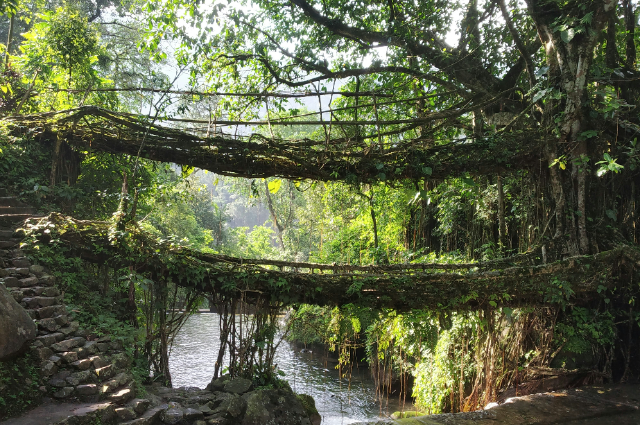
Photo by Utkarsh B on Unsplash
India has taken an important step in showcasing one of its most extraordinary cultural treasures to the world. The country has officially submitted a nomination to UNESCO, asking them to recognise Meghalaya's living root bridges as a World Heritage Site. If successful, these incredible structures would join the ranks of globally celebrated landmarks like the Taj Mahal and the Great Wall of China.
The nomination package, formally called "Jingkieng Jri / Lyu Chrai Cultural Landscape," was handed over to UNESCO's World Heritage Centre in recent weeks. India's Ambassador to UNESCO, Vishal V. Sharma, presented the detailed dossier to Lazare Assomo Eloundou, who heads the organisation's World Heritage Centre. The application will be reviewed during UNESCO's 2026-27 evaluation cycle, meaning we could know the outcome within the next couple of years.
What Makes These Bridges Special?
The living root bridges of Meghalaya are not ordinary structures. Unlike conventional bridges built with steel, concrete, or wood, these are literally alive. Indigenous communities in the Khasi and Jaintia Hills have been creating these bridges for centuries using a remarkable technique that works with nature rather than against it.
The process involves guiding the aerial roots of rubber fig trees across rivers and streams. Over many years and sometimes decades, these roots are carefully trained and woven together until they form sturdy, living bridges that can support the weight of dozens of people at once. As the trees continue to grow, the bridges actually become stronger over time.
What's truly remarkable is that this isn't just about engineering or construction. These bridges represent a complete way of thinking about humanity's relationship with the natural world. The indigenous communities who build and maintain them follow a philosophy centred on coexistence with nature and deep respect for what they call Mei Ramew, or Mother Earth.
A Living Cultural Landscape
The nomination doesn't just focus on individual bridges. It encompasses an entire cultural landscape spread across the Khasi and Jaintia Hills. This landscape tells a story of how communities have lived in harmony with their environment for generations, developing sustainable practices that modern society is only now beginning to truly appreciate.
The Khasi and Jaintia people have maintained traditional land management systems and community governance structures that ensure these bridges and the forests around them are protected and cared for. It's a living tradition, meaning it's not something preserved in a museum or history book. Real people continue to practice these traditions today, building new bridges and maintaining old ones using techniques passed down through families.
This connection between people, nature, and belief systems creates something more valuable than just tourist attractions. It demonstrates that communities can thrive while protecting their environment, offering lessons that resonate far beyond Meghalaya's borders.
A Team Effort
Ambassador Sharma made a point of recognizing the many people and organisations who made this nomination possible. He acknowledged India's Prime Minister, the Union Minister for Culture, and Meghalaya's Chief Minister for their leadership and support. He also highlighted the crucial work done by the Archaeological Survey of India and the Ministry of External Affairs in preparing the detailed documentation required for such nominations.
However, perhaps most importantly, he recognized the local communities themselves. After all, without their continuous care and dedication over centuries, these bridges wouldn't exist. They are the true guardians of this heritage, and any recognition from UNESCO would ultimately be a tribute to their stewardship.
Why This Matters
UNESCO World Heritage status is more than just a prestigious title. It brings global attention and often helps protect important sites for future generations. For Meghalaya, this recognition could mean increased support for conservation efforts and opportunities for sustainable tourism that benefit local communities.
The nomination also demonstrates India's commitment to preserving what UNESCO calls "living cultural landscapes", places where traditional ways of life continue to shape and maintain the environment. These are different from ancient monuments or archaeological sites. They're about communities actively keeping traditions alive.
In our rapidly changing world, where traditional knowledge is often dismissed in favour of modern technology, Meghalaya's living root bridges stand as powerful examples of indigenous wisdom. They show that solutions developed over centuries by people deeply connected to their land can be just as effective and often more sustainable than contemporary approaches.
The bridges also challenge our usual definitions of architecture and engineering. They blur the line between the natural and the constructed, showing that these categories don't always need to be separate. In doing so, they invite us to reconsider our relationship with the environment.
Looking Ahead
As UNESCO evaluates this nomination over the next couple of years, the world will have an opportunity to learn about Meghalaya's extraordinary heritage. Whether or not the bridges ultimately receive World Heritage status, the nomination itself represents an achievement. It puts a spotlight on indigenous knowledge systems and sustainable practices that deserve wider recognition.
For the communities of the Khasi and Jaintia Hills, this is a moment to celebrate their ancestors' wisdom and their own continued dedication to preserving these remarkable traditions. Their living root bridges are not just pathways across rivers; they're bridges between past and present, between humanity and nature, and potentially, between India and a greater global understanding of what heritage truly means.
. . .
References: