
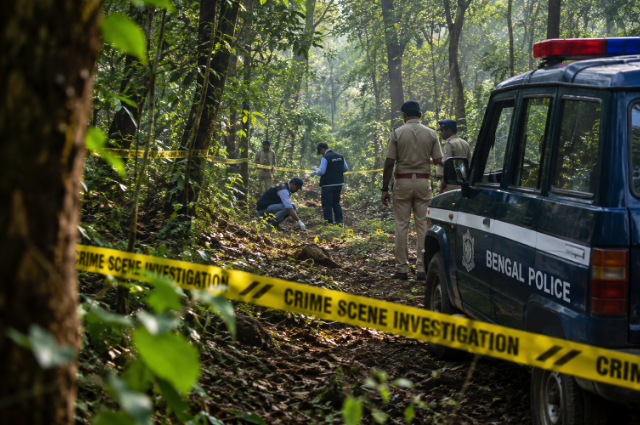
The discovery of skeletal remains linked to at least four people in a forest near Jatgaria has raised serious questions in Kanksa, West Bengal. Police and forensic teams reached the site after local villagers reported the remains, but the identities and deaths of the deceased remain unknown. DNA testing, missing-person records and forensic examination will now help establish what happened. Until those results arrive, several claims circulating locally remain unverified.
Four Sets of Skeletal Remains Deepen the Kanksa Mystery
The skeletal remains were recovered from a forest area near Jatgaria in Kanksa block, located in West Bardhaman district. The Times of India described the remains as belonging to at least four people. A large police team and forensic experts visited the location after villagers alerted authorities.
Investigators collected biological material, soil and possible personal belongings from the site. The remains were later taken to a state hospital, where a post-mortem examination was carried out. The examination is expected to help assess age, sex, and possible causes of death.
The available report does not establish whether all the remains were found in one spot or at separate locations. It also does not confirm that the people died at the same time or in the same incident.
What Remains Unconfirmed
Police have not confirmed the identities of the deceased, the time since death, or the manner of death. The authorities have also not said whether the remains are connected to one event.
Local speculation has included claims of multiple murders or a suicide pact. Police said no conclusion could be drawn at this stage. Anonymous posts and unverified social media claims should not be treated as evidence.
DNA Testing Could Establish the Identities of the Deceased
Forensic teams first document the scene and record the position of each bone or group of remains. They then label, preserve, and transport the material for laboratory examination. The condition of the bones can offer clues about age, biological sex, injuries and other physical traits.
These findings can narrow the search, but they do not confirm identity by themselves. Exposure to heat, moisture, animals and soil can damage bones and reduce the information available to experts. The post-mortem process may also examine any remaining tissue or material attached to the bones. The final findings will depend on how complete the remains are and whether the laboratory obtains usable samples. DNA profiling may help compare the recovered material with samples from biological relatives. Investigators can also check whether usable DNA exists in official medical or identification records. The samples are being sent to the state forensic laboratory, according to the reported police briefing.
A match can identify a deceased person with a high degree of scientific confidence. It does not, by itself, show how that person died or who may be responsible.
Police are examining missing-person records from the area. One missing complaint filed at Budbud police station on July 8 was reported to be under review, but no official link has been confirmed.
Witness Accounts and Local Intelligence
People who live near the forest may have noticed unusual movement, vehicles or activity. Forest workers, travellers and others familiar with the area may also help investigators understand when the remains could have been placed there. Witness accounts need to be checked against phone records, site evidence and other statements. A rumour or unverified sighting cannot prove identity, guilt or involvement. Identifying the deceased is only one part of the investigation. Forensic pathologists must also assess whether the bones show signs of injury, disease or other changes linked to death.
Severely decomposed or incomplete remains may make it difficult to identify fractures or other trauma. In some cases, testing may establish only limited conclusions about the cause of death. The post-mortem examination at the state hospital and laboratory reports will carry more weight than early opinions based on the discovery site.
How to Follow the Case Responsibly
Follow updates from police authorities, established news organisations, and court documents where available. Avoid sharing graphic photographs, alleged confessions, or names based only on social media posts.
The Kanksa investigation may take time because identity, cause of death, and the circumstances of the discovery require separate findings. Verified updates will be more useful than fast speculation.
Conclusion
Skeletal remains linked to at least four people were found in the Kanksa jungle near Jatgaria after villagers alerted police. Authorities collected biological and soil samples, examined possible belongings and sent material for forensic testing. A missing complaint filed at Budbud police station on July 8 is also being reviewed.
The key questions remain unanswered: who the deceased were, when they died, how they died and whether the remains are connected. DNA analysis, post-mortem findings, missing-person records and verified witness accounts must answer those questions.
References