
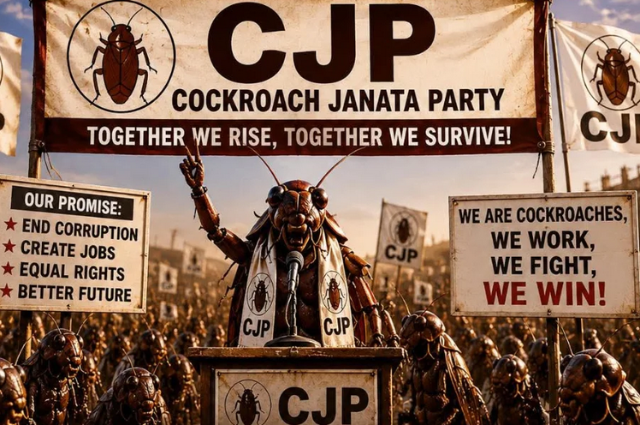
For decades, political protests in India followed a familiar script where seasoned politicians waved party flags, union leaders raised traditional battle cries, and ideological student groups filled public spaces. However, the events that unfolded at New Delhi’s historic Jantar Mantar demonstration site represent a radical break from tradition. A satirical digital movement, born barely a month prior out of pure online sarcasm and youth frustration, transitioned from phone screens directly onto the pavement.
Calling themselves the Cockroach Janta Party (CJP), hundreds of students, exam aspirants, and parents converged in the capital. They were unified not by traditional political allegiance, but by shared anger over irregularities in national-level examinations, specifically paper leaks in the National Eligibility cum Entrance Test (NEET-UG 2026) and glitches in the Central Board of Secondary Education's (CBSE) grading system. The primary, unyielding demand of this crowd was simple where the immediate resignation of Union Education Minister Dharmendra Pradhan.
What makes this event an important milestone in modern Indian socio-politics is how the movement reclaims a derogatory term to use as a shield of defiance. By examining how this protest came together, how the authorities responded, and how ideological clashes briefly threatened to derail its peaceful message, we can better understand the shifting landscape of youth activism in a highly digitised era.
The Genesis of the "Cockroach" Identity
To comprehend why hundreds of young individuals walked into the heat of a Delhi summer wearing cockroach masks, one must understand the origin of the term in this context. The movement was sparked after remarks attributed to a Supreme Court hearing allegedly compared vocal online critics to "cockroaches" and "parasites." While it was later clarified that these remarks were taken out of context, the digital ecosystem had already captured the phrase.
Instead of taking offense, India’s educated but increasingly frustrated youth embraced the label. The logic behind the satire is both clever and deeply symbolic, where cockroaches are globally recognised as creatures that can survive almost anything, even a nuclear blast. By adopting this identity, the youth sent a sharp message to the political establishment: “You can ignore us, crush our exams, or call us names, but we are resilient. We do not die, and we will not go away.”
Abhijeet Dipke, a 30-year-old political communications strategist and Boston University graduate, recognised this viral sentiment. He founded the fictional "Cockroach Janta Party" on social media. What began as an online parody rapidly grew into a massive digital petition signed by over 800,000 people. Recognising that digital anger must translate to physical presence to effect change, Dipke flew from the United States to New Delhi, carrying a copy of Dr. B.R. Ambedkar’s autobiography, a deliberate nod to constitutional rights to spearhead the party's first-ever physical demonstration.
Chaos, Compliance, and the Logistics of Protest
Taking an internet movement to the streets of New Delhi is an immense logistical and legal challenge. Under normal circumstances, organising a mass gathering at Jantar Mantar requires submitting a formal request to the local police station at least 24 hours in advance. Initially, there was confusion, with police stating no formal request had been processed, leading to fears that the protest would be shut down before it even began.
However, to prevent chaotic scenes and avoid mass gatherings at the airport or police stations, the Delhi Police took an unusual step. Authorities met Dipke upon his arrival at the airport and facilitated the necessary paperwork on the spot. They granted a one-time exemption, in accordance with Supreme Court guidelines, allowing a peaceful demonstration strictly between 10:00 AM and 5:00 PM.
When the demonstration commenced, Jantar Mantar was heavily fortified. Hundreds of police personnel and paramilitary forces erected multi-layer barricades. Despite the intimidating security presence, the atmosphere remained remarkably creative. Young students held up textbooks and national flags. They distributed cockroach masks and carried witty, biting posters. One particularly popular placard read, “We asked for 'Make in India', you gave us 'Leak in India'”, a direct criticism of the government's failure to secure highly competitive national exams that dictate the futures of millions of students.
A Paradigm Shift in Modern Activism
The Cockroach Janta Party’s demonstration concluded precisely at its 5:00 PM deadline, but the organisers made it clear that this was merely the opening act. CJP leaders issued an ultimatum that if Education Minister Dharmendra Pradhan does not resign or face dismissal, the movement will expand beyond Delhi, organising chapters and protests across various states.
Ultimately, this protest highlights a profound shift in how young citizens interact with governance. It proves that the line between digital spaces and real-world activism has dissolved. When traditional channels of communication feel closed or unresponsive, the youth will invent entirely new frameworks for resistance, even if it means dressing up as insects to make their voices heard.
The "Cockroach Protest" will likely be remembered not just for its unusual imagery but as a lesson in political survival. It serves as a reminder to those in power that when an administrative system fails the youth repeatedly, the resulting frustration will eventually find a way to break through the concrete of official indifference.
. . .
References: