
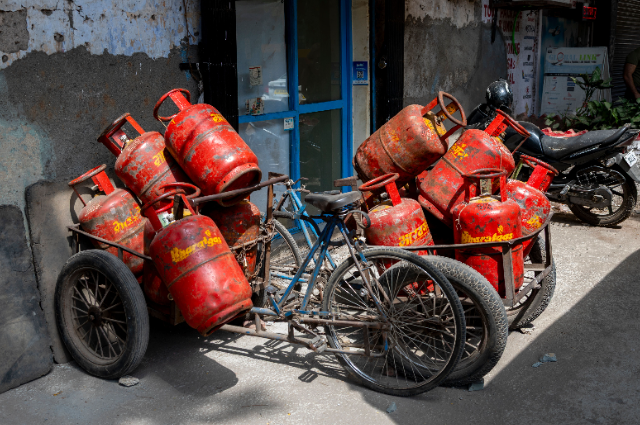
If you have walked into an Indian kitchen recently, you might have noticed that the blue flame on the stove is burning a slightly deeper hole in the household budget. As of June 2026, the cost of a standard 14.2 kg domestic Liquefied Petroleum Gas (LPG) cylinder in Delhi has climbed by ₹29, pushing the retail price to ₹942. For families enrolled in the Pradhan Mantri Ujjwala Yojana, the government's flagship program designed to provide clean cooking fuel to lower-income households, the price has been adjusted to an effective ₹642.
To many, a ₹29 increase might seem modest at first glance. However, context changes everything. This marks the second notable price hike in just three months, following a sharper ₹60 jump in March. When combined with simultaneous increases in petrol, diesel, and compressed natural gas (CNG), it is easy to understand why the average consumer feels a creeping sense of financial exhaustion.
Yet, as local kitchens feel the squeeze, a fierce global debate is unfolding. The government recently pointed out that even after these adjustments, Indian households still pay some of the lowest prices for cooking gas in the entire world. How can a price that feels burdensome at home be considered "low" globally? To understand this paradox, we have to look past our own doorsteps and trace the journey of a gas cylinder through international conflict zones, massive government safety nets, and the complex mechanics of energy economics.
The Global Tinderbox: Why Subsidies Alone Can’t Freeze Prices
To understand why the price of an Indian cooking cylinder changes, we must first look at where the gas comes from. India does not produce enough natural gas to satisfy its massive domestic demand. In fact, more than half of the LPG consumed in Indian homes is imported from abroad, primarily from the energy-rich nations of West Asia.
Because we rely so heavily on external suppliers, our domestic prices are inextricably tied to international benchmarks, specifically the Saudi Contract Price (Saudi CP), which serves as the global pricing standard for LPG. Since late February 2026, this global benchmark has surged by a staggering 46 percent.
The trigger for this massive spike is the ongoing geopolitical crisis in West Asia. Geopolitics is rarely just about diplomacy; it acts as a direct lever on the cost of everyday goods. As the regional conflict intensified, the Strait of Hormuz, the narrow, critical waterway through which a massive chunk of global energy supplies travel, became highly unstable. Commercial shipping in the strait slowed to a near-crawl.
For India, this was a direct hit to the supply chain. Approximately 54 percent of all the LPG India consumes must sail right through the Strait of Hormuz. When a major trade is restricted, shipping costs skyrocket, insurance rates for cargo ships soar, and the raw cost of the fuel itself spikes due to fears of scarcity. No matter how much a government wants to keep local prices stable, it cannot completely shield its economy from a global energy shock of this magnitude.
The Economics of "Under-Recovery": A ₹60,000 Crore Balancing Act
When international fuel prices shoot up through the roof, someone has to pay the difference. In a completely free-market economy, that burden falls squarely on the consumer. If the global price of gas doubles, your utility bill doubles.
If you want to see what cooking gas would actually cost without government intervention, you only need to look at the commercial sector. Restaurants, hotels, and industries do not receive the same price protections as private households. They buy the larger 19 kg commercial cylinders, which are priced strictly according to prevailing market rates.
Following five consecutive price hikes triggered by the West Asia crisis, a commercial cylinder in Delhi now costs ₹3,113.50. When broken down by weight, commercial users are paying about ₹164 for every kilogram of gas. Meanwhile, after the June retail adjustment, a regular domestic household pays around ₹66 per kilogram, and a Ujjwala household pays roughly ₹45 per kilogram.
This contrast explains why the government maintains that Indian domestic rates are among the lowest in the world. Regular consumers are buying their gas at roughly a 45 percent discount compared to the international market price, while Ujjwala beneficiaries enjoy a massive 60 percent discount. The commercial cylinder reflects raw economic reality; the domestic cylinder reflects targeted social policy.
The Broader Picture: Inflation and the Household Budget
While it is factually true that Indian cooking gas is heavily cushioned compared to global standards, telling a homemaker that their fuel is technically "cheap" does little to ease the immediate pressure on their monthly budget. Human budgets do not operate in a vacuum of international comparisons; they operate on the ground reality of disposable income. The LPG hike is particularly challenging because it does not arrive alone. It lands at a time when petrol and diesel prices have crept up by an average of ₹7.50 per litre, and CNG has risen by about ₹6 per kg. When transport fuels become more expensive, the cost of moving vegetables, grains, and consumer goods from farms and factories to urban markets rises with them.
For the middle class and lower-income families, energy inflation acts as an invisible tax. When cooking gas and transportation eat up a larger slice of the family income, households are forced to cut back on discretionary spending, whether that means delaying a clothing purchase, eating out less, or scaling back on minor luxuries. Therefore, even a seemingly minor adjustment like ₹29 can trigger a chain reaction that tightens consumer spending across the wider economy.
. . .
References: