
.jpg)
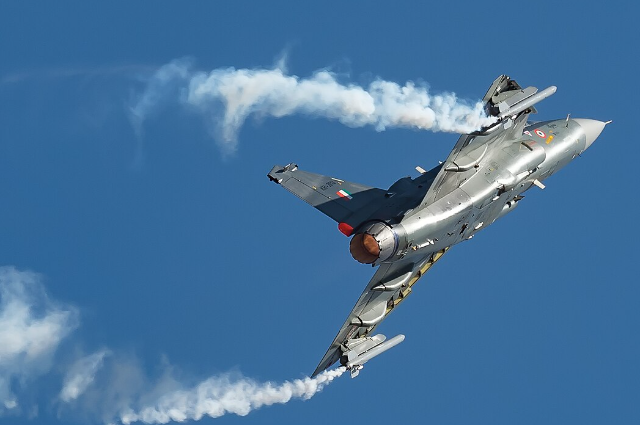
On November 21, 2025, India's aspirations for indigenous defence manufacturing collided with a tragic reality at the Dubai Air Show. The HAL Tejas fighter jet, once a symbol of New Delhi's technological ability and self-reliance in military aviation, fell from the skies at Al Maktoum International Airport, taking with it Wing Commander Namansh Syal, a 37-year-old pilot whose exceptional flying skills had previously mesmerised audiences at international air displays. The aircraft crashed at approximately 2:10 pm local time during what was meant to be a routine demonstration flight on the final day of the prestigious biennial air show, killing the pilot instantly when he was unable to eject.
The Crash: A Sequence of Catastrophe
The incident unfolded with devastating swiftness before thousands of spectators. During a demanding low-altitude aerobatic manoeuvre, the Tejas appeared to perform a negative-g "push turn" toward the crowd. However, something went critically wrong. The aircraft lost control and descended rapidly into the ground at tremendous speed in front of onlookers. Black smoke rose over the airfield, and within minutes, emergency response teams mobilised across the site. While rescue teams acted with commendable speed, no amount of preparation could overcome the violence of the impact. The pilot, classified as a Full Operational Clearance (FOC) version Mk 1 aircraft, had moments to react but could not recover in time to use the emergency ejection systems.
What makes this tragedy particularly alarming is that this is only the second recorded crash of the Tejas platform since its maiden flight in 2001. The first occurred in March 2024 in Rajasthan's Jaisalmer region, where an engine seizure forced the pilot to eject. That incident was isolated enough to be explained away, attributed to a specific mechanical failure. Two crashes within eighteen months, however, suggest a more concerning narrative about the aircraft's reliability during high-stress demonstration flights. The timing couldn't be worse by occurring on one of the world's most prominent defence aviation stages, where international military buyers and defence analysts observe everything meticulously.
Strategic Implications in a Contested Region
India faces mounting security pressures, particularly from the growing military alignment between China and Pakistan. The Tejas was positioned as a crucial piece of India's modernization strategy, intended to address the depletion of its fighter fleet. The Indian Air Force signed major contracts in September 2025 to procure 97 additional Tejas aircraft, with deliveries expected to begin in 2027. An earlier deal signed in 2021 for 83 Tejas aircraft has already faced significant delays, primarily due to shortages of General Electric F404 engines imported from the United States. These delays have already frustrated India's defence procurement timeline. Now, a fatal crash raises uncomfortable questions about the platform's maturity for operational deployment.
Remarkably, this crash occurred just one day after India's Ministry of Defence vehemently rejected claims of an oil leak in the aircraft. Videos circulating on social media the day before appeared to show liquid dripping from the Tejas, sparking concerns among observers about potential structural or system failures. The Defence Ministry dismissed these allegations as "fake" and "deliberately misleading," explaining that the footage actually showed routine draining of condensed water from the Environmental Control System and On-Board Oxygen Generating System. That categorical rejection of supposed mechanical problems, followed within hours by a catastrophic structural failure, creates an unfortunate optics problem for defence officials already under scrutiny about the platform's readiness.
A Loss That Extends Beyond Metrics
Behind the statistics and strategic implications is a human tragedy. Wing Commander Namansh Syal was no ordinary pilot, as he was highly skilled and well-respected within his squadron. Family members described him as humble and dedicated, recently self-confident about promotion at this age. The Tejas programme has lost a supporter and exemplar of what the aircraft could achieve in capable hands. His death represents not merely a statistical accident but a profound loss to the aviation community and his grieving family.
A court of inquiry has been constituted to ascertain the cause of the accident, a necessary but insufficient response. Several critical questions loom, which include - Was this a pilot error during an aggressive manoeuvre, or was there an undetected technical malfunction? Did the reported fuel system concerns from the previous day have any connection to the crash? How will HAL address the reliability concerns that two crashes within eighteen months inevitably generate? Can confidence in the platform be restored before large-scale operational deployment?
Price of Pride and Progress
The Tejas crash at Dubai represents a sobering reminder that indigenous military capabilities, however impressive and symbolically important, must never be rushed to an international showcase before safety is absolutely certain. India's ambitions to modernise its defence sector are legitimate and strategically necessary. However, that ambition must never override the imperative to protect the lives of brave pilots who demonstrate these platforms to the world. Wing Commander Syal's sacrifice demands a thorough investigation, transparent findings, and comprehensive corrective action. Only through such accountability can India ensure that future demonstrations become celebrations of achievement rather than memorials to loss.
. . .
References: