
Life has an uncanny, sometimes terrifying ability to flip completely on its head in a matter of hours. One day, you are a promising young intellectual with the world at your feet; the next, you are a nameless face blending into the harsh concrete of a bustling metropolis.
This became a stark reality for Abhay Suresh Belkoni, a 25-year-old third-year medical student pursuing a Bachelor of Homoeopathic Medicine and Surgery (BHMS). For 47 days, his family in Nanded, Maharashtra, experienced the living nightmare of his sudden disappearance. Meanwhile, Abhay was undergoing a silent tragedy of his own, forced by circumstance and a mental health crisis to beg for food on the unforgiving streets of Mumbai.
A Journey Derailed by Misfortune
The nightmare began when Abhay boarded a train to return to his college in Jalgaon. What was supposed to be a routine journey quickly devolved into chaos. While on the train, Abhay's bag, which contained his phone, identity documents, money, and a paper with his family's contact details, was stolen.
Stranded, penniless, and stripped of any means of communication, Abhay found himself thrust into an overwhelming environment. Compounding the situation was a pre-existing mental health condition. Under the crushing weight of panic and trauma, his memory clouded over, and he found himself completely unable to recall his family's phone numbers or how to reach home.
A brief glimmer of hope appeared when Abhay managed to use a railway vendor's phone to call his family. However, before he could articulate his location or describe what had happened, the line disconnected. When the panicky family called back, the vendor could only inform them that the young man had already walked away into the crowd.
Lost on the Footpaths of Mumbai
With no resources and a deteriorating mental state, Abhay ended up in Mumbai, specifically on the footpaths of SV Road in the western suburb of Malad. For nearly a month and a half, the medical student survived purely on the charity of strangers, begging for meals just to stay alive. To the thousands of commuters rushing past him daily, he was just another anonymous face of Mumbai’s homeless population.
Back home, his family, including his father, who works as a school teacher, and his older brother, a doctor at a government hospital, embarked on a desperate search. After weeks of exhausting all leads, they filed a formal missing person report with the Tamsa police in Nanded, fearing the worst.
The Power of Empathetic Policing
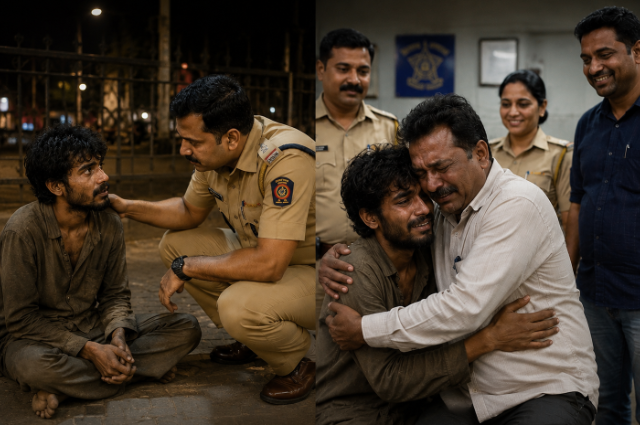
Abhay’s rescue was not born out of mechanical law enforcement, but out of genuine human intuition and kindness. During a routine anti-begging and rehabilitation drive by the Malad Police, Constable Komalsingh Jadhav spotted a young man sitting on the pavement. The youth looked physically weak, disoriented, and was unable to speak coherently.
Rather than processing him as just another statistic, the police team chose a path of empathy. They brought him back to the station, gave him a warm bath, provided fresh clothes, and sat him down for a hot meal. Once Abhay felt safe and calm, Sub-Inspector Manisha Kagalkar began to speak with him gently. As the fog of trauma began to lift, Abhay managed to share his name and his hometown of Nanded.
An Emotional Late-Night Reunion
Acting swiftly under the guidance of Senior Inspector Dushyant Chavan and DCP Sandip Ghuge, the Malad police contacted the Tamsa police station in Nanded. The puzzle pieces instantly came together; a missing person’s report matched Abhay perfectly.
When Abhay’s father received the call that his son was alive and safe in Mumbai, the relief was overwhelming. The family immediately rushed to the city, arriving at the Malad police station late into the night. The moment the father’s eyes fell upon his son, weakened but safe, he broke down in tears.
This moving incident serves as a powerful reminder of how easily vulnerability can strike anyone, regardless of education or background. More importantly, it highlights the profound impact that compassionate, empathetic policing can have on saving lives and repairing broken families.
References
- https://www.seaandjob.com
- https://www.ptinews.com
- https://timesofindia.indiatimes.com
- https://www.hindustantimes.com