
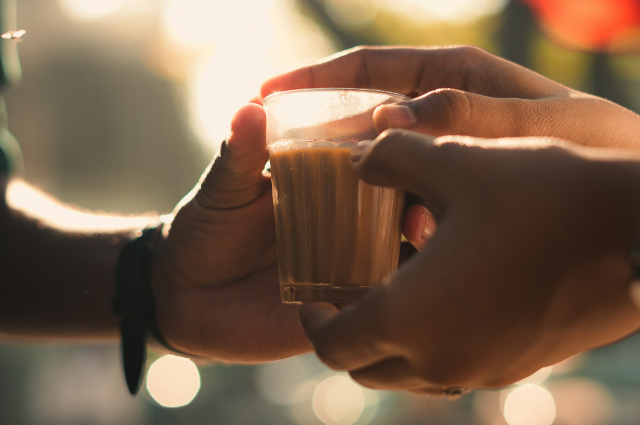
Every morning, millions of Indians reach for their steaming cup of chai, believing they're simply embracing a cherished ritual. But what if it is told to you that the temperature of that comfort, not the beverage itself, could be slowly damaging your health? Recent evidence compels us to reconsider not what we drink, but how we drink it.
The Science Isn't New, But this Confirmation is true
In 2016, the International Agency for Research on Cancer made a classification that should have shaken the world awake about very hot beverages above 65°C earned a "probably carcinogenic" rating, placing them in Group 2A alongside indoor wood smoke. Yet this warning seemed abstract, detached until now.
The February 2025 UK Biobank study, examining nearly half a million participants, has brought this threat uncomfortably close to home. The findings are unambiguous, and about those consuming eight or more very hot drinks daily have to face nearly six times the risk of oesophageal squamous cell carcinoma. Even moderate exposure doubled the risk for some individuals. This isn't happening in some far-off laboratory; it's happening in everyday Western populations, validating decades of evidence from Asia, Africa, and South America.
For India, where chai fuels billions of mornings and roadside stalls serve boiling cups as gestures of hospitality, this research demands our attention.
Understanding the thermal damage inflicted on the Oesophagus
The mechanism is misleadingly simple yet devastating. When liquids above 65°C repeatedly contact the thin lining of the oesophagus, they inflict thermal damage, which is by essentially burning the tissue. Think of it as giving some minor burns, day after day and year after year.
This chronic thermal injury triggers some biological responses, persistent inflammation weakens protective barriers, accelerates cell turnover, and creates conditions where DNA replication errors can slip through unchecked. Over decades, what began as a harmless preference for piping-hot beverages transforms into precancerous changes, eventually resulting as oesophageal cancer.
Animal experiments starkly demonstrate this progression exposing animals to 70°C water accelerates oesophageal tumour development. Human epidemiological data confirms the pattern that larger drinks and more frequent consumption multiply the harm, with bigger sips spiking internal tissue temperature more intensely.
What makes this particularly serious is that the damage accumulates invisibly. You don't feel the cellular chaos happening deep within your oesophagus. There's no immediate pain signalling danger and just the familiar warmth of your morning ritual, repeated thousands of times.
The Cultural Context We Cannot Ignore
This isn't merely a medical issue; it's deeply cultural. In Iran, traditional chai ceremonies involve beverages served at temperatures that would burn most Westerners. South American mate circles prioritise communal sharing of near-boiling infusions. Indian tapri stalls take pride in serving chai so hot it requires careful sipping through pursed lips.
These traditions embody hospitality, connection, and heritage. Studies first flagged concerning patterns in these regions where decades ago, but many dismissed them as confused by other factors that include tobacco use, alcohol consumption, and dietary patterns. Even in Western populations without these puzzling variables, the temperature-risk relationship persists.
The evidence now spans continents and cultures, united by a single factor, which is habitual consumption of very hot liquids creates measurable cancer risk regardless of geography or ethnicity.
A Problem With Remarkably Simple Solutions
Here's what makes this health threat uniquely manageable, and the solution requires no medication, no expensive intervention, no dramatic lifestyle renovation. Simple cooling habits can eliminate the risk entirely.
Let your drink sit for a few minutes until it drops below 58°C and a temperature that remains pleasurable but poses no thermal injury risk. Stir vigorously to distribute heat. Blow gently across the surface. Remove takeaway lids that trap heat and slow cooling. Add cold water or milk.
These aren't revolutionary strategies; they're minor adjustments that preserve everything we love about our beverages and the flavour, the comfort, the ritual, while removing the danger. A 2025 review confirms that coffee and tea offer beneficial antioxidants at safe temperatures, becoming hazardous only when consumed boiling hot.
The risk scales with exposure volume that includes daily multiples of very hot drinks, elevating odds far beyond occasional consumption. This suggests a dose-response relationship, where modifying frequency and temperature can dramatically reduce individual risk.
The Personal and Public Health Imperative
Consider the broader implications. In regions where hot drink consumption is widespread, this preventable risk rivals other recognised carcinogens. Cooling habits could affect oesophageal cancer rates dramatically, much like helmet laws reduced head injuries and a simple intervention with profound population-level benefits.
For families, the approach becomes even more compelling. Picture grandparents instinctively blowing on chai before offering it to grandchildren, modelling protective behaviour seamlessly woven into cultural tradition. This isn't abandoning heritage; it's evolving it with wisdom.
The stakes are personal too. Oesophageal cancer carries a grim prognosis, often diagnosed late because early symptoms are subtle. Prevention through temperature awareness represents genuine empowerment and a modifiable lifestyle factor entirely within individual control, unlike genetic predispositions or environmental carcinogens beyond personal reach.
Moving Forward With Informed Choices
No credible recent research challenges the temperature-cancer link. Instead, accumulating evidence reinforces it, with outlets emphasising that it's the thermal exposure, not caffeine, tannins, or the beverage itself, driving the threat. This clarity is liberating. We needn't abandon our beloved chai or coffee. We simply need to approach them with slightly more patience, allowing moments for cooling that protect our future selves.
The Logical Indian perspective resonates here that this represents a gentle push towards empathetic self-care, harmonising age-old joys with evidence-based wisdom. By embracing cooler sips, we model kindness not just to ourselves but to loved ones and communities, fostering dialogue and positive public health outcomes.
. . .
References: