
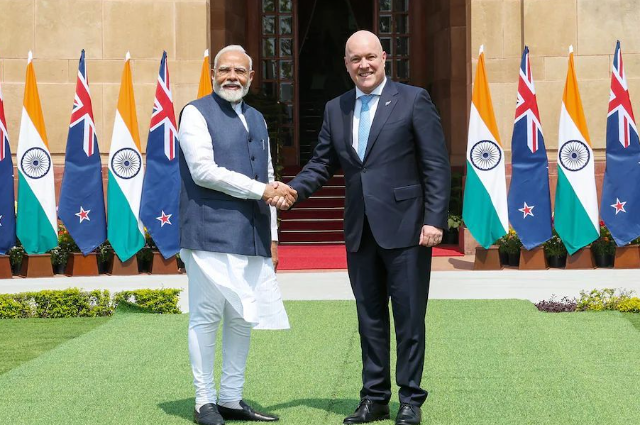
The landscape of global trade is shifting from broad, multi-national conglomerates towards a surgical, high-impact bilateral agreement. In this evolving theatre, the recent trade pact between India and New Zealand stands out as a "once-in-a-generation" alignment. This is not merely a bureaucratic exchange of signatures; it is a sophisticated recalibration of the Indo-Pacific economic corridor. By producing the core tenets of the agreement, which span zero-tariff access, professional mobility, and a massive $20 billion investment commitment, we see the emergence of a partnership that prioritises long-term structural growth over short-term transactional gains.
This deal represents the "New India" approach to diplomacy, which is assertive in seeking market access for its massive labour force and manufacturing sector, yet fiercely protective of its domestic agricultural and dairy foundations. It is a masterpiece of "calibrated liberalisation."
The Zero-Tariff Revolution: Levelling the Playing Field
The headline of this agreement is undoubtedly the "zero-tariff" regime. New Zealand has committed to eliminating tariffs on 100% of Indian exports. While New Zealand is a high-income, developed economy, it has historically maintained protective barriers in sectors where India excels. By removing these hurdles, the deal provides an immediate shot in the arm for Indian MSMEs (Micro, Small, and Medium Enterprises).
Currently, Indian exporters in the textiles, leather, gems, and jewellery sectors face varying levels of duty that often squeeze profit margins in a competitive global market. The transition to a zero-duty structure means that "Brand India" becomes the default choice for New Zealand importers. On the flip side, India has been equally strategic. By offering duty-free access to 54.3% of New Zealand’s exports, India is targeting essential industrial inputs, such as cooking coal, logs, and wool. These are not luxury goods; they are raw materials that lower the cost of production for Indian manufacturers, effectively subsidising the "Make in India" initiative through smarter sourcing.
Talent as a Commodity: The TEE Visa and Professional Mobility
Perhaps the most innovative aspect of this deal and the one that distinguishes it from traditional Free Trade Agreements (FTAs) is its focus on human capital. In the modern economy, the movement of people is as vital as the movement of pallets. The creation of the Temporary Employment Entry (TEE) Visa pathway is a landmark achievement for Indian diplomacy.
With a dedicated quota of 5,000 visas annually for skilled Indian professionals, the deal addresses the specific demographic needs of both nations. New Zealand gains access to India’s world-class talent pool to fill its labour shortages, while India secures high-value global exposure for its workforce. What is truly unique, however, is the inclusion of "iconic occupations." By carving out space for AYUSH practitioners, Yoga instructors, Indian chefs, and classical music teachers, the agreement recognises India’s cultural soft power as a formal economic asset.
Furthermore, the protections offered to the Indian student community in New Zealand are by ensuring 20-hour weekly work rights and post-study work visas of up to four years for PhD students to ensure that the "brain drain" of yesterday becomes the "brain gain" and "remittance strength" of tomorrow. This isn't just trade; it’s a long-term investment in the global Indian diaspora.
The $20 Billion Promise: Fueling the Future
Trade deals are often criticised for focusing only on what is sold today, ignoring what is built tomorrow. This pact silences that criticism with an overwhelming $20 billion investment commitment from New Zealand over the next 15 years. Historically, New Zealand’s Foreign Direct Investment (FDI) into India has been modest. This commitment signals a total paradigm shift.
This capital is not intended for passive stock market play; it is directed towards the infrastructure of the future. From green energy initiatives to digital tech startups and logistics, this $20 billion will serve as the "venture capital" for the Indo-New Zealand relationship. For India, which aims to become a $5 trillion economy, this steady stream of high-quality investment provides the fiscal stability needed to upgrade ports, railways, and digital grids.
The Defensive Masterstroke: Protecting the Heart of India
In any trade negotiation, what you don't give away is just as important as what you gain. For years, the primary sticking point between these two nations was the dairy sector. New Zealand is a global dairy powerhouse; India is the world’s largest producer of milk, supported by millions of small-scale farmers. A blanket opening of the dairy market would have been catastrophic for rural India.
The editorial genius of this deal lies in its exclusion of sensitive sectors. By keeping milk, cheese, curd, and butter off the liberalisation list, Indian negotiators have protected the livelihoods of roughly 80 million dairy farmers. Instead of a "trade" in dairy, the two nations have agreed on a "Productivity Partnership." New Zealand will provide technical expertise in cold-chain logistics and orchard management by helping Indian farmers reduce waste and increase yields without being outcompeted by foreign imports. It is a transition from competition to collaboration.
The India-New Zealand FTA is more than the sum of its parts. It is a roadmap for how a developing giant and a developed island nation can find common ground. It balances the high-tech demands of the 21st century, like IT services and professional visas, with the ancient necessities of the 19th century, like coal and wool.
By securing 100% tariff-free access, 5,000 professional visas, and a $20 billion investment pipeline, India has not just signed a trade deal; it has secured a partner in its journey towards becoming a global superpower. The focus now must shift from the ink on the paper to the boots on the ground. For Indian businesses, the message is clear that the road to the Pacific is open, and it is paved with zero duties and unlimited potential. This is, indeed, a once-in-a-generation opportunity that could redefine India’s economic footprint in the Southern Hemisphere for decades to come.
. . .
References: