
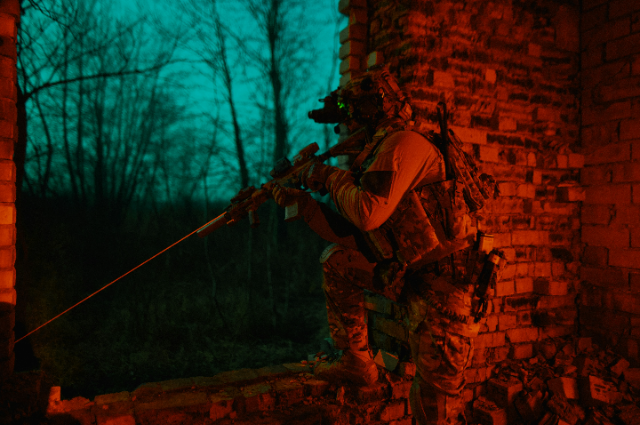
Photo by Aleksey Kashmar on Unsplash / Representative Image
On the night of January 19, 2026, a young soldier gave his life for his country. His name was Havildar Gajendra Singh, a member of the Indian Army's Special Forces. He was killed during a counter-terrorism operation called Operation TRASHI-I in the Singhpora area of Kishtwar district, Jammu and Kashmir. Eight other soldiers were injured in the same encounter. His death is not just a military event. It is a deeply human story of one who deserves more than a few lines in a news report.
What Happened That Night
The operation began on a Sunday evening. The Indian Army received specific intelligence that terrorists were hiding in the hilly, forested areas around Singhpora. Based on this information, security forces moved in and set up a barrier, essentially that was surrounding the area to prevent anyone from escaping. As troops closed in on the suspected hideouts, they came under heavy gunfire from the militants. What followed was a long and dangerous exchange of fire that went on through the night.
During this fierce battle, Havildar Gajendra Singh was fatally wounded. He lost his life while carrying out his duty. At the same time, at least eight other soldiers were injured. They were quickly evacuated from the area and taken to military medical facilities. Officials confirmed later that all the injured jawans were in a stable condition and were being closely monitored by doctors.
The Indian Army acknowledged his sacrifice publicly. The official statement from the White Knight Corps paid tribute to him, saying he made the "supreme sacrifice" while carrying out his mission. Senior officers and fellow soldiers remembered him as a brave and committed professional who showed great courage under fire. His family was informed, and full military honours were accorded to him as per tradition.
Who Was Havildar Gajendra Singh?
Behind the official statements and the operational reports, there was a man. Havildar Gajendra Singh was a trained Special Forces soldier. These are not ordinary assignments. Special Forces operations are among the most dangerous tasks in the military. They require years of training, constant readiness, and the ability to function in situations where the risk of death is very real. Every time such a soldier steps into the field, he knows what could happen. And yet, he goes anyway.
His death reminds us that military operations are not abstract events happening on a map. They are carried out by real people sons, fathers, brothers and who leave their families and put their lives on the line so that others can live in safety.
What Is Operation TRASHI-I?
Operation TRASHI-I is part of a larger effort by the Indian Army to dismantle militant groups that are active in the remote, mountainous regions of Jammu and Kashmir. These operations are planned carefully. They rely on intelligence gathered over time, and they require close coordination between different units of the Army and other security agencies.
Kishtwar district, where this encounter took place, is located in the Jammu region. The area is known for its difficult terrain and deep valleys, thick forests, and steep hills. This kind of landscape makes it easier for militants to hide and harder for security forces to operate. Because of this, the region has seen repeated militant activity over the years.
Security forces have been stepping up their operations in recent months, especially during the winter season. Winter is a time when militant groups sometimes try to move across borders or regroup in remote areas. The Army wants to stop this before it becomes a bigger threat. Search operations in the Singhpora area were still ongoing at the time of reporting, and additional soldiers were sent in as a safety measure.
A Separate Tragedy: The Doda Accident
Around the same time, another painful incident came to light. On January 22, an Army vehicle fell into a deep gorge in the nearby Doda district of Jammu and Kashmir during a search operation. The accident killed ten soldiers and injured eleven others severely. One of those killed was Havildar Shailendra Singh Bhadauria, who belonged to the 4th Rashtriya Rifles and was originally from Bhind in Madhya Pradesh.
His body was brought back to his home village with full military honours. Hundreds of villagers, family members, and officials gathered to pay their respects. His six-year-old son performed the final rites. Bhadauria had joined the Army in 2005 and is survived by his wife, two daughters, and a son. His grandfather and brother had also served in the military.
This accident shows that the dangers faced by soldiers in Jammu and Kashmir go beyond enemy fire. Even routine operations in such harsh terrain carry serious risks. The mountains do not forgive mistakes.
Thinking Beyond the Headlines
It is easy to read these stories and move on quickly. The news cycle moves fast, and another headline will soon take its place. But that is not fair to the people behind these reports.
Every soldier who dies in the line of duty leaves behind a family that will carry that loss forever. Every injured soldier will spend weeks or months recovering physically and mentally. These are not numbers in a report. They are real lives, real pain, and real grief.
At the same time, it is important to understand why these operations happen. The security situation in Jammu and Kashmir demands action. Militant activity, if left unchecked, can lead to even greater loss of life, including among civilians. The soldiers who carry out these missions are doing so to protect the country and its people.
But lasting peace in this region cannot come from military action alone. It also needs dialogue, understanding, and efforts to address the deeper reasons why conflict continues here. Until that broader work is done seriously, soldiers like Havildar Gajendra Singh will continue to make the ultimate sacrifice and their families will continue to bear a burden that no country should ever take for granted.
. . .
References: