
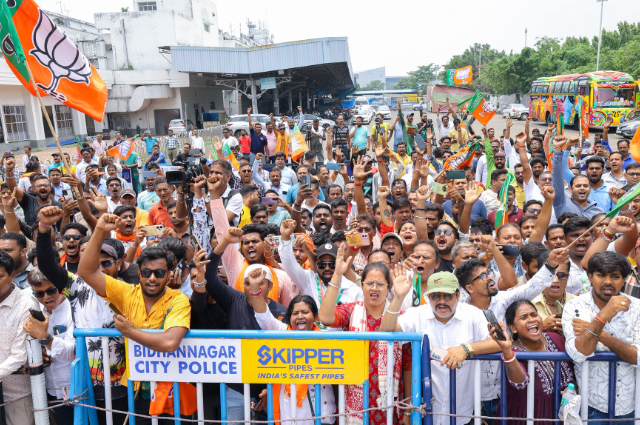
The political landscape of West Bengal has undergone a dramatic transformation. What was once a stronghold for the Trinamool Congress (TMC) has been completely reshaped by an unprecedented electoral wave. The recent election results represent more than just a change in leadership; they signal a fundamental shift in the state's power dynamics.
A Historic Mandate
The most striking takeaway from the election is the sheer scale of the TMC's loss. In a performance described as "zero gravity," the party essentially lost its weight and influence across eight entire districts. For a party that governed with an iron grip for fifteen years, seeing its presence evaporate in former strongholds is an overwhelming blow.
The numbers tell a story of a total sweep. The Bharatiya Janata Party (BJP) secured a massive majority with 207 seats, while the TMC was relegated to just 80. The most symbolic moment of this collapse was the defeat of Chief Minister Mamata Banerjee in her own constituency of Bhabanipur. When the face of a movement loses its home turf, it sends a clear message that the mandate for change was absolute.
Defiance in the Face of Defeat
Despite the clarity of the numbers, the immediate aftermath has been marked by high-stakes political drama. Mamata Banerjee has taken a path of total defiance, refusing to resign from her post. Her stance is built on the narrative that the election was not a fair fight.
She has characterized the results as a "moral victory" and accused the central government and the Election Commission of manipulating the outcome. By refusing to follow the traditional protocol of stepping down after an electoral loss, she has created a constitutional stalemate, asserting that her "moral" authority remains intact regardless of the official vote count.
Tensions Within the National Alliance
The shockwaves from Bengal have traveled quickly to New Delhi, causing friction within the national "INDIA" bloc. Rahul Gandhi has publicly backed Banerjee’s claims of a "stolen" mandate, framing the BJP's victory as a threat to democratic institutions.
However, this support has exposed deep cracks within the Congress party. While Gandhi calls for unity, many Congress leaders on the ground have been seen celebrating the TMC's downfall. This internal conflict highlights a difficult reality that while the national parties want to stand together against the BJP, the local rivalries in Bengal are too deep to ignore. The TMC’s loss is, for some opposition members, a long-awaited opportunity to reclaim their own lost ground.
Internal Revolt and the Blame Game
While the TMC leadership blames external forces, a different conversation is happening behind closed doors. Within 48 hours of the defeat, the party began to face a revolt from within its own ranks. Local leaders are openly criticizing the "main leaders," suggesting that the party has become disconnected from the people. The feedback from the ground suggests that the defeat wasn't just a result of a strong opposition, but a failure of the TMC to address internal issues and public dissatisfaction. The "invincibility" of the party has been shattered, and the internal blame game suggests that the party is now fighting for its own survival.
A New Chapter for Bengal
West Bengal now enters an era of deep uncertainty. The BJP is set to form its first government in the state, while the outgoing leadership remains in a state of protest. This election has redrawn the map of Bengal politics. It has been shown that no fortress is solid and that political tides can turn with devastating speed. As the state moves forward, the focus will be on whether the transition of power can happen smoothly or if the defiance of the outgoing leadership will lead to further instability. One thing is certain that the Bengal we knew for the last decade and a half has changed forever.
. . .
References: