
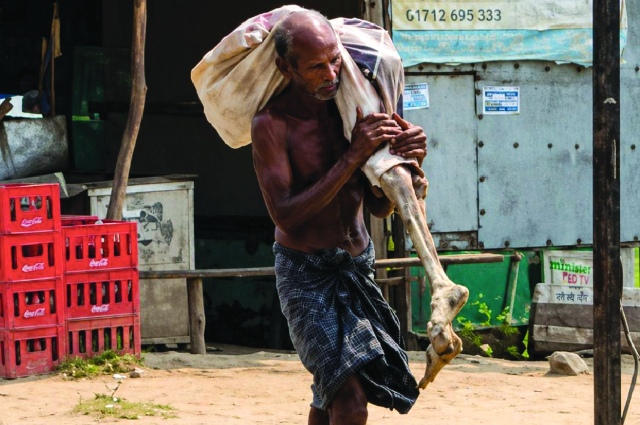
In the heart of Odisha’s Keonjhar district, a scene unfolded that sounds less like a news report and more like a haunting piece of literature. Jitu Munda, a member of a local tribal community, unearthed the skeletal remains of his sister and carried them nearly three kilometers to a branch of the Odisha Gramya Bank. This was not an act of protest or a ritual of grief; it was a desperate attempt to satisfy a bank manager’s demand for "proof of death." The incident serves as part of a system that often values the reliability of a rubber stamp over the dignity of a human being.
The tragedy began with a modest sum of money of approximately ₹19,300. To a large financial institution, this is a rounding error. To Jitu Munda and his family, it was a vital resource left behind by his deceased sister, Kalara Munda, who had passed away months earlier. When Jitu first approached the bank to claim the balance, he was met with the rigid logic of modern bureaucracy.
Because he was not the registered nominee on the account, the bank required two specific documents: a death certificate and a legal heir certificate. To a bank official, these are the basic tools of risk management, designed to prevent fraud and ensure that funds reach the rightful owner. However, for a man like Jitu, where living in a remote area with limited literacy and virtually no experience directing the web of government offices, and these documents were effectively locked behind a door he didn't have the key to.
From Frustration to Digging up
Reports indicate that Jitu had visited the bank multiple times, pleading with officials to release the funds so he could manage his family's needs. Each time, he was turned away for lack of "proof." In a heartbreakingly literal interpretation of this requirement, Jitu decided that if the bank did not believe his words, they would have to believe his eyes.
He returned to the site where his sister had been buried in January, dug up her remains, and placed the skeleton in a sack. He then embarked on a grueling three-kilometer walk in the heat, eventually arriving at the bank to present the physical evidence of his sister's passing. The shock of the bank staff and the local public was immediate, but the shock of the observer should be directed elsewhere, towards a system so disconnected from the people it serves that a man felt his only recourse was to dig and bring the dead body.
The Paradox of Proactive Administration
What followed the public outcry was a display of administrative efficiency that was as impressive as it was frustrating. Once the story hit the headlines and the visual of a man with a sack of bones became a liability for the state, the hurdles that had stood in Jitu's way for months vanished overnight.
Within twenty-four hours, local revenue officials visited Jitu’s home. The vague death certificate and legal heir certificate were processed and issued on the spot. The bank manager, previously bound by "unavoidable regulations," facilitated the immediate disbursement of the ₹19,300 to Jitu and other legal heirs. The district administration provided an additional ₹30,000 from the Red Cross Fund as a gesture of support.
This rapid resolution proves a troubling point where the documents were never "impossible" to get; the system simply lacked the will to help a marginalized citizen obtain them until the situation became a public embarrassment.
The Hidden Cost of the "Paper Trail"
This incident highlights a massive "empathy gap" in the way institutional procedures are applied in rural India. For the tribal population, the distance between a village and a government office isn't just measured in kilometers; it's measured in the ability to speak the language of bureaucracy. When we demand that the most vulnerable members of society produce complex documentation to access their own meagre savings, we are essentially taxing their poverty.
The bank’s standard defense that they are protecting the depositor’s interests holds no water when that "protection" results in a brother having to unearth his sister's dead body. True financial inclusion is not just about opening accounts; it is about ensuring that the exit ramp for those accounts is as accessible as the entrance. It requires bank managers and local leaders to act as facilitators rather than gatekeepers.
A Call for Institutional Empathy
Jitu Munda’s walk to the bank was a scream for visibility. In his mind, he was invisible to the bank manager, and his sister’s death was a non-event because it wasn't written on a piece of paper with a government seal. By bringing the skeleton into the bank, he forced the institution to look at the reality it had been ignoring.
We must move towards a governance model that prioritizes "outreach-based verification" over "paper-based hurdles." If a bank manager in a rural branch knows that a claimant is struggling with literacy or access, the protocol should trigger a referral to a local revenue officer to assist the citizen, rather than a flat rejection.
The "eagerness" shown by the Odisha government after the humiliation broke should be the standard speed of service, not a damage-control mechanism. While Jitu finally received the money, the trauma of having to unearth a loved one is a debt the system can never truly repay. This case should serve as a permanent reminder to every desk-bound official that behind every "missing document" is a human being whose dignity is not for sale, and whose grief should never be subjected to the indignity of a bureaucratic deadlock.
The ₹19,300 is now in Jitu’s hands, but the image of that sack remains a haunting symbol of how far we still have to go to ensure that the law serves the living without desecrating the dead.
. . .
References: