
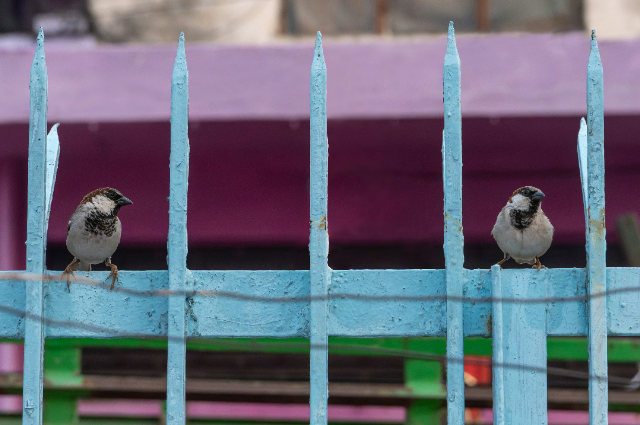
Photo by Rishabh Nishad on Unsplash
In the existing maze of modern Chennai, where glass towers replace trees and traffic drowns birdsong, something remarkable is happening. Sparrows, those tiny brown birds once usually found in our courtyards and gardens, are making a comeback. This isn't a natural phenomenon or government initiative, it's the fruit of one engineer's profound belief that we owe nature a debt we've been too long ignoring.
When Passion Meets Purpose
Ganeshan D wasn't born a conservationist. He was an IT professional, someone who understood algorithms better than avian habitats. Yet somewhere between spreadsheets and software, he recognised an uncomfortable truth where the house sparrow, humanity's companion for millennia, was disappearing from urban India. By 2020, when he established Koodugal Nest alongside his wife Shanthini, sparrow populations in cities had fallen nearly 60 percent. The causes were painful due to modern habitat loss, pollution, architectural changes that left no nesting spaces, and the silent erasure of insects that sparrows feed their young.
What sets Ganeshan apart isn't just his concern but his conviction that small actions, multiplied across communities, can reverse environmental decline. His philosophy is deceptively simple, as nature sustains us entirely, yet we return almost nothing. Koodugal Nest emerged from this imbalance as both remedy and reproof.
Building More than Boxes
Over one year, the initiative distributed approximately 15,000 nest boxes across Tamil Nadu. These aren't merely wooden shelters; they're educational tools, conservation instruments, and symbols of collective responsibility. Through partnerships with 35 schools, Ganeshan transformed students into conservation agents. More than 10,000 children constructed these boxes with their own hands, learning biology, empathy, and citizenship simultaneously.
Fourteen-year-old Prayukta's reflection captures this transformation by watching sparrows care for their young revealed nature's interconnected web, inspiring her to continue this work into adulthood. This is environmental education, not through textbooks but through tangible participation, an approach that cultivates curiosity rather than awareness.
The results speak volumes. Northern Chennai has witnessed a 30 percent increase in sparrow populations, while certain areas report a 15 percent rebirth. These aren't just statistics; they represent mornings filled with chirping, balconies visited by nesting pairs, and ecosystems gradually regaining balance. Sparrows consume vast quantities of insects, contributing to natural pest control. Their return signals not just species recovery but ecosystem restoration.
Expanding the Vision
Koodugal Nest's work extends beyond nest boxes. The organisation has established eight sparrow sanctuaries serving as educational hubs where children learn life skills while developing environmental consciousness. These spaces embody Ganeshan's larger philosophy for conservation, which shouldn't be separate from daily life but woven into it. By creating environments where humans and sparrows coexist harmoniously, these sanctuaries demonstrate that urban development needn't mean ecological devastation.
Technology complements grassroots action in Koodugal's model. The organisation is developing mobile applications for biodiversity monitoring, enabling students, volunteers, and citizens to track sparrow populations and contribute data to research. This fusion of community engagement with scientific methodology creates a replicable framework for urban conservation and one that's democratic, data-driven, and deeply local.
Recognition has followed achievement. Ganeshan received the Tamil Nadu Leadership Award and the Inspiro Award, acknowledgements of how individual dedication can spark collective transformation. More significantly, Koodugal Nest has been invited to present at the British Ornithologists' Union conference at the University of Nottingham in March 2026, offering a global platform to showcase how local and community-led initiatives can achieve lasting impact.
Science Behind the Success
Academic validation came through research published in Biotropica examining urban sparrow challenges. The study revealed that despite increased parental care, urban sparrows experience lower flying success due to environmental stressors. This scientific foundation reinforces Koodugal's practical interventions, demonstrating that nest boxes address real biological needs rather than serving merely symbolic purposes.
Corporate partnerships with Chennai Willingdon Corporate Foundation, Genesys, SurveySparrow, and Lennox India Technology have provided resources for scaling operations. The initiative now covers ten additional districts across Tamil Nadu, with expansion plans reaching beyond Chennai. Prime ministerial recognition has accelerated this growth, transforming what began as one man's vision into a nationwide movement.
Challenges and Reflections
Success hasn't come without obstacles. Securing initial funding, building community awareness, and convincing schools to integrate conservation into the curriculum required persistent advocacy. Yet these challenges shaped Koodugal's approach, making it more collaborative and responsive to community needs. Ganeshan's engineering background proved invaluable as he approached conservation with systematic planning, measurable outcomes, and iterative improvements.
The sparrow's plight reflects broader environmental degradation. Urbanisation, while economically necessary, often proceeds without ecological consideration. Buildings lack ledges where birds once nested. Pesticides eliminate insects that constitute sparrows' primary food source. Native plants, essential for supporting insect populations, vanish from manicured lawns and parks. Ganeshan's work addresses these interconnected problems through holistic solutions that recognise sparrows as indicators of environmental health rather than isolated species.
Looking forward to Chennai streets, balconies, and schoolyards
As sparrows return to Chennai's streets, balconies, and schoolyards, they carry implications beyond their small bodies. Their comeback demonstrates that urban environments can support biodiversity if we choose to make space for it. It proves that education rooted in action cultivates deeper environmental consciousness than abstract instruction. Most importantly, it shows that individuals, armed with vision and community support, can reverse ecological decline.
Ganeshan's work poses uncomfortable questions for urban India. If one engineer with limited resources can restore sparrow populations across multiple districts, what might be achieved with broader societal commitment? If schoolchildren can become effective conservationists, why do our educational systems prioritise environmental awareness so poorly? If corporate partnerships can fund nest box distribution, why aren't more businesses investing in urban biodiversity?
The sparrow's return to Chennai isn't merely ecological success; it's a challenge to reimagine our relationship with urban nature. It suggests that our cities needn't be ecological deserts but can become spaces where human development and environmental health coexist. As Koodugal Nest expands its work nationwide and shares its methodology internationally, the organisation offers a hopeful vision that our smallest birds might teach us the largest lessons about coexistence, responsibility, and the possibility of restoration.
In Ganeshan's own words, sparrows thrive near human settlements, and protecting them preserves nature's balance. Perhaps the profound truth here is that by protecting sparrows, we restore balance within ourselves, remembering that we belong to ecosystems rather than standing apart from them. The chirping gradually returning to Chennai's mornings carries this reminder that what we owe nature isn't separate from what we owe ourselves and future generations.
. . .
References: