
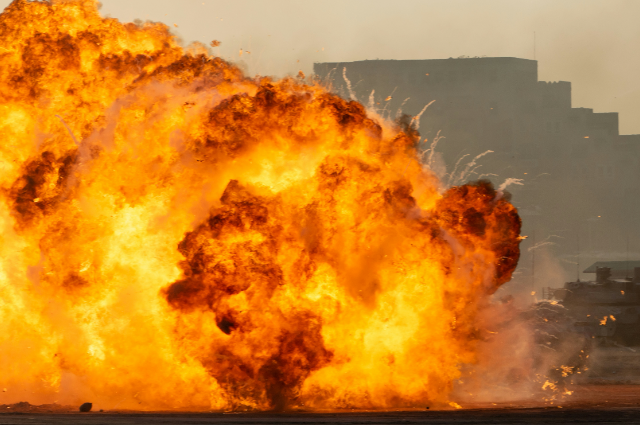
Photo by Jeff Kingma on Unsplash
The Middle East has seen many wars. But what began on the night of February 28, 2026, was something that most analysts thought they would never see in their lifetimes, which is a direct, full-scale military attack by the United States and Israel on Iran. Three days later, the world is still trying to make sense of what just happened, and more importantly, what comes next.
How It Started?
After months of close coordination with Israel and weeks of direct negotiations with Iran, President Trump ordered the attack. Senior administration officials said Iran's efforts to rebuild its nuclear program after American strikes last year, combined with Iran's refusal to discuss its ballistic missile program, represented an "intolerable risk" to the United States.
That rationale has already been challenged. A U.S. arms control group called the attack an "illegal war of choice," saying it was not authorised by Congress as it violated international law, and was based on false claims. "Trump and his aides claimed, without credible evidence, that Iran had restarted its nuclear program and had enough available nuclear material to build a bomb within days," the group said, calling all three of those claims false. Regardless of the justification, the bombs fell and the consequences have been overwhelming.
A Supreme Leader Is Gone
The single most consequential event of this conflict so far is the killing of Iran's Supreme Leader, Ayatollah Ali Khamenei a man who had ruled the country for 37 years. He was killed in the opening Israeli strike, dubbed "Roar of the Lion," alongside other senior Iranian leaders. His death has left a nation that he ruled for decades in hopelessness, possibly heading towards a period of great turmoil. Two opposing factions, where protesters pushing for greater freedom and the heavily armed security forces confronting them are now struggling for power, while American and Israeli bombs continue to fall.
Iran's president declared Khamenei a martyr and vowed revenge. In Tehran's streets, mourners gathered in squares to grieve. But in southern Iran, something else happened a crowd toppled a monument dedicated to the Islamic Republic's founder, Ayatollah Khomeini, a symbol that not every Iranian is mourning the same way.
The Human Cost
The numbers are brutal and still climbing. The Iranian Red Crescent reported 555 people killed in Iran since the start of the war, across 131 cities. Three American service members were also killed, and at least 11 people died in Israel.
There have been costly mistakes, too. Three American F-15 fighter jets were shot down by Kuwaiti air defenses in what the U.S. military called "an apparent friendly fire incident," though all six crew members ejected safely and were recovered in stable condition. That kind of chaos and allies accidentally shooting down each other's planes tells that something important about how fast this situation is moving, and how little control anyone really has over it.
War is Spreading
Iran is not simply absorbing the blows. It is firing back widely and indiscriminately. Explosions have been reported in Abu Dhabi and Dubai in the UAE, Doha in Qatar, Bahrain's capital Manama, Kuwait City, and Oman's capital Muscat. A major Saudi oil refinery in Ras Tanura was shut down after a suspected Iranian drone strike, sending oil prices surging roughly 10%, while European gas prices rose more than 25%. Stock markets across Europe and Asia dropped. The global economy is already feeling the heat.
A British air base in Cyprus was also struck by a suspected Iranian drone, and France said it had reinforced its military posture in the eastern Mediterranean. This is no longer just a Middle Eastern conflict, it is pulling in the wider world.
The Nuclear Question Nobody Can Answer
Perhaps the most unsettling development of all is what the UN's nuclear watchdog, the IAEA, has said. Its director general warned that with missiles still flying, a "possible radiological release with serious consequences" cannot be ruled out, noting that Iran and other countries in the region have operational nuclear power plants and research reactors that, if hit, could force evacuations of areas as large as or larger than major cities. This is not a hypothetical. It is a live warning from the world's top nuclear authority.
What Happens Now?
President Trump has said the military operation will continue "until all of our objectives are achieved," and that this could take "four weeks or less," though he acknowledged more American casualties are possible.
Meanwhile, China called for an immediate ceasefire, calling the U.S.-Israel attack an "undisguised assault on sovereignty." Russia expressed condolences. Europe urged diplomacy. None of it, so far, has slowed anything down.
The EU's foreign policy chief offered perhaps the most honest assessment of the moment, Khamenei's death is a "defining moment" in Iran's history, with an "open path to a different Iran" now possible, but what comes next remains deeply uncertain.
That uncertainty is the story. A region already on edge is now in open warfare. A nuclear-armed neighbourhood is trading missiles. Airports are closed. Oil prices are rising. The world is watching, nervously, to see whether anyone is brave enough or wise enough to stop this before it becomes something far worse.
. . .
References: