
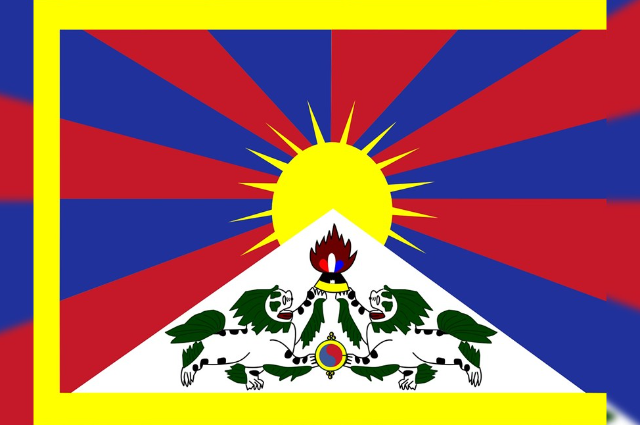
Image by Clker-Free-Vector-Images from Pixabay
Tibetan protesters detained in Delhi after unfurling Tibet flags brought a sensitive political issue into the security zone around a major international meeting. The protest targeted a Chinese delegation attending the BRICS Summit 2026 in the capital, while police action quickly became the second focus of the story. The incident raises three linked questions: what happened near the BRICS venue, why Tibet flags carry political weight, and how police handle protests near visiting foreign delegations.
What Happened When Tibetan Protesters Challenged the Chinese Delegation
According to ThePrint, police detained three Tibetans near an underpass close to Bharat Mandapam on Friday morning. The protesters had unfurled Tibetan flags while opposing the visit of the Chinese delegation for the BRICS summit.
The report said security around Bharat Mandapam had already been tightened, with Delhi Police and paramilitary forces deployed in the area. A member of Students for a Free Tibet told ThePrint that four or five people had been detained, creating a second figure within the same report.
The group said the protest challenged Beijing's account of multilateral cooperation. Its statement called for attention to Tibet, alleged human rights violations, and objections to projects such as the proposed Medog Dam. These claims were made by the group and should not be treated as findings by Indian authorities or the news reports.
ThePrint also reported a separate peaceful march in north Delhi's Majnu Ka Tila area. Around 250 to 300 members of the Tibetan Youth Congress and Tibetan nationals reportedly took part, holding banners and posters against the Chinese president's visit.
The reported detentions became the immediate focus
The detention count differs across the available accounts. ThePrint's headline and police source put the number at three, while The Hindu reported that five people were detained. ThePrint also carried a statement from Students for a Free Tibet saying that four or five people had been taken by police.
The reports do not settle whether the figures reflect different times, separate groups, or different understandings of who was detained. They also do not establish the duration of detention, the police station involved, or whether every person detained was a protester.
The available reports do not confirm formal charges, arrests, court proceedings, or convictions. For that reason, "detained" remains the more accurate term unless later police or court records show that criminal proceedings followed.
The BRICS setting amplified the protest's visibility
BRICS is a group that brings together major emerging economies for political and economic cooperation. A Chinese delegation attending a BRICS summit therefore receives more security attention than a private or local visit.
ThePrint said the protest took place near the venue where the summit was being held. That location gave the action a direct connection to the visiting delegation and increased the chances of police intervention, media coverage, and diplomatic attention.
The same flag can carry different meanings for different audiences. Activists may view it as a demand for attention to Tibet. Police may see it as a security concern near a restricted venue. Diplomats may read it as a public challenge during a sensitive visit.
What the Incident Shows About Protest Rights and Diplomatic Security
Political expression may be protected, but protests can face limits around sensitive venues, security zones, and visiting delegations. The legality of a detention depends on facts such as the protest location, permissions, conduct, police orders, and the law used. The reports do not provide enough information to decide whether the police response was lawful or proportionate. They also do not establish that the protesters committed an offence. Detention alone does not prove guilt.
Police must protect public order and visiting officials, while protesters retain rights that cannot be removed without proper grounds. Any final judgment should rely on official records or a court decision, not on the detention number alone. The reported actions are that protesters unfurled Tibet flags and opposed the Chinese delegation. The number detained remains disputed between the reports, and the available accounts do not settle the legal status of those held.
Detention should not be treated as proof of guilt. The incident also should not be described as a change in India-China relations unless officials issue statements or later diplomatic events show a direct effect.
Precise wording matters in cross-border disputes. Phrases such as "ThePrint reported three detainees" and "The Hindu reported five people detained" preserve the difference without presenting an unresolved figure as fact.
Conclusion
The Tibetan protesters detained in Delhi had unfurled Tibet flags near the BRICS venue while protesting the Chinese delegation's visit. The action brought Tibetan activism into a heavily guarded diplomatic setting and led to police detentions. The reports do not confirm formal charges, arrests, or the legality of the police action. The clearest next step is to check a Delhi Police statement or court record before concluding what happened. Around issues involving Tibet, China, and international delegations, accurate numbers and careful language matter as much as the protest itself.
References