
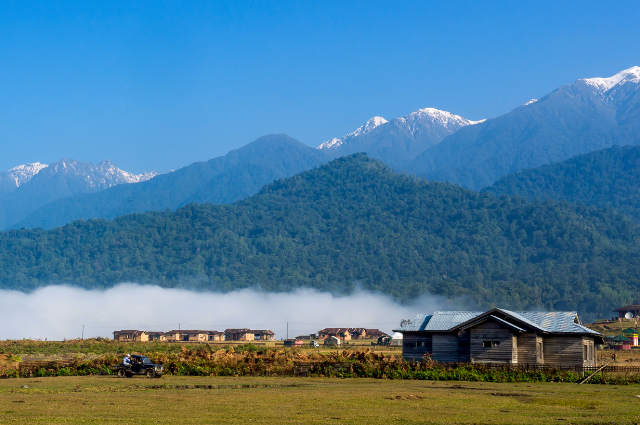
In the remote valleys of Arunachal Pradesh, the Siang River has become the centre of a growing conflict between development ambitions and indigenous communities' concerns. The proposed Siang Upper Multipurpose Project (SUMP), an 11,200 MW hydropower and water-storage project, is being considered as one of India's most strategically significant infrastructure initiatives. Yet, for many residents living along the river, the proposal represents more than a development opportunity. It raises the possibility of losing ancestral land, traditional livelihoods, cultural heritage and an environment that has sustained generations.
The controversy intensified in October 2026 when opposition to preliminary survey activities led to protests, arrests and clashes in the region. A shutdown was subsequently called across Siang, Upper Siang and East Siang districts on November 2, following the detention of individuals associated with the anti-dam movement. What began as a disagreement over technical surveys has consequently developed into a wider debate about public participation, indigenous rights and the limits of development.
A River That Carries More Than Water
The Siang is the Indian stretch of the Yarlung Tsangpo River, which originates in Tibet before entering Arunachal Pradesh and eventually flowing into Assam, where it forms part of the Brahmaputra River system. Its importance extends beyond geography and electricity generation.
For the Adi community, among the major indigenous communities of Arunachal Pradesh, the river is deeply connected to cultural identity, traditional knowledge, agriculture and everyday life. Forests, farmland and waterways form an interconnected landscape that supports local livelihoods and community traditions.
Consequently, the possibility of a large reservoir creates concerns that cannot be measured simply in hectares of land or the number of buildings affected. A village is not merely a collection of houses. It represents generations of relationships, customary practices, sacred places and shared histories.
This explains why sections of the local population remain opposed even though the government maintains that the project has not received final construction approval.
Understanding the Scale of the Proposed Project
The Siang Upper Multipurpose Project is proposed with an installed capacity of approximately 11,200 MW. However, its significance is not limited to electricity generation. The project is also being considered for strategic water storage and flood moderation, particularly in view of developments on the upper reaches of the river.
The project remains at the pre-feasibility report (PFR) stage. This involves preliminary technical investigations to understand the feasibility, engineering requirements and possible consequences of the proposed development. It is not equivalent to final approval or the commencement of construction.
Nevertheless, these investigations have become a major source of disagreement. The government considers surveys necessary to understand the project's feasibility, while opponents fear that allowing drilling and other preparatory activities could gradually make the project difficult to resist.
This difference in perception reveals a fundamental problem: an activity that authorities regard as a technical exercise may be viewed by residents as the beginning of an irreversible transformation.
The Human Cost: Displacement and Cultural Loss
One of the strongest objections raised by protesters concerns the potential submergence of villages and agricultural land. Representatives of the opposition movement have estimated that around 27 villages could be completely submerged, with several dozen more facing indirect impacts. These figures should be treated as reported estimates rather than a confirmed assessment, since the final impact would depend on the project's design and technical findings.
Even the possibility of displacement creates serious concerns. Families could lose agricultural fields, orchards, access to forests, fishing resources and established community networks. Relocation may provide alternative housing, but it cannot automatically recreate the cultural and social environment in which communities have lived for generations.
India's experience with large dams and infrastructure projects has demonstrated that compensation alone does not always restore livelihoods. Rehabilitation must consider long-term income security, access to essential services, cultural continuity and the rights of affected communities.
For the Siang Valley, these questions must be addressed before decisions are made, rather than after displacement becomes unavoidable.
The Environmental Questions Cannot Be Ignored
The proposed project also raises important environmental questions. The Siang flows through a biologically rich Himalayan landscape where forests, river ecosystems and wildlife habitats are interconnected.
A reservoir of this scale could potentially alter natural river flows, sediment movement, aquatic habitats and downstream ecological conditions. Changes in the river's seasonal behaviour could affect agriculture, fisheries and communities that depend on its natural flow.
The region's seismic vulnerability makes careful geological and engineering investigations particularly important. Large infrastructure projects in earthquake-prone mountain regions require detailed assessments of slope stability, seismic risks, landslides and dam safety.
These are not arguments that automatically establish that the project is unsafe. Rather, they highlight the need for transparent, independent and scientifically credible assessments before any construction decision is considered.
Environmental impact assessments should also examine cumulative effects, including the combined consequences of multiple hydropower developments within the same river basin.
The Strategic Dimension: China's Upstream Plans
The debate surrounding SUMP has another important dimension: India's strategic concerns regarding China's upstream hydropower development.
The Yarlung Tsangpo originates in Tibet, where China has announced plans for a massive hydropower project. Developments upstream have raised questions in India about future water security, information sharing, river flows and the possibility of sudden changes in water availability.
Indian policymakers view the Siang project as a potential means of strengthening the country's ability to manage water resources, regulate flows and improve energy security.
Supporters also point to the possibility of employment, improved infrastructure and economic development in a relatively remote region.
These concerns deserve serious consideration. However, national security cannot become a reason to overlook the rights and legitimate concerns of the people living closest to the proposed project. Strategic planning must also recognise that local communities are stakeholders in national development, not obstacles to it.
Consent Must Come Before Confrontation
At the heart of the controversy lies a question of public trust. Protest organisations have alleged that survey activities and security deployments proceeded without adequate consultation with affected residents. Government representatives have maintained that the current exercise is preliminary and that no final decision to construct the dam has been taken.
On November 25, the Arunachal Pradesh government initiated village-level discussions with representatives of communities in areas identified for preliminary survey activities. However, opposition groups continue to demand that the surveys be stopped until their concerns are addressed.
These developments indicate that dialogue has become essential to resolving the impasse.
Meaningful consultation must go beyond formal meetings. Residents should receive accessible information about the project's proposed design, possible submergence areas, environmental consequences, rehabilitation provisions and long-term benefits. Independent experts should be allowed to explain technical findings, while community representatives must have a genuine opportunity to question assumptions and present alternative perspectives.
The process should also clarify applicable legal safeguards, environmental clearance requirements and the rights of affected tribal communities.
Development Must Not Come at the Cost of Identity
The Siang controversy presents India with a difficult but important choice. Hydropower, water security and infrastructure development are legitimate national priorities. Equally important are environmental protection, indigenous rights and the preservation of communities whose histories are inseparable from the land.
A successful development model cannot be measured only by megawatts generated or investment attracted. It must also be judged by whether local people retain their dignity, livelihoods, cultural identity and confidence in the institutions making decisions about their future.
The Siang River has sustained communities long before the proposed dam became a national discussion. Its future should not be determined through confrontation, incomplete information or decisions made without meaningful participation.
Whether the project eventually proceeds, changes in design or is abandoned, one principle must remain non-negotiable: the people who live along the river must have a meaningful voice in determining its future.
A river that connects communities, ecosystems and generations should not become a permanent battlefield between development and the people it is meant to serve. True progress begins when national ambition and local rights are treated not as opposing forces, but as equally important responsibilities.
References
- ThePrint – A Dam, Ancestral Land & a Standoff: Arunachal's Siang Villages Battle a National Project (October 28, 2026) - https://theprint.in
- The Indian Express – Siang Dam Project: Planned to Counter China, Why It Is Being Opposed in Arunachal (October 29, 2026) - https://indianexpress.com
- The New Indian Express – Arunachal Shutdown Call Over Arrests of Protesters Opposing 11,200 MW Siang Dam (November 1, 2026) - https://www.newindianexpress.com
- NDTV – Explained: Why Even a Pre-Feasibility Survey Triggered Arunachal Anti-Dam Protest (November 22, 2026) - https://www.ndtv.com
- The Times of India – Arunachal Government Starts Village-Level Talks on Siang Dam, Protest Groups Hold Ground (November 25, 2026)] https://timesofindia.indiatimes.com
- Ministry of Environment, Forest and Climate Change – Rajya Sabha Answer on Environmental Effects of the Upper Siang Hydropower Project (August 1, 2024) -https://sansad.in
- Down To Earth – Protests Against Siang Mega-Dam in Arunachal Pradesh Turn Violent (October 25, 2026 - https://www.downtoearth.org.in